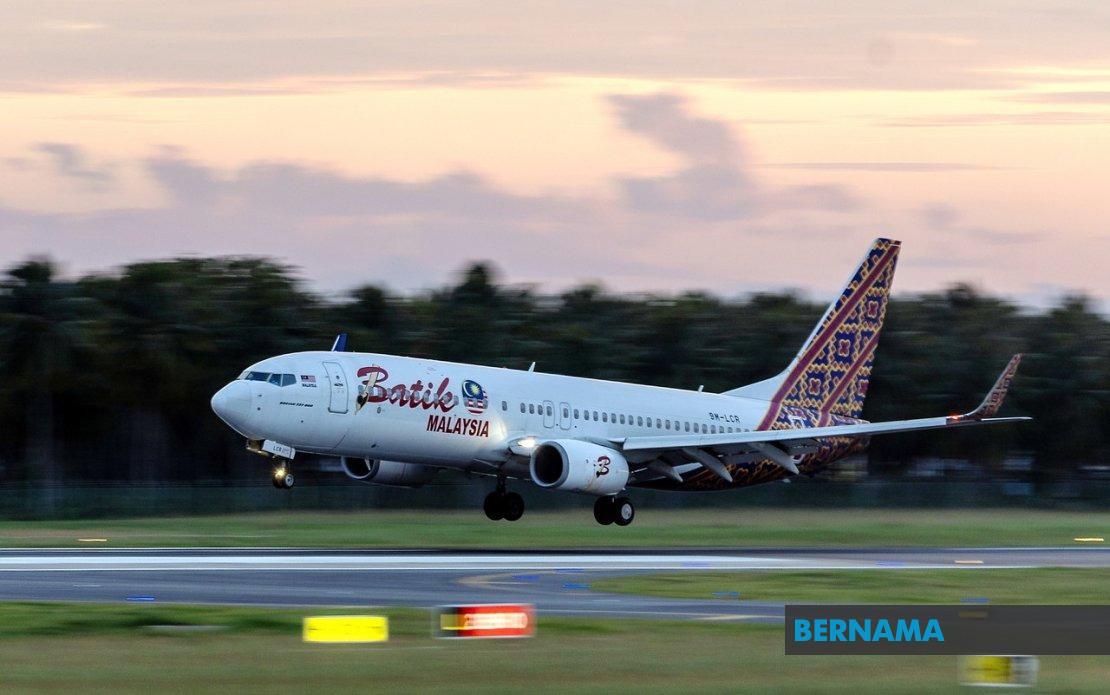
Batik Air will expand its Bintulu-Kuala Lumpur route to operate two flights daily beginning July 20, marking a significant response to sustained public complaints about service cuts and escalating airfare costs. Tourism, Arts and Culture Minister Datuk Seri Tiong King Sing confirmed the announcement on Friday, emphasising that the schedule reflects careful coordination with the carrier following months of feedback from residents and business stakeholders across the region.
The decision represents a compromise between government expectations and operational constraints identified by the airline during negotiations. Tiong had initially pursued a three-daily-flight arrangement but acknowledged that Batik Air opted for a phased approach, commencing with one additional departure to test market conditions and assess capacity requirements. This pragmatic positioning leaves room for further expansion, with the minister indicating that a third daily service could be implemented if passenger volumes justify the investment.
Under the new timetable, passengers departing Kuala Lumpur will have flight options at 10:00 am and 2:30 pm, while those returning from Bintulu can choose departures at 1:10 pm and 5:40 pm. The staggered scheduling addresses commuter requirements across business, education, medical, and tourism sectors, providing flexibility that was absent during the period of reduced service. The timing accommodates both same-day business travel and overnight options, recognising Bintulu's diverse connectivity needs.
Bintulu's emergence as an economic hub underpins the heightened demand for air services. Beyond its traditional timber and palm oil industries, the port city has attracted petrochemical investments and diversified commercial activities that generate regular business travel. The city's strategic position within Sarawak's development corridor has also increased medical tourism and educational migration, creating sustained passenger flows that single-daily services could not accommodate. These economic fundamentals suggest that demand projections underlying the expanded schedule rest on solid foundations.
The preceding months witnessed genuine friction between government and operator regarding service standards. Public frustration crystallised around two interconnected grievances: the sudden withdrawal of flights that residents had grown dependent upon, and the corresponding surge in ticket prices that made alternative transport modes uncompetitive. These dual pressures prompted Tiong to leverage his portfolio's influence, framing the issue as one affecting not merely convenience but broader economic competitiveness and social equity. His repeated communications with Batik Air management transformed what might have remained a routine commercial matter into a policy priority.
Government intervention in aviation route development reflects a broader Southeast Asian pattern wherein state officials increasingly treat air connectivity as infrastructure essential to regional development. Malaysia's experience mirrors efforts across Indonesia, Thailand, and the Philippines where ministers have similarly negotiated with carriers to maintain or expand routes serving secondary cities. The Bintulu case demonstrates that such negotiations, whilst sometimes criticised as heavy-handed, can yield practical outcomes when backed by credible political pressure and framed within sustainable economic logic rather than pure subsidy.
Tiong's public statements emphasise that price moderation must accompany frequency expansion. He has urged Batik Air to recognise that reasonable fares stimulate demand, ultimately benefiting operator revenues through higher passenger volumes. This argument reflects conventional network airline economics, though its persuasiveness depends partly on carrier confidence that markets will indeed expand rather than merely redistribute journeys across new time slots. The minister's implicit threat that inadequate pricing could trigger further government involvement suggests this negotiation continues beyond the current announcement.
The reliability dimension emerged prominently in discussions, with Tiong specifically requesting that increased frequency not come at the expense of operational consistency. Recent years have seen Malaysian aviation marked by schedule volatility, with carriers frequently cancelling or rescheduling flights due to weather, maintenance, or demand fluctuations. For business passengers and students, such unpredictability imposes costs that extend beyond ticket pricing, potentially driving modal shifts toward overnight bus services or private transport. The minister's emphasis on stable operations signals that government will monitor not merely frequency metrics but actual service delivery.
Looking forward, the three-flights-per-day scenario that Tiong identifies as contingent upon passenger growth deserves scrutiny. If the July 20 expansion proves successful, market momentum could relatively quickly justify a third service, potentially creating a fully-served route spanning morning, midday, and evening departure windows. However, realising that potential requires more than airline agreement; it necessitates sustained economic activity in Bintulu, competitive positioning relative to alternative transport, and passenger willingness to pay fares that support additional frequency without subsidies. These conditions, whilst plausible, remain subject to broader economic currents.
The Bintulu-Kuala Lumpur route also carries symbolic significance within Malaysia's internal aviation network. Sarawak's integration into the broader domestic air system has historically lagged Peninsular routes, partly reflecting smaller population bases and lower route-level profitability. Successful expansion of regional services therefore aligns with national objectives around inclusive development and equitable access to modern transport infrastructure. A twice-daily service from Bintulu to Kuala Lumpur, sustained through commercial viability rather than permanent subsidy, strengthens the case for similar interventions elsewhere in the country's less-populated corridors.

