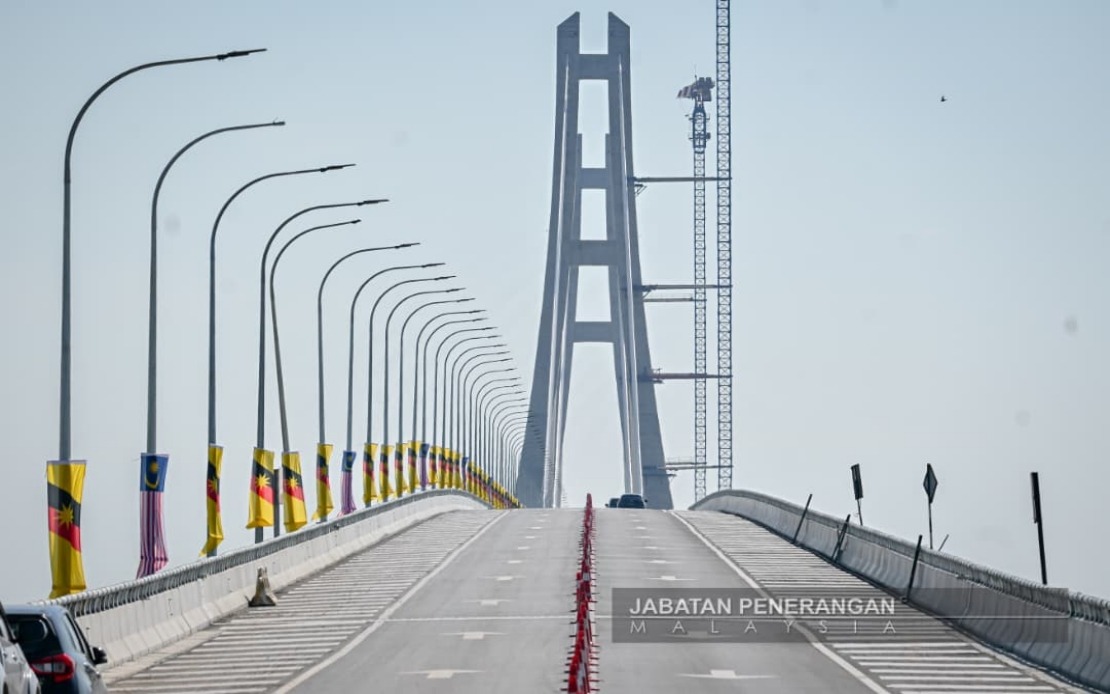
Sarawak has crossed a symbolic threshold with the official opening of the Batang Lupar 1 Bridge, a RM848.75 million infrastructure project that Premier Tan Sri Abang Johari Tun Openg characterised as transformative for the state's development trajectory. The 4.844-kilometre bridge spanning Malaysia's longest river represents far more than concrete and engineering—it crystallises the state government's commitment to modernising connectivity across its sprawling coastal regions and unlocking economic potential that has long remained constrained by geographical barriers.
The bridge terminates a lengthy period of vulnerability for communities living along the Batang Lupar's banks. For generations, residents across Sebuyau, Betong, Sri Aman and Samarahan relied on ferry services to traverse the river, an arrangement fraught with operational challenges and genuine safety concerns. Abang Johari acknowledged the human dimension of this infrastructure project, noting that ferry operations had precipitated tragic incidents driven by the river's notorious tidal conditions, where powerful waves and strong winds periodically rendered crossing impossible. The construction mandate itself emerged organically from grassroots advocacy, as elected representatives at multiple political cycles championed community demands for a permanent, reliable transport solution.
The bridge functions as a cornerstone component of the broader Sarawak Second Trunk Road (STRR) initiative, an ambitious RM3.21 billion programme designed to weave together the state's fragmented coastal communities through a cohesive modern highway network. This positioning transforms the Batang Lupar crossing from an isolated monument into a linchpin within an integrated transport ecosystem. Deputy Premier Datuk Amar Douglas Uggah Embas, who oversees infrastructure and port development, articulated the systemic impact: the completed network will compress the Kuching-Sibu corridor from 396 kilometres to 252 kilometres, delivering a 144-kilometre reduction in travel distance. When extrapolated across thousands of daily journeys by commuters, commerce and supply chains, such distance compression translates into measurable time savings, reduced fuel consumption and lower logistics costs benefiting businesses throughout the coastal zone.
The practical implications of instantaneous access merit closer examination. Previously, travellers enduring ferry waits occasionally spanning an hour now traverse the same passage in minutes, weather-independent and schedule-reliable. This reliability multiplies opportunities for economic integration. Agricultural producers in inland areas now face dramatically reduced transaction costs when moving perishable goods to coastal markets and export hubs. Investors contemplating manufacturing operations across these districts encounter enhanced labour mobility and supply-chain predictability. Healthcare networks can coordinate more effectively when patient transfers no longer depend on tide tables and weather forecasts.
Sarawak's coastal districts have historically occupied peripheral positions within the state's economic geography, their development hampered by both distance from Kuching's commercial nucleus and internal fragmentation. The bridge-anchored transport infrastructure reconfigures this spatial arrangement fundamentally. Sebuyau, Betong, Sri Aman and Samarahan transition from isolated pockets into integrated components of a functioning coastal economic corridor. Agricultural production—traditionally the economic foundation for these communities—becomes more competitive when transportation costs decline. Tourism potential similarly expands when accessibility improves; communities with cultural and natural attractions previously inaccessible to casual visitors now enter the realistic orbit of day-tripping tourists from Kuching and beyond.
The Malaysia Book of Records recognition of the Batang Lupar 1 Bridge as the nation's longest river-spanning structure carries symbolic weight beyond mere statistics. Such designations attract media attention and regional interest, potentially elevating Sarawak's profile as an infrastructure innovator within Southeast Asia's development narrative. For state policymakers, this positioning supports broader messaging around Sarawak's capability to execute large-scale, complex engineering projects—credentials valuable when competing for private investment and federal infrastructure allocations.
The STRR project's scheduled completion by 2030 indicates this bridge represents the opening act of a multi-year transformation. Subsequent phases will progressively solidify the coastal corridor's connectivity. This extended timeline creates both opportunities and risks: sustained political commitment across election cycles becomes essential to prevent cost overruns and schedule slippage that have plagued previous Malaysian infrastructure initiatives. The Batang Lupar 1 Bridge's successful delivery and early performance will establish momentum and credibility crucial for mobilising support for subsequent phases.
From a Malaysian federalism perspective, this project exemplifies Sarawak's leveraging of devolved infrastructure authority to address state-specific development challenges. Unlike peninsular states largely dependent on federal trunk road programming, Sarawak's constitutional arrangements grant it substantial autonomy in infrastructure planning and execution. The STRR demonstrates how this autonomy, combined with sustained revenue from petroleum resources, enables the state government to pursue development visions that might languish indefinitely awaiting federal prioritisation. Neighbouring Sabah inevitably observes Sarawak's progress with strategic interest, potentially reinforcing demands for comparable coastal connectivity investments.
Regional competitiveness within Borneo also contextualises this infrastructure milestone. Sarawak's enhanced coastal connectivity creates new comparative advantages relative to Indonesian Kalimantan and Brunei, potentially influencing labour migration patterns and investment flows. Enhanced accessibility to Sarawak's ports in Sri Aman and Samarahan may improve their competitive positioning against Indonesian alternatives, though realising such potential requires parallel investments in port infrastructure and institutional efficiency.
The ferry's permanent retirement represents a poignant transition point for coastal communities accustomed to this mode of transport. Local communities reliant on ferry operations—operators, labourers, small merchants whose livelihoods depended on port activities—now confront displacement and economic readjustment. While the bridge creates broader opportunities, transition support mechanisms ensuring affected workers access retraining and alternative employment become essential policy considerations often overlooked in infrastructure-centric development narratives.
Agricultural constituencies across the coastal districts should experience tangible benefits as market access improves. Sarawak's agricultural sector, traditionally oriented toward domestic and regional markets, operates at disadvantage against more accessible production regions. Enhanced connectivity to Kuching's commercial infrastructure and export gateways potentially reverses long-standing competitive handicaps. Smallholder producers of rice, sago and aquaculture products previously accepting unfavourable price terms due to limited market alternatives may discover improved negotiating positions.
The bridge also carries symbolic resonance for Malaysian infrastructure capability. Amid periodic concerns about cost escalation and implementation challenges affecting major national projects, the Batang Lupar 1 Bridge's delivery within budgeted parameters and targeted timeline offers reassuring precedent. This success potentially influences confidence among international development financiers and private investors regarding Malaysian infrastructure execution capacity.
Looking forward, the Batang Lupar 1 Bridge's opening represents a waypoint rather than a destination in Sarawak's infrastructure transformation. Realising the full development potential of the coastal corridor depends on complementary investments in industrial estates, telecommunications infrastructure, educational facilities and healthcare services that leverage improved connectivity to concentrate economic activity. The bridge has removed the primary physical constraint; maximising its development dividend requires coordinated policy action across multiple domains.

