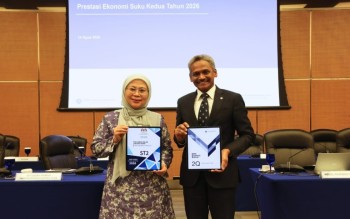
Bank Negara Malaysia has no intention to revise its 2026 gross domestic product growth forecast downward, remaining confident that the Malaysian economy will expand around five per cent for the full year. Governor Datuk Seri Abdul Rasheed Ghaffour made the declaration following the release of second-quarter GDP figures, which showed the economy expanding faster than anticipated. Any formal revisions to the central bank's growth projections will typically occur during the annual federal budget announcement, he explained, signalling that BNM's outlook remains firm at this stage of the year.
The economy grew 6.0 per cent in the second quarter of 2026, outperforming the Department of Statistics Malaysia's preliminary estimate of 5.8 per cent. This marks the third consecutive quarter of growth exceeding BNM's own expectations, reinforcing the central bank's assessment that underlying economic momentum remains sound. The stronger-than-forecast performance reflects resilience across multiple sectors and spending categories, suggesting Malaysia's economy has found footing despite regional and global uncertainties that have troubled other trading nations throughout 2026.
BNM attributes much of this outperformance to the breadth of growth across the economy rather than concentration in any single sector or spending category. Domestic demand has emerged as the primary engine, with household consumption particularly robust. The external sector has also contributed meaningfully, particularly in the previous quarter, providing a counterbalance to any softness in domestic investment. This diversification matters significantly because it indicates the expansion is not dependent on temporary factors that could reverse quickly, but reflects sustained strength in fundamental demand drivers.
The household consumption component registered 4.8 per cent growth in the second quarter, demonstrating remarkable resilience given the persistent inflationary pressures that have characterised the global economy over recent years. Abdul Rasheed identified income growth as the principal support for consumption, followed by household savings and targeted government policy measures aimed at protecting purchasing power. Notably, he downplayed the role of household borrowing in fuelling consumption, describing it as a relatively minor contributor. This composition is important because it suggests the consumption boom is underpinned by genuine income growth and precautionary savings rather than unsustainable credit expansion that could eventually become problematic.
Export performance has similarly defied concerns about global demand weakness. Both electrical and electronics exports, traditionally Malaysia's heavyweight export category, and non-E&E shipments have expanded during the period. This mix of growth across different product categories suggests Malaysian exporters have successfully navigated the complex global trade environment, retaining competitiveness despite competition from regional peers and supply chain disruptions. Additionally, the information and communications technology services sector has shown expansion, reflecting the economy's gradual diversification away from pure goods exports toward higher-value service offerings.
Yet Abdul Rasheed acknowledged that headwinds remain on the horizon, and BNM is not immune to the risks permeating international markets. Geopolitical tensions and broader global economic uncertainties could exert downward pressure on Malaysian growth as the year progresses into the second half. The central bank's continued confidence in the 5.0 per cent forecast assumes these external risks remain manageable and do not materially disrupt the economic relationship between Malaysia and its major trading partners.
One environmental concern receiving specific attention is the potential impact of El Niño weather patterns on the Malaysian economy. Abdul Rasheed cautioned that any El Niño-related damage would likely manifest only with a time lag and would be largely concentrated within the agricultural sector. However, he urged businesses and households to begin preparing contingency measures now, should drought or other weather-related disruptions intensify. This forward-looking stance reflects BNM's role not merely as an economic forecaster but also as an institution promoting economic resilience through preparedness.
The composition of growth across consumption, investment, exports, and tourism provides reassurance that Malaysia possesses multiple sources of economic dynamism heading into the latter half of 2026. Should one component weaken, others appear positioned to partially offset the decline. This redundancy in growth sources has proven valuable during periods of external volatility, allowing the economy to maintain momentum even when individual sectors face temporary headwinds.
For Malaysian policymakers and investors, the BNM assessment offers qualified optimism amid global uncertainty. The decision to maintain the 5.0 per cent forecast suggests the central bank believes the underlying fundamentals remain intact and current growth momentum is not merely cyclical or based on unsustainable foundations. The income-driven nature of consumption growth and the diversification of export performance lend credibility to this assessment. Nevertheless, the acknowledgement of downside risks from geopolitical tensions and global slowdown indicates BNM is not blind to the challenges that could materialise in coming months, and any significant deterioration in external conditions could ultimately force a revision when budgetary announcements occur later in 2026.

