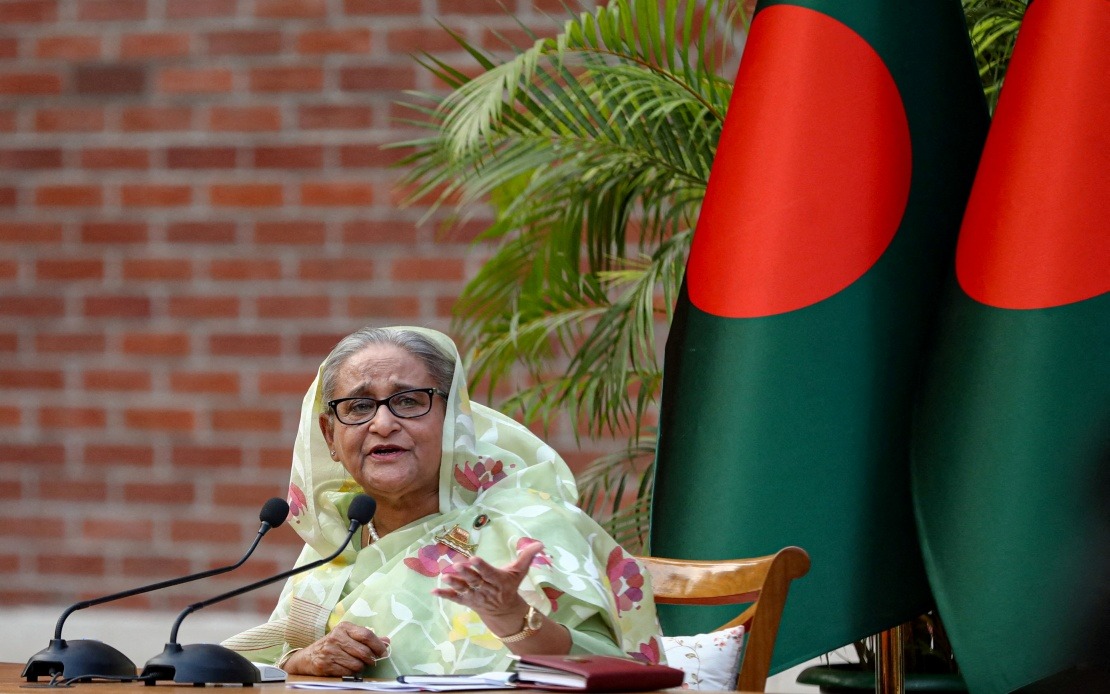
Bangladesh's ousted Prime Minister Sheikh Hasina has declared her unwavering commitment to return home and face the country's courts, even as she confronts a death sentence imposed in absentia and the prospect of extradition from her current refuge in India. The 78-year-old former leader, who fled Bangladesh in August 2024 amid civil unrest, told Kyodo News in a written interview that she remains prepared to accept imprisonment or execution rather than remain in exile. Her public defiance marks a significant political gambit as Bangladesh navigates a fractious transition following the February 2026 general election victory of the opposition Bangladesh Nationalist Party, which now governs under Prime Minister Tarique Rahman.
Hasina's conviction stems from her government's response to a violent student-led uprising that erupted in June 2024 after Bangladesh's high court reinstated a 30 percent job quota reserved for descendants of veterans from the 1971 independence war. The initial protests morphed into a broader anti-government movement that paralysed the nation, culminating in security operations that, according to United Nations estimates, claimed as many as 1,400 lives, predominantly through shootings by state security forces. The war crimes tribunal in Bangladesh sentenced Hasina to death in November 2025 on charges related to crimes against humanity during this crackdown, marking an unprecedented judicial action against a former head of government in the region.
The political aftermath has been equally dramatic, reshaping Bangladesh's institutional landscape and international standing. Following Hasina's departure, an interim administration took control under Muhammad Yunus, the Nobel Peace Prize laureate economist and microfinance pioneer, who was appointed chief adviser after student protest leaders recommended him for the role. The February 2026 election then handed power to the Bangladesh Nationalist Party, a coalition that had remained in opposition during Hasina's tenure. The new government swiftly moved to consolidate power by imposing a comprehensive ban on all activities of Hasina's Awami League party in May 2025, effectively sidelining the faction that had dominated Bangladeshi politics for much of the past two decades.
India's handling of the extradition request adds a crucial dimension to Hasina's predicament. New Delhi received Bangladesh's formal request to hand over the former premier but has not yet complied, citing the need to examine the matter through the lens of established legal and judicial frameworks. This measured approach reflects India's complex relationship with Bangladesh and the broader sensitivities surrounding the treatment of political refugees in South Asia. India's Ministry of External Affairs has maintained that the extradition decision requires careful consideration of bilateral legal obligations and international law, leaving Hasina's status in limbo even as Bangladesh's new authorities press for her return to face trial.
Hasina's response to the death sentence emphasises her steadfast denial of personal culpability for the violence. She has consistently maintained that she never ordered security forces to open fire on protesters, instead asserting that the movement was infiltrated and manipulated by political opponents seeking to destabilise her administration. In her interview, she called for an independent forensic examination by foreign experts to determine how each death occurred and which weapons were used, implying that such evidence might vindicate her and reveal the true chain of command responsible for the killings. This evidentiary gambit suggests that Hasina intends to mount a vigorous legal defence if she does indeed return and face trial, rather than accept the death sentence as final.
Human Rights Watch has cast doubt on the legitimacy of Hasina's trial, noting that her conviction occurred in absentia without her presence to mount a direct defence. The international watchdog has simultaneously stressed the importance of holding those responsible for abuses under her government accountable through proper legal processes. This tension between procedural fairness and substantive justice highlights the broader challenge facing Bangladesh as it seeks to address accountability for the 2024 violence while maintaining democratic credibility. The question of whether Hasina's trial can be reopened or retried with her present remains legally and politically contentious, particularly given the speed with which the war crimes tribunal has moved to convict her without her participation.
For Malaysian and broader Southeast Asian observers, the situation illustrates the volatile dynamics that can emerge when public anger over inequality intersects with state security responses. The original dispute over the job quota system—a means-tested affirmative action mechanism favouring descendants of independence war veterans—triggered protests ostensibly rooted in concerns about meritocracy and fairness in public employment. However, as protests escalated and political rivals saw opportunity, the movement consumed the government that had initially governed the country. This pattern resonates across the region, where demographic pressures, employment competition, and grievances over privilege can rapidly destabilise political regimes if governments misjudge public sentiment or respond with excessive force.
Hasina's record as prime minister encompasses multiple tenures from 1996 to 2001 and 2009 to 2024, during which she pursued infrastructure development and security-focused governance. Her third term, which began in 2009, witnessed major security incidents, including the July 2016 attack on the Holey Artisan Bakery in Dhaka that killed 20 hostages—primarily Italian, Japanese, and Bangladeshi nationals—in one of South Asia's deadliest terrorist assaults. Seven Islamist militants were convicted and initially sentenced to death for the attack, though sentences were later reduced to life imprisonment. The bakery attack underscored the persistent threat of militant extremism in Bangladesh and influenced Hasina's security-oriented approach to governance, which became increasingly controversial as her tenure progressed.
The role of international partners and development agencies adds further complexity to Bangladesh's political crisis. Japan, which has invested substantially in Bangladesh's infrastructure through the Japan International Cooperation Agency, has significant interests in stability. Hasina has invoked regional and global stakes in her appeal for reconciliation, noting that Bangladesh's stability matters not only to its own population but to South Asia, the Bay of Bengal region, and countries like Japan that have committed resources and diplomatic capital to the nation's development. This internationalisation of the Bangladesh crisis suggests that any resolution to Hasina's exile and trial will have implications for how the international community engages with post-transition governance in the country.
Hasina's call for healing without impunity presents a conceptual framework for her potential future role, should she return and secure acquittal or pardon. She has acknowledged that Bangladesh requires both reconciliation and accountability, arguing that proper legal processes—rather than selective justice—must adjudicate crimes committed during her administration. This position allows her to accept some form of transitional justice while rejecting the notion that she personally orchestrated violence. Whether Bangladesh's new government, the courts, or international actors will accept this formula remains uncertain, and her return to Bangladesh could trigger renewed political turbulence if supporters and opponents mobilise around her trial.
Looking ahead, Hasina's stated vision for Bangladesh emphasises democratic restoration and the primacy of popular sovereignty. She has framed the coming decade as an opportunity for recovery and renewal, but only if genuine democracy replaces what she characterises as the current system's democratic deficit. This rhetorical positioning—casting her potential return not as a bid to reclaim power but as a broader project of democratic renewal—may be designed to appeal to elements within Bangladesh society dissatisfied with the new government's performance or concerned about the durability of the interim and elected arrangements. However, whether she can translate such rhetoric into political leverage depends on India's extradition decision, the willingness of Bangladesh's courts to retry her case with procedural fairness, and the shifting balance of public opinion in a nation still processing the trauma of 2024 and the political upheaval that followed.

