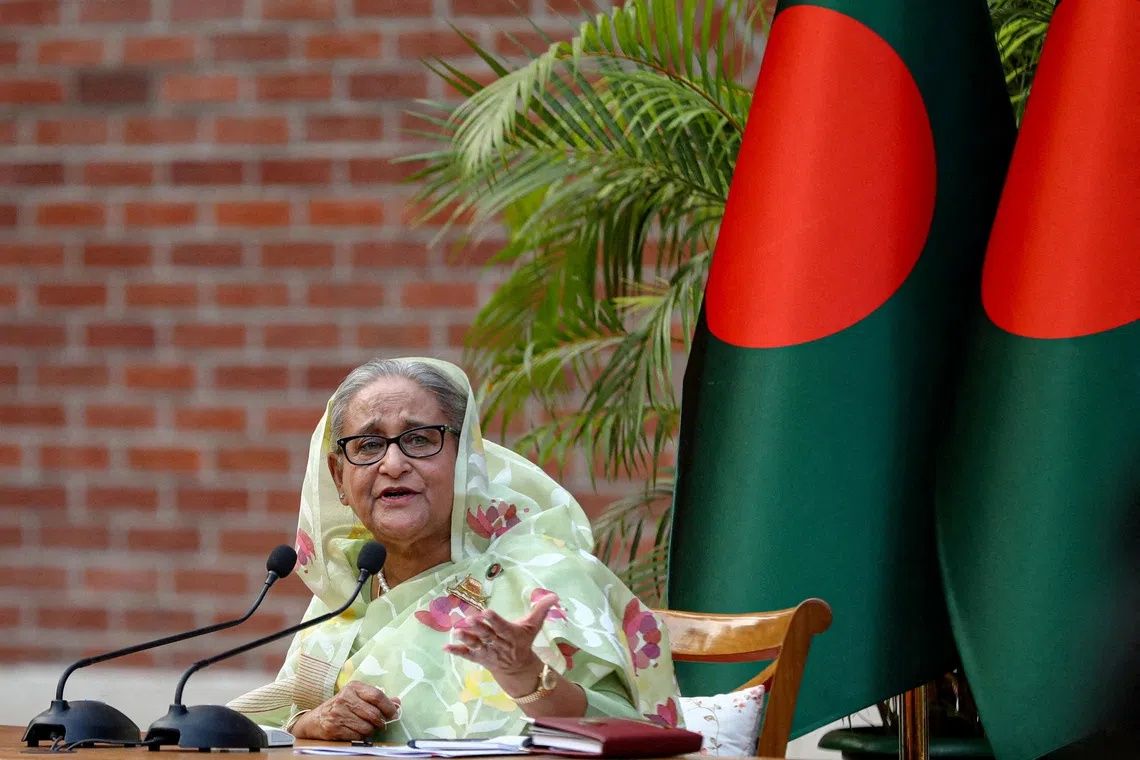
Bangladesh has formally demanded that India clarify its position on exiled former prime minister Sheikh Hasina's planned virtual speech from New Delhi, cautioning that facilitating political activities by a fugitive could undermine the steady improvement in bilateral relations between the two neighbours. The diplomatic intervention marks the first official response from Dhaka to Hasina's scheduled appearance at an event hosted by the Foreign Correspondents' Club of South Asia on August 5, commemorating the second anniversary of the student-driven uprising that unseated her government last year.
The timing of this dispute is particularly sensitive given that Bangladesh continues to pursue Hasina's extradition from India, where she has resided since fleeing the country in August 2024 following weeks of violent civil unrest. Despite facing multiple criminal charges in her home country, Hasina indicated to Reuters in a recent interview that she intends to return to Bangladesh in December, signalling defiance of the legal proceedings against her. This declaration adds another layer of complexity to an already delicate diplomatic situation.
Shama Obaed Islam, Bangladesh's State Minister for Foreign Affairs, articulated Dhaka's position during a press briefing on Monday evening, emphasizing that the government wishes to maintain momentum in its relationship with New Delhi. "We are moving forward with India with a forward-looking approach. We don't want that progress to be affected," Islam stated, before pointedly requesting that India articulate its official stance on the matter. Her comments underscored Dhaka's frustration with what it perceives as ambiguity from New Delhi regarding its obligations to prevent fugitives from conducting political operations on Indian territory.
The Foreign Correspondents' Club of South Asia confirmed that Hasina, aged 78, will deliver her remarks via video link alongside her son, Sajeeb Wazed Joy, and other panellists participating in the anniversary commemoration. The organization did not immediately respond to enquiries regarding the concerns raised by the Bangladesh government, leaving questions unanswered about whether the event organizers will proceed unchanged or consider modifications to their programming.
Islam reiterated that Bangladesh had consistently communicated its concerns to India regarding Hasina and other Awami League leaders issuing political statements from Indian soil. She stressed that Dhaka views such activities as violations of what it understands to be India's own policy commitments. "We do not want India-Bangladesh relations to be harmed by statements from fugitive accused individuals," Islam declared, adding that India had previously indicated expectations that individuals fleeing their home countries would refrain from engaging in political activities within Indian borders.
Although Islam acknowledged that the New Delhi event is not being organized by the Indian government itself, she indicated that Bangladesh would escalate the matter through formal diplomatic channels if necessary. This potential escalation suggests that Dhaka views this issue as sufficiently significant to warrant elevated discussion, potentially involving the foreign ministries of both nations. The statement implies a willingness to pursue the matter persistently if India does not provide satisfactory assurances.
As of the time of reporting, India's foreign ministry had not issued any public response to Bangladesh's concerns, leaving Dhaka's diplomatic démarche effectively unanswered. This silence itself may be interpreted by observers as either a diplomatic stance of non-interference or simply a delay pending internal consideration of the matter.
Bilateral relations between India and Bangladesh have faced considerable strain since Hasina's removal from power, though recent months have witnessed tentative signs of reconciliation. Following Tarique Rahman's government's assumption of office after February's elections, both nations have publicly committed to rebuilding ties through enhanced diplomatic engagement and cooperative initiatives. The handling of the Hasina speech issue will serve as a crucial test of whether this stated commitment to improved relations translates into concrete diplomatic coordination and mutual accommodation on sensitive matters.
Hashina's presence in India since her government's collapse has represented an ongoing irritant in the bilateral relationship. Bangladesh initiated extradition proceedings against her, and in 2025 a domestic court sentenced her to death in absentia for crimes against humanity, citing her responsibility for the 2024 security crackdown. International organizations, including the United Nations, have estimated that the crackdown claimed up to 1,400 lives during the months of civil turmoil that preceded her departure.
Hashina has categorically rejected the death sentence as legally void and lacking legitimacy, framing it as a politically motivated judgment. Her defiant stance, combined with her stated intention to return to Bangladesh in December regardless of the charges against her, suggests that this diplomatic dispute may represent merely one chapter in an ongoing saga likely to generate further tensions between Dhaka and New Delhi. The resolution of how India handles the August 5 speech event will provide important signals about whether New Delhi prioritizes its strengthening relationship with Bangladesh or maintains a hands-off approach to activities occurring on its territory involving fugitives from neighbouring states.
For Malaysia and the wider Southeast Asian region, this diplomatic tension underscores the complex dynamics that emerge when neighbouring nations grapple with political exiles and the principles governing their treatment. It also highlights how internal political upheavals in one country can create ripple effects in regional diplomatic relations, particularly when powerful neighbours are involved. The outcome of this bilateral disagreement between India and Bangladesh may establish precedents relevant to how regional states address similar challenges in the future.

