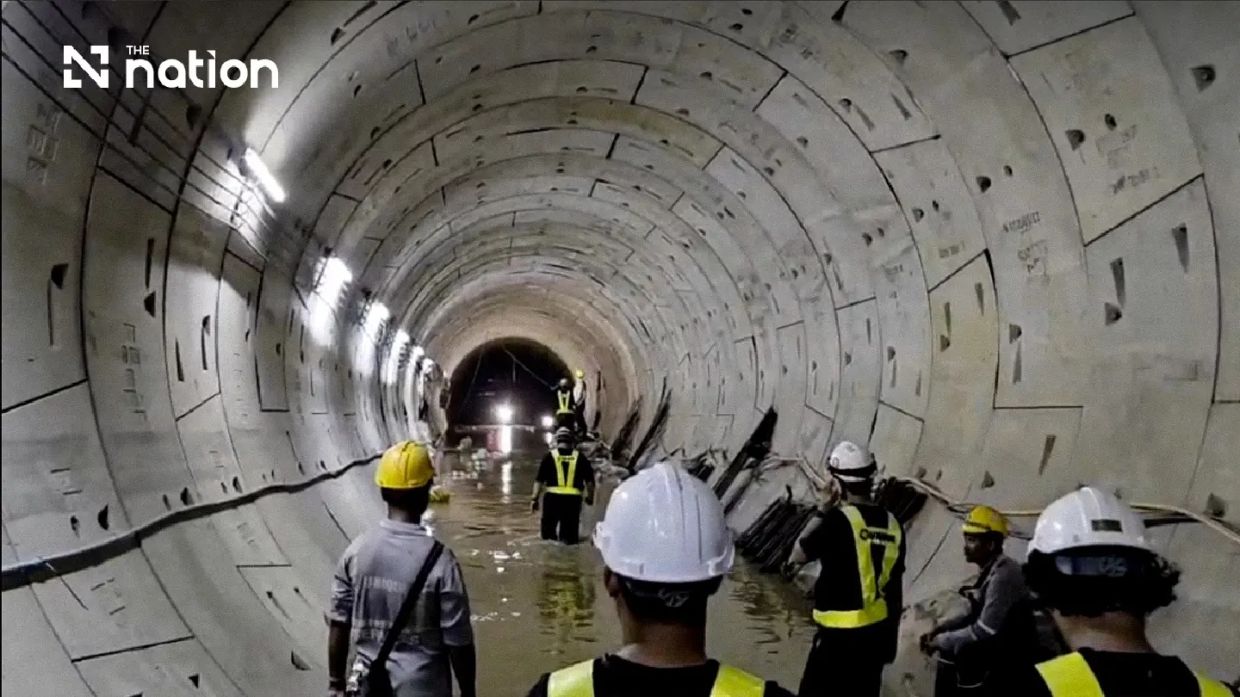
Thailand's ambitious Purple Line mass transit expansion faces renewed scrutiny following water infiltration into a tunnel construction shaft during heavy rainfall on July 8, an incident that mobilized the country's top transport officials and underscored persistent engineering challenges plaguing the project's southern extension. Prime Minister Anutin Charnvirakul arrived at the site near Wongwian Yai shortly after midnight to personally oversee the response, signalling the seriousness with which the government treats problems on this strategically important infrastructure initiative.
The flooding occurred within a construction shaft beneath the tunnel section forming part of the Tao Poon–Rat Burana route, which is an extension along the Kanchanaphisek Ring Road. As Bangkok experienced significant precipitation throughout July 8, water accumulated rapidly within the worksite, necessitating immediate intervention by transport authorities and engineering teams to assess structural integrity and prevent escalation. The incident forced Deputy Prime Minister and Transport Minister Phiphat Ratchakitprakarn, alongside three deputy transport ministers and other senior officials, to converge on the location to evaluate the situation and coordinate emergency protocols.
The troubled section represents part of Contract 4, which encompasses the Saphan Phut–Dao Khanong stretch valued at 14.982 billion baht, or approximately US$447.3 million. Unique Engineering and Construction Public Company Limited, the contractor responsible for this segment, is engaged in tunnel excavation and retaining wall construction—operations inherently vulnerable to water intrusion when rainfall exceeds design parameters. The involvement of senior government representatives, including Mass Rapid Transit Authority of Thailand Governor Gardphajon Udomdhammabhakdi and UNIQ's leadership, reflected concerns about whether existing mitigation measures proved adequate.
Deputy Transport Minister Phattharaphong Phatraprasit declared the situation manageable following preliminary assessment, yet mandated comprehensive technical evaluation to pinpoint the leak's origin and implement corrective action without delay. His instructions required the contractor and MRTA to conduct rigorous surveillance, execute detailed engineering analysis, and take decisive steps preventing structural compromise, public safety risks, or construction delays. Such directives also encompassed regular ministry reporting and adherence to stringent engineering safety protocols—establishing explicit accountability for ongoing oversight.
Prime Minister Anutin characterised the response as engineering-focused, balancing immediate repairs with longer-term preventive strategies. He emphasised that accumulated water levels remained manageable and had not necessitated road closures in surrounding areas. This distinction proved crucial, as Anutin drew explicit comparison to the catastrophic Vajira Hospital incident near the Purple Line project months earlier, where tunnel structural failure triggered ground collapse and surface subsidence—an event that shook public confidence and intensified scrutiny of project management. The prime minister stressed that early detection of the Wongwian Yai leak, coupled with active water level monitoring throughout the day, positioned authorities to respond before conditions deteriorated into structural emergency.
The MRTA installed equipment to measure ground and building movement in proximity to the leak site, with Anutin confirming that no abnormal displacement had been detected during initial checks. He acknowledged that continuous observation would continue, though he anticipated the inspection process would conclude relatively quickly. His emphasis on monitoring rather than structural alarm suggested confidence that engineering safeguards functioned as intended—a measured assessment designed to reassure the public whilst maintaining vigilance.
Anutin's midnight site visit provoked questions about whether memories of the Vajira collapse had driven his personal involvement and the rapid ministerial mobilisation. He responded candidly that the previous disaster had imparted harsh lessons, making authorities fundamentally more alert to risk management, advance public communication, and rapid response mechanisms. Implicit in this acknowledgement lay recognition that the Purple Line project carried accumulated reputational burden; any incident, however contained, threatened public perception of government competence and contractor reliability. The prime minister framed heightened alertness as appropriate institutional learning rather than panic, positioning the aggressive response as evidence of improved governance.
After consulting with the MRTA governor, engineering advisors, and contractor representatives, Anutin reported consensus that controlled conditions could be sustained and repairs accelerated to normalise operations expeditiously. This alignment of stakeholders—rare in infrastructure disputes—suggested either genuine operational confidence or deliberate public messaging. Either way, the declaration represented an attempt to restore investor and public confidence following years of Purple Line complications ranging from cost overruns to construction delays to spectacular failures.
The Purple Line extension itself carries profound implications for Bangkok's transportation network and broader Southeast Asian infrastructure development. For Malaysian readers and regional observers, the project exemplifies both the ambition and fragility of large-scale transit infrastructure in tropical climates. Seasonal monsoon rains, high water tables, and complex geology present perennial challenges that engineering design sometimes inadequately anticipates. The incident near Wongwian Yai illustrates that even advanced contractors and government oversight cannot eliminate unforeseen complications; instead, institutional capacity to detect, respond, and rectify problems becomes paramount.
The multiple responses to this single flooding incident—ministerial visits, contractor directives, monitoring equipment deployment, and regular reporting requirements—represent mechanisms for maintaining project momentum whilst managing embedded risk. Whether such institutional vigilance ultimately succeeds depends on contractor execution, continued monitoring rigour, and weather patterns during remaining construction phases. For Bangkok residents, businesses, and investors dependent on the Purple Line's eventual completion, the incident serves as both reassurance that authorities take problems seriously and reminder that infrastructure projects operating at this scale remain vulnerable to both natural forces and human error.
The coming weeks will reveal whether the Wongwian Yai leak represents an isolated incident requiring technical correction or symptom of deeper design vulnerability requiring more fundamental redesign. The MRTA and UNIQ face pressure not merely to repair immediate damage but to demonstrate that systematic improvements prevent recurrence. Success on this front proves essential for maintaining political support, contractor motivation, and public confidence as construction progresses toward eventual line opening and integration into Bangkok's metropolitan mass transit system.

