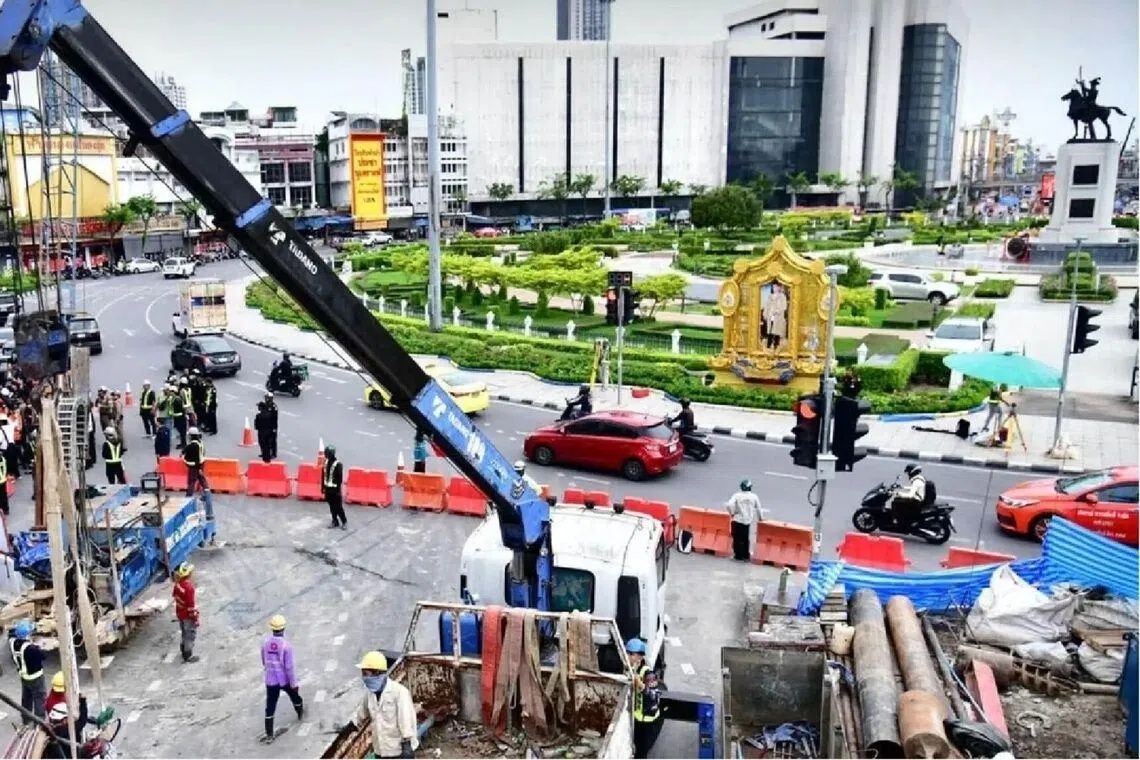
Bangkok's sprawling urban infrastructure faced fresh challenges this month when water seepage within a drainage sump on the southern Purple Line construction site caused significant ground subsidence near Wongwian Yai, necessitating the emergency evacuation of roughly 60 residents from nearby commercial properties and raising questions about the broader safety of the city's aggressive mass transit expansion programme.
The incident unfolded as construction crews encountered unexpected water infiltration at the lowest point of an underground tunnel section. Rather than merely pooling within the sump, the leaked water began to erode surrounding soil, gradually drawing earth into the underground cavity. This process weakened the foundation above until the ground and road surface visibly collapsed, creating observable cracks and depressions that alerted officials to a potentially catastrophic structural failure in the making. The affected stretch of Prajadhipok Road between Ban Khaek intersection and Wongwian Yai—approximately 200 metres in length—was promptly sealed to traffic as authorities scrambled to prevent further deterioration.
Responding swiftly to the emergency, Bangkok Governor Chadchart Sittipunt personally visited the site on July 9 alongside deputy governor Wisanu Subsompon and deputy permanent secretary Kanokwan Iamlim to assess conditions firsthand. The Bangkok Metropolitan Administration and the project contractor jointly ordered the immediate relocation of residents from three commercial buildings positioned within 30 metres of the damaged road surface. Residents were transferred to temporary accommodation, predominantly hotels, where they are expected to remain for approximately one week pending structural assessments. The Mass Rapid Transit Authority of Thailand's contractor has assumed financial responsibility for all accommodation, compensation, and related expenses incurred by displaced families and businesses.
To prevent cascading structural failures among neighbouring buildings, authorities deployed sophisticated real-time monitoring systems. The Department of Disaster Prevention and Mitigation installed two Rescue Guardian monitoring units on structures closest to the subsidence point. These devices continuously measure building tilt and micro-movements in the structural frame, transmitting data to a central monitoring system that triggers immediate alerts if abnormal displacement occurs. This technological response reflects growing recognition that urban construction emergencies in densely populated cities require constant surveillance rather than periodic inspections. Engineers from Thailand's national Urban Search and Rescue team joined the effort to evaluate structural integrity across the broader area and ensure that all response measures meet established engineering and public safety standards.
The sinkhole has created immediate and significant traffic disruptions across a section of Bangkok already identified as a major bottleneck. All outbound lanes of Prajadhipok Road from Ban Khaek intersection toward the King Taksin the Great Monument have been closed, forcing authorities to temporarily convert two inbound lanes for outbound traffic. Motorists have been directed to alternative routes via Itsaraphap, Lat Ya, or Somdet Chao Phraya roads, yet the disruption particularly affects the area surrounding major educational institutions including Suankularb Wittayalai School and Suksanari School. Governor Chadchart has indicated that Bangkok may implement additional school shuttle services modelled on measures previously deployed following the subsidence incident near Vajira Hospital, an earlier construction-related collapse on the same Purple Line alignment but involving a different contractor.
Water leak sealing remains the immediate operational priority for engineers overseeing remediation work. Once the leak is controlled and prevented from drawing additional soil into the tunnel, authorities can better assess whether the subsidence has stabilised. Authorities have reported that water levels and the rate of ground settlement have begun to stabilise, though round-the-clock monitoring continues. Multiple instruments track road surface elevation, soil movement patterns, water seepage rates, and building condition indicators to detect any resurgence of problematic activity that might necessitate extended closures or further evacuations.
The incident highlights a critical vulnerability in Bangkok's expansion of underground rapid transit infrastructure through dense urban zones with complex hydrogeological conditions. This particular subsidence event occurred on the southern Purple Line alignment, the same stretch that experienced a more dramatic road collapse near Vajira Hospital in previous months. The fact that two separate construction contractors are managing different sections of the same line suggests inconsistent standards or oversight mechanisms across the broader project. Each incident introduces legitimate questions about contractor competence, quality control processes, and the adequacy of pre-construction geological surveying in an urban environment where utility networks, water tables, and soil composition vary dramatically within short distances.
The broader implications for Bangkok's transportation planning are substantial. The Purple Line represents a flagship initiative to expand mass transit capacity and reduce congestion, yet repeated construction incidents erode public confidence and generate unexpected costs. Traffic diversions during construction phases create secondary economic impacts on surrounding businesses, schools, and residents whose daily routines are disrupted. Insurance and compensation claims ripple through municipal budgets, and public patience with ongoing disruptions wears thin when multiple incidents suggest systemic rather than isolated problems.
Authorities have committed to easing restrictions only after engineers confirm comprehensive safety across affected buildings, the roadway, and surrounding infrastructure. This cautious approach reflects lessons learned from previous incidents and acknowledges that premature reopening could trigger additional failures if underlying instability persists. The forward command centre established near the subsidence point coordinates efforts among the BMA, the MRTA, the contractor, district authorities, police, and emergency response teams, demonstrating the multi-agency complexity now required to manage urban infrastructure crises in Bangkok's congested landscape.
Further traffic arrangement announcements will emerge once officials determine the necessary duration of the Prajadhipok Road closure. Current estimates suggest residents may return within approximately one week, yet this timeline remains contingent upon successful leak remediation and satisfactory structural assessments. The incident serves as a sobering reminder that Bangkok's ambitious urban development agenda, while essential for managing population growth and mobility, requires exceptionally rigorous engineering oversight, transparent contractor accountability, and genuine coordination among multiple government agencies to protect public safety amid the competing pressures of rapid expansion and maintenance of existing city functions.

