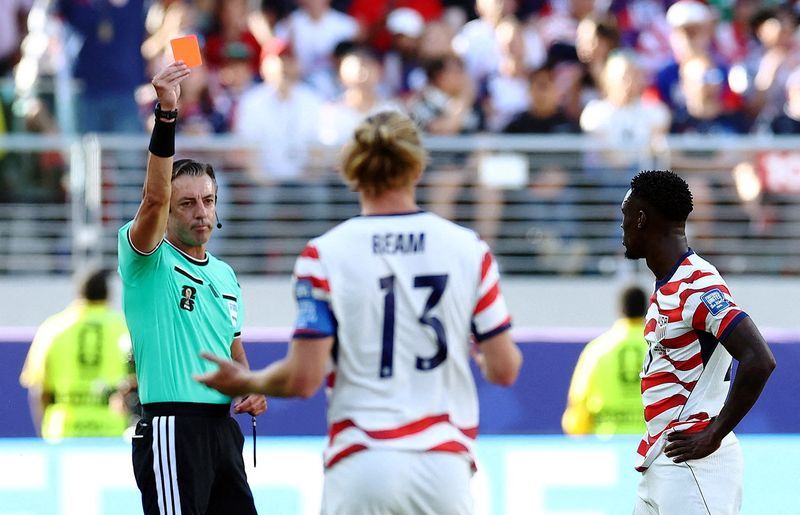
The reversal of Folarin Balogun's World Cup suspension has triggered serious concerns about the integrity of football's disciplinary systems, with senior figures in English football warning that the controversy threatens to erode public confidence in officiating far beyond the tournament itself. Howard Webb, who oversees all refereeing operations in the Premier League, and Richard Masters, the league's chief executive, have both expressed alarm at the implications of FIFA's decision to overturn the American striker's dismissal, particularly given the political pressure that preceded it. Their warnings come at a critical juncture, with the English domestic season set to commence and unprecedented scrutiny likely to fall upon officials' every major decision.
The Balogun affair represents far more than a disputed disciplinary call. The sequence of events—United States President Donald Trump publicly advocating for the player's reinstatement, followed by FIFA subsequently lifting the suspension through what critics characterised as an opaque and previously non-existent process—created a perception that political influence could override the sport's established rules. For Webb, who refereed the 2010 World Cup final, the troubling aspect was not primarily the substance of the original red card decision itself, but rather the institutional failure that allowed external pressure to circumvent established procedures. This distinction is crucial: it suggests that the damage extends beyond a single contentious call to the broader framework governing how football's most important matches are adjudicated.
The timing of this controversy compounds the damage significantly. Webb highlighted that in the modern era, controversial decisions are routinely amplified through social media, where online users frequently ascribe corrupt motives to officiating without factual basis. The Balogun case provides apparent vindication for those who harbour suspicions about match-fixing or institutional bias. By demonstrating that external political pressure can influence FIFA's disciplinary processes, the World Cup incident has inadvertently supplied ammunition to conspiracy theorists and sceptics who claim that corruption runs rampant behind football's closed doors. For Webb, this conflation of legitimate debate with baseless speculation represents perhaps the greatest threat to the sport's credibility, particularly as the Premier League season approaches.
Masters echoed these concerns from a different angle, lamenting that the World Cup tournament has become defined by off-field controversies rather than the quality of football displayed on the pitch. He noted that discussions should be centred on Spain's dominant tournament performance and England's painful semi-final exit, rather than administrative failures and political interference. This shift in public discourse reflects a deeper problem: when governing bodies allow external pressure to influence their decisions, they inevitably distract from the sport itself and invite questions about whether similar pressures might be operating silently in other contexts. For league executives responsible for marketing the Premier League globally, this reputational damage carries direct commercial implications.
The structural weaknesses in FIFA's disciplinary architecture that the Balogun case exposed are equally concerning. Unlike many domestic league competitions, FIFA's regulations contain no mechanism for reviewing and overturning red card decisions on appeal. This absence created the unusual circumstance where the only pathway to reversing Balogun's suspension lay outside the normal disciplinary framework—essentially inventing a new process for an unprecedented situation. Masters characterised this as a fundamental flaw that FIFA must address, though the fact that such gaps exist in football's most important competition raises questions about how thoroughly these regulations have been considered and stress-tested against real-world scenarios.
The implications for the Premier League are particularly acute given the heightened attention that awaits the new season. Webb acknowledged that the World Cup fallout will inevitably carry into domestic competition, creating an environment where officials' decisions face unprecedented scrutiny. Every marginal call, every use of video assistant referee technology, every interpretation of contact in the penalty area will be viewed through the lens of the Balogun precedent. This psychological backdrop creates a challenging environment for officials, who must simultaneously enforce new laws designed to reduce time-wasting and increase match tempo while navigating an atmosphere of heightened scepticism regarding their motives and impartiality.
The new officiating guidelines taking effect this season introduce additional complexity to an already fraught situation. Webb outlined that referees will issue fewer verbal warnings and penalise more infractions, particularly those involving time-wasting and unsporting conduct. This more stringent enforcement approach is intended to improve match flow and entertainment value. However, implementing these changes in an environment where public trust in officiating has been shaken risks creating the appearance that interpretive decisions are being made arbitrarily or inconsistently. Webb himself acknowledged this tension, suggesting that referees will need time to calibrate their approach and that the impact of these changes will only be fully apparent in retrospect.
From a Southeast Asian perspective, the Balogun controversy carries particular resonance. Football governance across the region has periodically faced accusations of corruption and lack of transparency, and the Premier League is widely regarded as a model of professional administration. When the world's most prominent domestic competition proves susceptible to political interference at the international level, it undermines the broader architecture that lesser-resourced football bodies attempt to build. Malaysian football administrators and officials will be watching closely how the Premier League and English Football Association navigate the credibility challenge posed by this episode, as the lessons—and failures—have direct implications for efforts to strengthen governance standards across Asia.
The fundamental challenge facing Webb, Masters, and the broader football community is one of institutional credibility. In an age where decision-making processes are instantly broadcast and dissected globally, opacity breeds suspicion. The Balogun case demonstrated that even FIFA's highest levels are not insulated from external pressure, and that the processes supposedly governing such situations can be circumvented when political will aligns with the desired outcome. Restoring confidence will require not merely winning debates about specific decisions, but demonstrating through transparent, consistent application of rules that the sport's governance structures genuinely operate according to stated principles rather than shifting political interests. Webb's concern that the episode has handed critics a powerful rhetorical weapon speaks to how deeply this incident has undermined the institutional trust that officials require to function effectively. As the Premier League season begins, every close decision will carry the shadow of the World Cup controversy, making the task of re-establishing confidence in football's officiating apparatus considerably more difficult than it would have been before FIFA's fateful decision to intervene in the Balogun matter.

