Bahrain is resisting the temptation to activate a substantial financial safety net from its Gulf neighbour even as the regional conflict takes a measurable toll on its economy, according to the country's development minister. Noor bint Ali Alkhulaif, who leads the Bahrain Economic Development Board and serves on the central bank's board, confirmed in an interview that the kingdom has not drawn upon the $5.3 billion currency swap facility agreed with the United Arab Emirates in April, despite facing one of the worst fiscal pressures among Gulf economies.
The revelation comes as Bahrain confronts an unusually difficult economic moment. Credit rating agency S&P Global projects the ongoing Iran conflict will shrink the economy by 3 per cent this year while creating a fiscal deficit approaching 8.5 per cent of gross domestic product—substantial headwinds for a nation already managing one of the region's heaviest debt loads. Fresh Iranian attacks in recent days have reinforced the precariousness of Bahrain's geopolitical position, sitting as it does across the Persian Gulf from the Islamic Republic and home to the United States Fifth Fleet.
Alkhulaif's decision to discuss the unused swap represents a carefully calibrated message to international markets and investors: Bahrain possesses adequate liquidity reserves and retains confidence in its economic recovery trajectory despite the conflict's disruptions. The government had anticipated 2024 would be a year of constructive economic rebuilding and diversification efforts. Instead, it has spent much of the year managing unexpected shocks, though the minister insisted recovery momentum is already emerging across key sectors.
Sectors once thought vulnerable to supply chain disruption have demonstrated resilience through adaptation. Manufacturing and logistics operations have identified workarounds to avoid the Strait of Hormuz, traditionally one of the world's critical shipping passages, while regional tourism—which comprised approximately 90 per cent of the 15 million visitors the kingdom welcomed last year—has rebounded to pre-conflict levels. This recovery in traveller numbers is particularly significant given that wealthy Gulf tourists typically represent high-spending segments.
Foreign exchange reserves have nonetheless slipped to their lowest level since the COVID-19 pandemic, hovering around $3 billion. This decline understandably triggers caution about fiscal sustainability, yet Bahrain's abstinence from the UAE swap suggests policymakers believe current reserves, combined with ongoing economic activity and projected recovery, will carry them through without invoking emergency measures. The discipline may also reflect reluctance to signal financial distress that could damage regional standing or investor confidence.
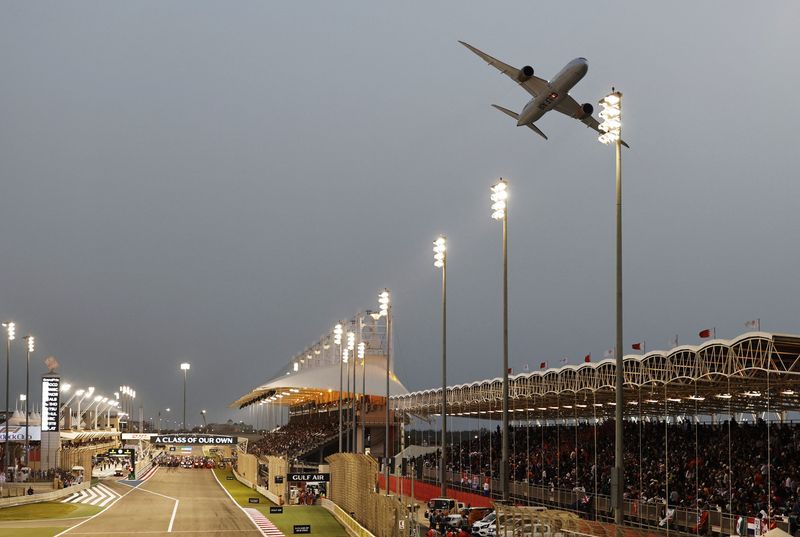
Beyond managing immediate fiscal pressures, Bahrain is pressing ahead with efforts to restore its Formula One Grand Prix to the international racing calendar after the event was cancelled in March alongside Saudi Arabia's race when hostilities erupted. The cancellation represented a significant loss: the weekend typically draws approximately 105,000 spectators, with between 10 and 15 per cent comprising international high-spenders whose accommodation, dining, and hospitality expenditures substantially benefit the local economy beyond ticket revenue.
Formula One sources indicate the most viable window for a Bahrain race reinstatement is the weekend of October 3-4, positioned between the Azerbaijan Grand Prix in Baku and the Singapore Grand Prix scheduled for October 11. This timing would require de-escalation of direct hostilities between the United States and Iran—a precondition Alkhulaif acknowledged as essential. She confirmed that discussions about restoring cancelled races to the calendar are underway, though she stopped short of announcing confirmation, characterizing the prospect as "potentially" viable rather than certain.
Industry analysts emphasize that Formula One authorities will need to make final scheduling decisions relatively soon to allow competing teams sufficient preparation time. The sport's complex logistics—involving transporting equipment, personnel, and hospitality infrastructure globally—demand advance notice. A decision point appears likely within weeks rather than months.
Beyond the immediate 2024 situation, Bahrain is positioning itself for longer-term Formula One prominence. With Ramadan expected to fall earlier in 2026, the kingdom appears poised to reclaim the prestigious opening race of the 2026-27 season and host the mandatory pre-season testing rounds that precede the championship. This would represent a return to Bahrain's traditional role as the Middle Eastern anchor of the F1 calendar, though realizing these plans remains contingent on sustained regional stability.
For Malaysia and other Southeast Asian economies, Bahrain's experience offers instructive lessons about managing external economic shocks while maintaining strategic credibility. The decision to preserve rather than deploy emergency liquidity facilities, combined with efforts to restore high-profile international events, represents a confidence-projection strategy that smaller regional economies often employ when navigating geopolitical turbulence.
Alkhulaif's measured optimism about recovery, delivered even as new Iranian attacks underscore security concerns, reflects a calculated balancing act between acknowledging difficulties and projecting stability. This messaging proves particularly important for tourism-dependent and trade-reliant economies where both investor perception and consumer confidence hinge substantially on perceptions of normalcy and forward momentum.
The broader question facing Bahrain involves whether regional de-escalation will materialize sufficiently to permit events like the Formula One Grand Prix to proceed as planned. Near-term indicators remain mixed, though the willingness of government officials to publicly discuss the possibility suggests at least preliminary optimism about trajectory changes in coming months.

