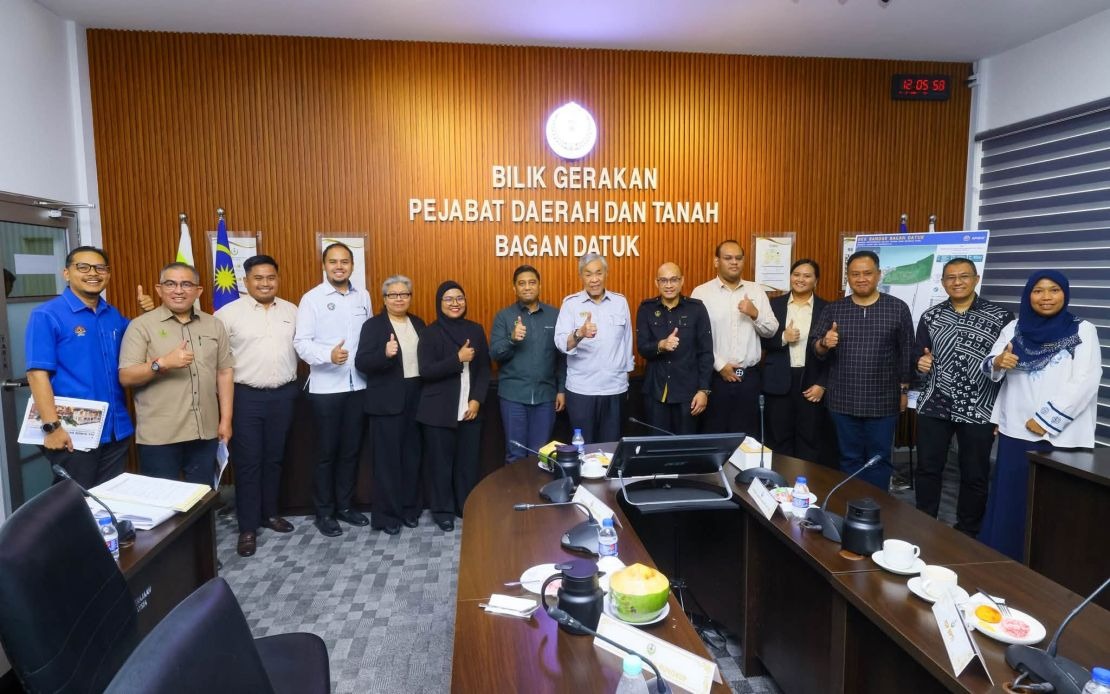
Deputy Prime Minister Datuk Seri Dr Ahmad Zahid Hamidi has thrown his weight behind a comprehensive development plan for Bagan Datuk, envisioning the Perak parliamentary constituency as a thriving administrative town that combines modern infrastructure with environmental quality and economic dynamism. Speaking in Ipoh on August 14, Zahid, who represents the constituency in Parliament, articulated a vision centred on creating a distinctive, livable community with competitive advantages that would benefit residents across multiple dimensions.
The announcement comes as Zahid received a presentation on the Bagan Datuk special area plan (RKK), a detailed strategic framework developed in collaboration with the Teluk Intan Municipal Council, the Bagan Datuk District Office, and specialised consultants. This study represents a methodical approach to translating aspirations into concrete urban planning outcomes, moving beyond rhetorical commitments to evidence-based development strategy. The involvement of multiple government and municipal bodies signals a coordinated effort to align various administrative functions and resources toward cohesive growth.
For Malaysian readers familiar with regional development initiatives, the Bagan Datuk model echoes broader national patterns of identifying secondary towns as growth nodes. The plan explicitly emphasises the integration of administrative functions within a park-like setting, reflecting contemporary urban design principles that prioritise livability alongside functionality. This approach represents a departure from purely commercial or industrial development models, instead positioning Bagan Datuk as a balanced township where government operations, residential amenities, and recreational spaces coexist symbiotically.
Zahid's personal connection to the constituency informs his advocacy; as a native of Bagan Datuk, he frames development not merely as political duty but as stewardship of a community he is rooted within. This positioning carries significance in Malaysian politics, where local representatives' credibility often hinges on demonstrated commitment to their constituencies beyond electoral cycles. His emphasis on listening to community presentations and soliciting stakeholder input suggests a consultative development process, though the success of such initiatives ultimately depends on implementation fidelity and resource allocation.
The special area plan encompasses several interconnected objectives: improving infrastructure quality, expanding economic opportunities, and enhancing environmental standards for residents. Infrastructure development typically includes transport networks, utilities, and public facilities that form the backbone of urban competitiveness. For Bagan Datuk, this would be particularly significant given its position within the Perak economy, where improved connectivity and modern amenities could attract investment and skilled workers.
Economic diversification emerges as a central concern within the development vision. Rather than relying on traditional agricultural or resource-extraction models, the plan appears to position Bagan Datuk as a services and administrative centre, potentially offering employment across government, finance, education, and healthcare sectors. This economic restructuring reflects Malaysia's broader shift toward knowledge-based and service-oriented industries, with secondary towns increasingly positioned as administrative and commercial hubs serving regional populations.
The sustainability of such ambitious development schemes depends critically on resource availability and political continuity. In the Malaysian context, development plans often face implementation challenges when political circumstances shift or budgetary priorities realign. Zahid's influence as Deputy Prime Minister provides institutional weight and potential access to federal funding mechanisms, yet this advantage could prove ephemeral if political configurations change. The plan's long-term success will therefore require buy-in from multiple government levels and sustained community engagement beyond the initial planning phase.
For Southeast Asian observers, the Bagan Datuk initiative exemplifies how secondary Malaysian towns are being repositioned within national economic strategies. Rather than concentrating development exclusively in major cities like Kuala Lumpur or Penang, authorities are increasingly investing in provincial centres that can serve regional functions while alleviating pressure on overloaded urban cores. This decentralisation logic has parallels across the region, from Thailand's secondary city initiatives to Indonesia's regional development programmes.
The competitive positioning language employed by Zahid—describing Bagan Datuk as a "competitive administrative town"—reflects contemporary urban policy discourse emphasising inter-city competition for investment, talent, and administrative functions. Such framing suggests that the plan includes not merely absolute improvement in living standards but relative advantages compared to alternative locations. This competitive stance shapes how the development will be marketed to potential investors and residents, potentially influencing outcomes.
Implementation mechanisms remain crucial but underexamined in the public announcements. The coordination required between municipal authorities, district administration, and federal agencies demands clear institutional frameworks, defined timelines, and transparent budgeting processes. Malaysian development projects have sometimes faltered when administrative boundaries or bureaucratic procedures created bottlenecks, suggesting that success will depend as much on organisational efficiency as on funding availability.
The emphasis on a "park-like" setting reflects global urban planning trends favouring integrated green space within developed areas. This aesthetic and environmental dimension carries implications for Bagan Datuk's attractiveness as a residence and workplace, potentially enhancing quality of life for residents and improving public health outcomes. However, maintaining such environmental standards requires ongoing commitment and resource allocation beyond initial infrastructure creation.
For constituencies facing stagnation or decline, such comprehensive development visions can catalyse renewal, yet they also carry risk of unfulfilled expectations if implementation lags. Bagan Datuk residents will be watching closely to see whether the special area plan translates from presentation to tangible improvements in infrastructure, services, and economic opportunity. The coming years will test whether Zahid's ambitious vision and the collaborative planning framework can overcome typical implementation challenges and deliver lasting transformation.

