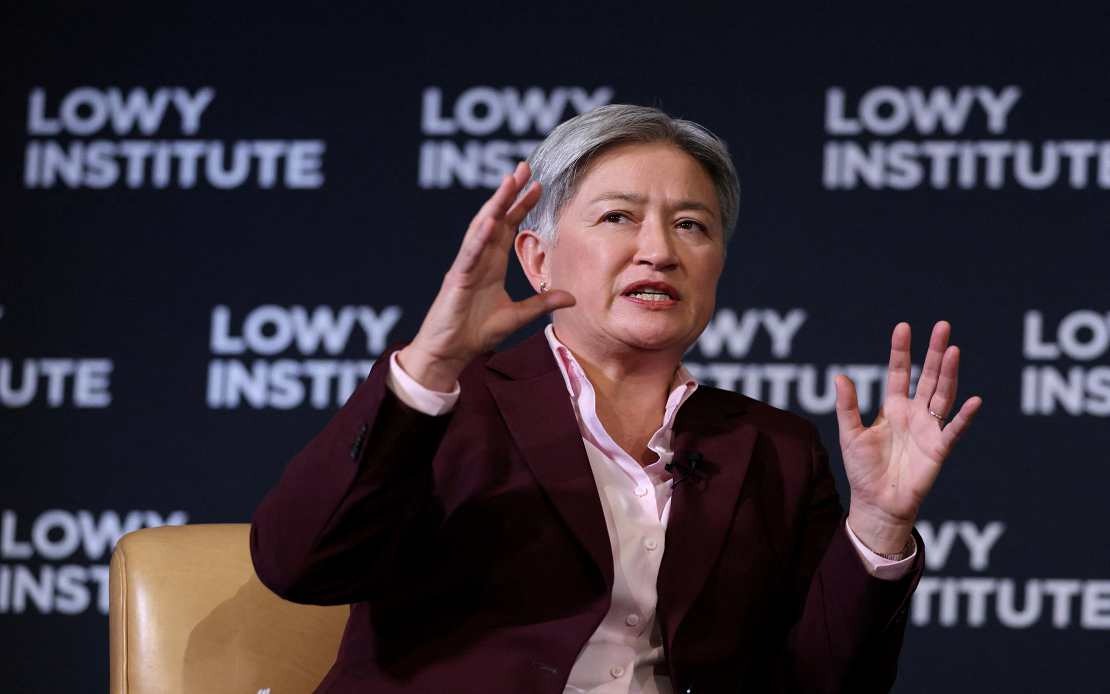
Australia's top diplomat has launched a forthright challenge to mounting political pressure for stricter immigration and cultural homogeneity, arguing that such a retreat would undermine the country's global standing and economic prospects. In a keynote address delivered Friday at the Lowy Institute in Sydney, Foreign Affairs Minister Penny Wong rejected what she termed the "melancholic fantasy of monoculture," positioning Australia's multicultural character as a fundamental source of national strength rather than a vulnerability that requires remedy.
Wong's intervention directly addressed the growing political clout of right-wing populist Senator Pauline Hanson, whose One Nation party has dramatically expanded its voter appeal during 2026. The party's leader had declared in June that Australia must transform into a monocultural society, an assertion that has gained unexpected political traction as traditional major parties face voter dissatisfaction. Wong framed the monocultural argument not merely as misguided policy but as fundamentally at odds with Australia's historical identity and contemporary interests.
The Foreign Minister's reasoning extended beyond cultural advocacy into strategic territory. She contended that isolationist policies implicit in monocultural demands would cripple Australia's capacity to build partnerships, expand trade relationships, and identify growth opportunities across the Indo-Pacific region. By characterising monoculturalism as a deliberate choice to weaken national competitiveness, Wong attempted to reframe immigration and diversity as economic imperatives rather than social preferences—a crucial rhetorical move in an environment where growing segments of the electorate express concern about migration levels.
One Nation's political resurgence represents a substantial challenge to Australia's established political order heading toward the 2028 general election. Latest polling by YouGov Australia, conducted in July, revealed that 26 per cent of voters now indicate they would support the party, a striking quadrupling of its 6.4 per cent result at the 2025 election. This surge has coincided with notable erosion of support for both major parties: the governing Labour Party has dropped from 34.5 per cent to 28 per cent, while the opposition Coalition has fallen from 31.8 per cent to 20 per cent.
The party's platform combines aggressive anti-immigration rhetoric with commitments to slash foreign aid and withdraw Australia from multilateral institutions should it enter government. These positions resonate with a constituency increasingly skeptical of Australia's migration intake and international engagement. One Nation has successfully channeled voter anxiety about demographic change into a coherent political program, creating a structural challenge that neither Labour nor the Coalition has effectively neutralised through their existing policy offerings.
Broader polling data underscores the depth of public concern about migration that One Nation has mobilised. The Lowy Institute's annual public opinion survey for 2026, published in June, found that 55 per cent of Australians believe the country accepts too many migrants. This figure has climbed steadily from 53 per cent in 2025 and 48 per cent in 2024, suggesting that anti-immigration sentiment has become increasingly mainstream rather than confined to activist circles. The trajectory points toward intensifying political pressure on whichever government holds office after 2028.
For Southeast Asian policymakers and observers, the Australian political shift carries significant implications. Australia's role as a regional power and trade partner depends substantially on the political preferences of the government in Canberra. A One Nation-led government committed to reducing foreign aid, reconsidering multilateral commitments, and substantially restricting immigration would fundamentally reshape Australian engagement with the region. Countries across Southeast Asia that rely on Australian investment, development assistance, and security cooperation would face uncertainty regarding long-term bilateral relationships.
Wong's defence of multiculturalism therefore represents more than domestic political positioning. It reflects the Foreign Affairs establishment's conviction that Australia's prosperity and influence depend on sustained openness to global engagement, of which immigration and diversity form essential components. The argument that monocultural policies would leave Australia "more hostile" internally aligns this position with broader claims about social cohesion, economic dynamism, and regional standing—a multi-layered response designed to address different audiences simultaneously.
The political momentum behind One Nation, however, suggests that Wong's rhetorical challenge, however carefully constructed, may struggle to reverse voter sentiment absent other policy adjustments. Both Labour and the Coalition face pressure to demonstrate responsiveness to public concerns about immigration without ceding ground to what they characterise as extremist positions. This creates a complex policy environment where the established parties attempt to maintain competitive positioning while resisting the populist framing of immigration as inherently problematic.
Australia's 2028 election will ultimately constitute a referendum on the direction of national policy. The rising viability of One Nation as a genuine governing prospect, rather than a marginal political force, reflects deeper shifts in how Australian voters weigh multiculturalism, immigration, and international engagement. Wong's defence of Australia's multicultural identity and global orientation represents the incumbent political class's most direct challenge to these shifts, but the durability of that position through a two-year electoral cycle remains uncertain amid persistent voter anxieties about demographic change and the pace of social transformation.

