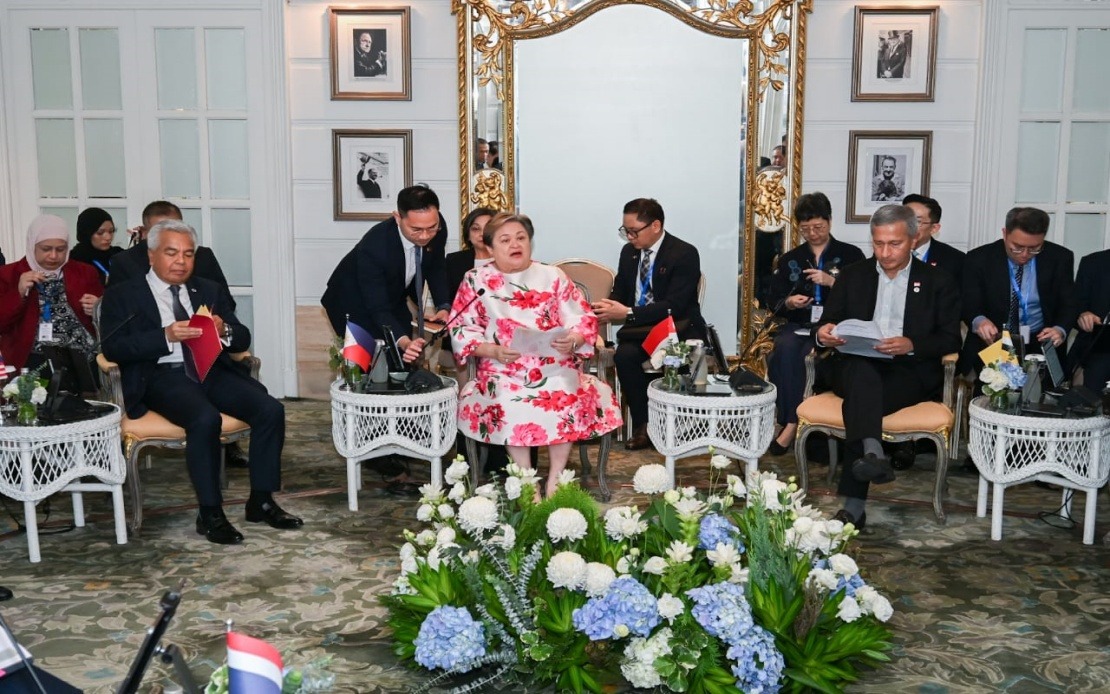
ASEAN has doubled down on its commitment to the Five-Point Consensus as the definitive framework for addressing Myanmar's political crisis, signalling the regional bloc's determination to maintain engagement despite persistent obstacles from Naypyidaw. At a significant gathering of ASEAN foreign ministers in Bangkok, the regional grouping outlined three interconnected priorities: expanding humanitarian relief operations, curbing violence against civilians, and fostering more inclusive political negotiations that could pave the way for national reconciliation. The emphasis on a unified approach underscores ASEAN's belief that the 5PC, adopted in April 2021, remains the most viable pathway forward even as Myanmar's military-dominated parliament has publicly rejected the initiative.
Philippine Foreign Secretary Maria Theresa Lazaro, serving as the ASEAN Chair's Special Envoy on Myanmar, made clear that ASEAN would not abandon its foundational peace framework regardless of Naypyidaw's stance. Speaking alongside Thailand's Foreign Minister Sihasak Phuangketkeow at the conclusion of consultations, Lazaro articulated the regional bloc's unwavering position: the consensus document serves as the basis for all ASEAN engagement with Myanmar's government and other stakeholders, and the organisation stands firmly behind this commitment regardless of how Naypyidaw responds. Her statement carries particular weight given her direct involvement in shuttle diplomacy with Myanmar's leadership, suggesting that ASEAN believes persistence and consistency offer the only realistic chance of eventually shifting Myanmar's calculus.
The timing of this reaffirmation is significant. Myanmar's parliament passed a formal motion rejecting the peace plan just days before the Bangkok meeting, a deliberate snub that could have triggered a complete ASEAN retreat from engagement. Instead, the regional organisation chose to treat the rejection as a negotiating position rather than a final word, interpreting it as a signal that Myanmar requires different approaches or additional incentives rather than evidence that dialogue has become futile. This strategic patience reflects ASEAN's institutional culture of maintaining engagement channels even when official positions diverge, though it also raises questions about how long the bloc can sustain credibility if Myanmar continues stonewalling without making tangible concessions.
On the humanitarian dimension, ASEAN has signalled that it intends to move beyond rhetorical support by mounting a dedicated mission to assess and expand aid delivery mechanisms. The Philippines, as current ASEAN Chair, is planning a humanitarian mission specifically designed to identify bottlenecks in the current assistance framework and explore pathways for increasing the volume of support reaching vulnerable populations inside Myanmar. This represents a shift from generic calls for aid delivery toward concrete operational planning, suggesting ASEAN recognises that humanitarian access has become both a moral imperative and a potential leverage point for broader diplomatic progress. For Malaysia and other member states with significant humanitarian expertise, this initiative offers an opportunity to demonstrate tangible regional commitment to Myanmar's civilian population.
Violence reduction stands as the second pillar of ASEAN's renewed push, with particular emphasis on protecting civilians from ongoing armed conflict. The escalation of clashes between Myanmar's military forces and armed resistance groups across multiple regions has created a humanitarian catastrophe that cannot be ignored, and ASEAN appears to be signalling that any credible political process must begin with confidence-building measures that reduce the bloodshed. This framing allows ASEAN to set achievable interim goals even if broader political settlements remain elusive, potentially creating a sequential pathway where violence reduction becomes a prerequisite for advancing toward dialogue rather than a consequence of it.
The third component—fostering inclusive political dialogue—addresses one of the core failures of Myanmar's current political trajectory. The military's consolidation of power following the February 2021 coup has systematically excluded opposition voices, armed resistance organisations, and ethnic minority leaders from any meaningful participation in governance or peace-building. ASEAN's emphasis on inclusivity and its specific mention of securing political prisoners' release signals that the regional bloc views genuine reconciliation as dependent on broadening rather than narrowing the stakeholder base. This directly contradicts Myanmar's military leadership's apparent strategy of political monopolisation, creating a fundamental tension that ASEAN must navigate.
Lazaro's characterisation of the meeting as a significant breakthrough warrants careful examination. This was indeed the first in-person encounter between ASEAN foreign ministers and Myanmar's foreign minister since the 2021 crisis began, suggesting that physical engagement had broken down entirely until this gathering. The resumption of ministerial-level talks itself represents progress in maintaining diplomatic channels, though it remains unclear whether Myanmar's participation reflected a genuine softening of its position or merely tactical engagement to prevent complete ASEAN isolation. The fact that the meeting proceeded despite Myanmar's parliamentary rejection of the 5PC suggests that either Myanmar's government maintains some daylight from its military leadership or that international diplomatic pressure compelled participation.
Thailand's hosting of the meeting carries multilayered significance. As Myanmar's immediate neighbour with substantial economic interests in stability, Thailand has incentives to maintain constructive engagement with all parties. Foreign Minister Sihasak's emphasis on "calibrated engagement" being a "two-way street" communicates a subtle but important message: ASEAN will continue reaching out, but Myanmar must reciprocate by addressing regional concerns and demonstrating good faith. This framing suggests that ASEAN will not indefinitely absorb Myanmar's intransigence without consequences, even if those consequences remain undefined. Thailand's domestic political dynamics, including its own complicated relationship with democratic governance, also influence its approach to Myanmar, creating potential complexity in ASEAN's unified messaging.
The question of timeline remains unresolved, with Sihasak indicating that ASEAN will assess progress at the annual ASEAN Summit later in 2023. This effectively creates a checkpoint mechanism whereby ASEAN can evaluate whether Myanmar has made meaningful movement on the three key areas before determining whether to maintain, escalate, or modify its engagement strategy. For Malaysia and other ASEAN members with active civil society constituencies concerned about Myanmar's humanitarian crisis, this timeline provides a focal point for pressure and advocacy throughout the intervening months. It also signals to Myanmar that while ASEAN values dialogue, patience has boundaries.
Cambodia's absence from the ministerial meeting requires contextualisation. The Cambodian government has historically maintained closer ties to Myanmar's military leadership and has sometimes resisted ASEAN consensus positions on Myanmar matters. Cambodia's non-representation at this particular gathering either reflects diplomatic scheduling conflicts or potentially signals disagreement with the consensus approach, though official sources have not clarified the reason. Malaysia's representation through Foreign Ministry Secretary-General Tan Sri Amran Mohamed Zin, rather than the Foreign Minister, suggests a working-level engagement typical of routine consultations rather than a high-stakes political confrontation, indicating that Malaysia maintains its diplomatic presence while avoiding the appearance of taking an aggressive stance toward Myanmar.
The broader geopolitical context adds urgency to ASEAN's Myanmar diplomacy. The regional bloc faces mounting criticism from Western nations, UN bodies, and human rights organisations regarding its perceived passivity in the face of Myanmar's deteriorating humanitarian situation. China and Russia, meanwhile, have generally supported Myanmar's military government or at minimum refrained from criticising it, complicating ASEAN's efforts to present a united international front. By reaffirming the 5PC and announcing concrete initiatives like the humanitarian mission, ASEAN attempts to demonstrate that its engagement strategy produces results beyond mere talk, even if demonstrable progress remains limited. This performance of commitment becomes especially important as ASEAN navigates expectations from both Myanmar and the international community.
Looking forward, ASEAN's capacity to implement its stated priorities will depend on Myanmar's willingness to move beyond symbolic participation toward substantive cooperation. The military government has shown remarkable resilience in withstanding international pressure, and there are limited indicators suggesting imminent policy shifts on violence reduction or political inclusivity. ASEAN's strategy implicitly assumes that sustained engagement, combined with humanitarian engagement and diplomatic messaging, will eventually create conditions where Myanmar's leadership recognises the costs of isolation exceed the benefits of intransigence. Whether that assumption proves valid will become apparent over the coming months as the regional bloc approaches its planned summit assessment point.

