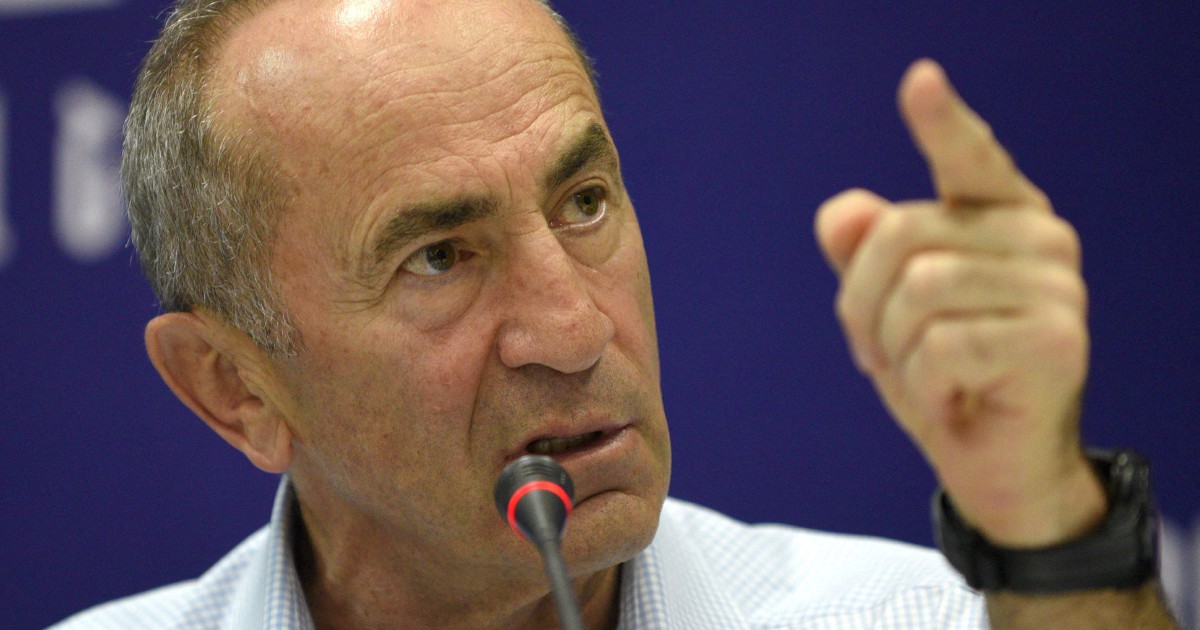
Armenia's prosecutorial authorities moved decisively on Tuesday to apprehend Robert Kocharyan, the country's ex-president who has emerged as a leading voice in the opposition movement. The detention marks an escalation in legal action against the former leader, with state prosecutors formally filing an array of corruption-related accusations stemming from Kocharyan's time leading the nation. The case signals intensifying political and legal tensions within Armenia as the country navigates its post-conflict reconstruction and internal political divisions.
Kocharyan, who previously served as Armenia's chief executive, has become increasingly vocal as an opposition figure challenging the current government's direction and policies. His prominence in civil society and political activism has positioned him as a significant counterweight to sitting authorities, making his detention particularly consequential for Armenia's democratic institutions and political landscape. The timing of the prosecution underscores underlying friction between the incumbent administration and former leadership figures who maintain substantial public support and organisational capacity.
The corruption charges encompass multiple alleged violations of law during Kocharyan's presidential tenure, though specific details of individual accusations require further clarification through the legal process. Such comprehensive prosecutions often involve financial impropriety, abuse of state resources, or conflicts of interest accumulated across an entire administrative period. The breadth of charges suggests authorities view Kocharyan's conduct during his presidency as systematically problematic rather than isolated in nature.
This development unfolds within Armenia's broader struggle to consolidate democratic governance following the traumatic 2020 conflict with Azerbaijan over the Nagorno-Karabakh enclave. That war strained state institutions and intensified existing political divisions, with former leaders and current authorities often blamed alternately for military failures, diplomatic missteps, and inadequate conflict preparation. Prosecutions of predecessor regimes frequently gain traction amid post-conflict transitions, as new administrations seek accountability and symbolic closure while potentially neutralising political rivals.
The detention carries implications extending beyond Armenia itself, resonating throughout the South Caucasus region where Armenia remains locked in tension with Azerbaijan and grappling with security challenges. Political instability in Yerevan, particularly if seen as driven by score-settling rather than genuine accountability, risks undermining the state apparatus precisely when robust institutions are essential for negotiating peace, managing international relations, and delivering public services to a war-affected population. The perception of selective justice versus impartial law enforcement will significantly influence Armenian civil society's confidence in governance.
Opposition movements across the region closely monitor such prosecutions, as they signal the boundaries of acceptable political dissent and the personal risks accompanying criticism of incumbents. Should Kocharyan's case proceed without transparent procedures and international oversight, it may reinforce perceptions that legal systems in post-Soviet states serve political masters rather than principles of equity and constitutional governance. Conversely, genuine accountability for historical wrongdoing, if handled judiciously, can demonstrate state commitment to the rule of law.
Regional observers and Western governments maintaining strategic interest in South Caucasus stability will scrutinise how Armenian courts handle the Kocharyan prosecution. International human rights organisations typically examine such cases for procedural fairness, protection of defendants' rights, and absence of political interference—metrics that determine whether proceedings advance or undermine democratic legitimacy. The decision to detain rather than summon Kocharyan, coupled with formal charging procedures, suggests authorities intend vigorous prosecution, though detention's justification and legal basis remain subjects for judicial review.
For Malaysia and ASEAN, Armenia's political dynamics offer cautionary lessons regarding post-conflict transitions and institutional resilience. Several Southeast Asian nations have navigated similar challenges following internal conflicts or regime changes, where competing factions sought both accountability and political advantage through legal mechanisms. The balance between pursuing genuine justice and avoiding weaponised prosecution remains perpetually contested terrain requiring robust constitutional frameworks and international attention.
Kocharyan's legal proceedings will likely extend significantly, consuming media attention and political energy throughout Armenia for months or years ahead. The case will influence opposition capacity to mobilise, the incumbent government's political positioning, and perceptions of institutional independence. How Armenia's judiciary handles this high-profile prosecution will establish precedents affecting future political accountability, making the outcome consequential not only for Kocharyan personally but for Armenian democracy's trajectory during this critical reconstruction period.

