Argentina's war veterans federation has made an unusual intervention in the sporting calendar, calling on the nation's football supporters to focus squarely on the game itself rather than treating Wednesday's World Cup semi-final against England as an opportunity to advance territorial claims over the South Atlantic islands. The April 2 War Veterans Federation, representing those who fought in the 1982 conflict that claimed 649 Argentine and 255 British lives, issued a statement emphasising that the match in Atlanta should remain a purely sporting contest devoid of political messaging or nationalist grievance.
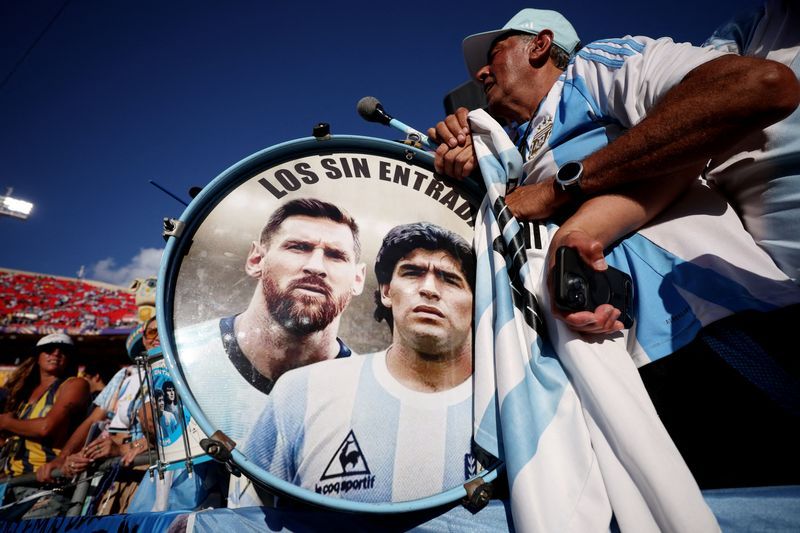
The intervention reflects tensions that have simmered throughout Argentina's World Cup campaign, where supporters have embraced chants that interweave references to the disputed Malvinas Islands—known to the British as the Falklands—with celebrations of football legend Diego Maradona and Lionel Messi's quest for a second World Cup title before retirement. While such songs have become part of Argentina's football culture during tournaments, the veterans' federation felt compelled to draw a distinction between sporting pride and the appropriation of wartime sacrifice for match-day atmosphere.
In their statement, the veterans made clear that Argentina's position on the islands remains firm, but argued that this position is best advanced through established diplomatic and legal channels rather than football stadiums. "Sovereignty is defended in international forums through diplomacy, historical truth and the peaceful, non-negotiable claim enshrined in our national constitution," the federation said, essentially asking fans to compartmentalise their identities as both supporters and citizens with distinct political interests.
The message carries particular weight given that those issuing it represent survivors and families of those killed in what many Argentines view as an unjust war, yet they are consciously stepping back from using the England match as a symbolic rematch. Their framing—that "the ball rolls, pride in our colours multiplies, but memory remains intact"—attempts to honour the fallen without channelling grief or anger into the sporting arena.
England and Argentina possess one of world football's most intensely storied rivalries, rooted not merely in competitive matches but in the broader geopolitical relationship between Britain and Argentina. The most famous encounter came in 1986 during the World Cup quarter-final, when Diego Maradona's illegal "Hand of God" goal became an enduring symbol of Argentine national pride and, to some, a kind of sporting justice against the former colonial power that had defeated Argentina militarily just four years earlier. That match became more than football; it became a proxy for national sentiment and historical grievance.
Recognising this context, Argentina's football authorities and coaching staff have worked deliberately to keep this week's encounter within sporting boundaries. Manager Lionel Scaloni has repeatedly stated that only football will be contested in Atlanta, and his players have largely avoided inflammatory rhetoric. Similarly, England's Jordan Pickford emphasised on Monday that the semi-final is "just a game of football," echoing sentiments aimed at defusing any sense that geopolitical stakes accompany the ninety minutes of play.
The broader sovereignty dispute itself remains unresolved decades after the war. Britain maintains firm control of the islands and sustains a military garrison there, while Argentina continues to pursue its territorial claim through international bodies including the United Nations and regional forums. This diplomatic stalemate has endured through various Argentine governments and shifting geopolitical alignments, suggesting that no World Cup match will alter the fundamental positions of either nation.
For Malaysian and Southeast Asian observers, the intervention by Argentina's war veterans offers insight into how sporting contests in regions bearing historical conflict can become vessels for deeper political messaging. Southeast Asia contains its own territorial disputes and post-conflict sensitivities; the veterans' plea for separation between sporting passion and national cause resonates as a model—though perhaps an imperfect one—for how football can be preserved as a realm distinct from state interests. The fact that those most directly affected by the 1982 war are urging restraint carries moral authority that politicians or even players might lack.
The semi-final represents Messi's potentially final opportunity to win a World Cup, a narrative that has dominated coverage throughout the tournament. Many Argentines see his success as redemptive for the nation, a sporting triumph that can restore pride without requiring recourse to geopolitical conflict. The war veterans' statement implicitly recognises this, suggesting that Argentina's true validation will come through football excellence rather than through using the stadium as a platform for unresolved territorial disputes.
Both teams will arrive in Atlanta with different pressures and narratives. For England, the match represents a chance to reach a World Cup final on foreign soil, continuing a resurgence that has seen the team reach the Euro 2020 final and maintain competitive standing among global powers. For Argentina, beyond Messi's legacy, there is the deeper national desire to reclaim World Cup glory after 36 years, a gap that feels particularly acute in a football-obsessed nation.
The war veterans' call for restraint will likely go unheeded by some supporters, as football atmospheres remain inherently passionate spaces where historical memory and sporting fervour blend inseparably. Yet their statement serves an important function: it acknowledges that the match matters intensely while arguing that it matters precisely because football carries its own intrinsic value, independent of the political disputes that nations may harbour toward one another. In essence, they are asking for football to be allowed to be football—a proposition that, however idealistic, speaks to something fundamental about sport's capacity to transcend, or at least temporarily suspend, the conflicts that define international relations.

