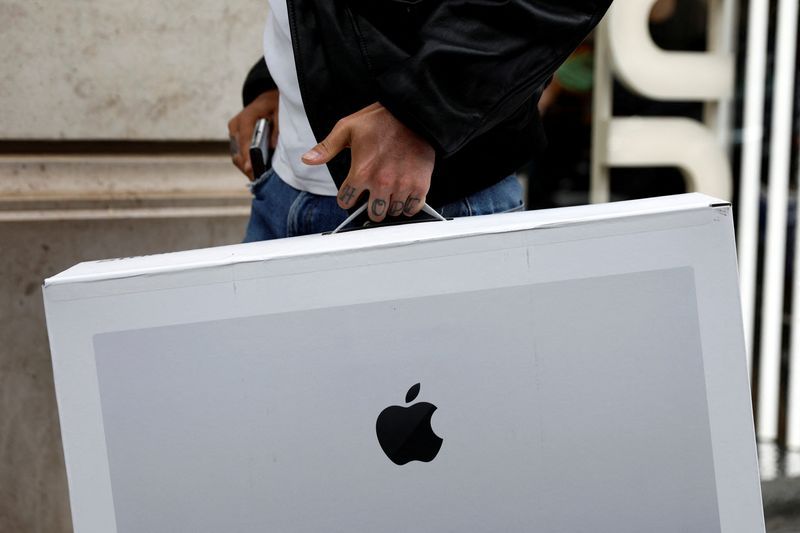
Apple has reclaimed the world's most valuable company title, surpassing Nvidia on Friday with a valuation of $4.88 trillion as investors recalibrate their expectations for the artificial intelligence boom. The move reshuffles the hierarchy of technology giants and signals a fundamental reassessment of which companies stand to benefit most from the transformative potential of AI technologies. Nvidia, the graphics processor heavyweight that dominated the rankings for nearly a year after becoming the first company to breach the $5 trillion threshold in October, has retreated to second place with a market value hovering near $4.86 trillion, following a 3.5 percent decline in share price.
This reconfiguration reflects a maturing perspective among institutional investors who are now questioning whether the companies generating the most immediate returns from AI infrastructure spending—chipmakers in particular—represent the most durable long-term opportunities. Apple's return to the pinnacle position marks its first time leading the global corporate pecking order since April of the previous year, underscoring how dramatically market sentiment can shift within a relatively compressed timeframe. The reversal is particularly striking given that Apple spent much of the recent period being dismissed by analysts as an also-ran in the competitive race to develop and deploy artificial intelligence capabilities.
The company had faced considerable scepticism from the investment community for its perceived tardiness in allocating capital toward foundational AI model development, a gap that seemed to disadvantage it compared to technology giants aggressively pursuing large language model research. Yet recent strategic pivots have begun to alter this narrative substantially. Toni Meadows, head of investment at BRI Wealth Management, explains that the sentiment transformation hinges on Apple's differentiated approach to capturing value from AI rather than attempting to compete head-to-head with established players in model development. According to this analysis, Apple's business model proves less dependent on the massive capital expenditure requirements that constrain rivals, while simultaneously positioning the company to extract meaningful returns through service bundling, entrenched ecosystem advantages, and the revenue potential of hardware refreshes driven by AI-enhanced features.
Apple's strategic positioning around artificial intelligence centres substantially on the iPhone ecosystem and the vast reservoir of personal user data embedded within its operating systems. Analysts have identified what amounts to an untapped treasure trove in the biographical and behavioural information generated daily by hundreds of millions of device users. This data foundation could theoretically enable dramatically more contextually aware and personally relevant responses from Siri, the company's virtual assistant, fundamentally transforming its competitive utility against assistant offerings from rivals. Yet extracting this value presents a genuine tension with Apple's carefully cultivated brand positioning around privacy protection and user data sovereignty—principles that have become increasingly central to the company's marketing and regulatory positioning.
The company took a significant step in asserting its AI credentials last month through the rollout of a substantially reconstructed Siri interface that had been delayed through multiple development cycles. The updated assistant represents Apple's attempt to narrow the competitive distance that has widened between its offering and the more sophisticated capabilities now available through various third-party applications and competing platforms. The timing of this initiative carries particular significance given the imminent leadership transition, as Chief Executive Officer Tim Cook prepares to transfer operational authority to John Ternus, a career hardware specialist, during September.
For Cook, whose tenure has been defined by steady incrementalism and operational discipline, presiding over a company that reclaims top valuation status provides a narrative counterpoint to persistent criticism about Apple's hesitant posture on artificial intelligence. The transition to Ternus creates an opportunity for the incoming leadership to chart a fresh strategic course regarding AI integration and monetisation approaches that might diverge from the inherited framework. Cook's final months at the helm are thus being viewed through the lens of whether Apple successfully positioned the company for sustained prosperity within the AI-dominated technology landscape.
It would be premature to interpret Apple's current market leadership as a definitive reordering of competitive hierarchies within the technology sector. Nvidia's position remains structurally powerful given the continued fundamental role that graphics processors play in powering the proliferation of generative AI applications across enterprise and consumer markets. The chipmaker's processors continue fuelling the infrastructure expansion that underlies the entire AI enterprise, suggesting that sentiment could readily reverse if market participants reassess the durability of AI spending cycles. Benjamin Hall, vice president of alpha research at Segal Marco Advisors, characterises Nvidia as a likely significant participant whatever technological or commercial developments emerge over coming years, implying that temporary leadership swaps may obscure more durable competitive advantages.
Apple itself confronts meaningful vulnerabilities that could constrain its momentum. The company has pursued a pricing strategy designed to offset inflationary pressures on component and labour costs, a calculus that introduces genuine risk that consumer price sensitivity could dampen demand for flagship products. The psychological resistance to incrementally higher device prices, particularly given the modest feature upgrades characterising recent generations, represents an understated but genuine competitive vulnerability that could erode the company's ability to sustain premium valuations.
The broader competitive landscape has expanded well beyond the binary between Apple and Nvidia, with investor attention progressively diffusing across the semiconductor industry more comprehensively. Memory chip manufacturers such as Micron have emerged as unexpected beneficiaries of AI-driven infrastructure buildouts, with the company crossing the $1 trillion market capitalisation milestone in May as investors embraced the critical role that memory technologies play within sophisticated AI systems. South Korea's SK Hynix has now accessed international capital markets through a recent Nasdaq listing, introducing another formidable competitor into the arena competing for investor capital allocation.
This proliferation of entrants and the diversification of investment focus across multiple semiconductor subsectors potentially fragments the concentrated attention that had previously focused overwhelmingly on the most visible artificial intelligence pioneers. Hall observes that new market participants could diffuse investment enthusiasm beyond the exclusive concentration on the so-called Magnificent Seven technology stalwarts into a broader constellation of companies positioned to benefit from various dimensions of the AI transformation. However, this optimistic assessment coexists with genuine turbulence emerging within semiconductor valuations more broadly as investors entered July with renewed scrutiny regarding whether artificial intelligence spending trajectories can sustain the elevated valuations that have characterised the sector.
The Philadelphia Semiconductor Index experienced substantial compression, declining nearly nineteen percent from its historical highs throughout July as market participants questioned whether the foundational premises supporting the semiconductor rally retain validity. Despite this pronounced contraction, the index has still managed outperformance relative to broader market benchmarks through the first half of the year, suggesting that underlying conviction about semiconductors' centrality to future technology infrastructure remains partially intact. The volatility underscores how provisional these competitive rankings and valuation hierarchies remain, with multiple scenarios plausible regarding which companies ultimately capture the most sustainable value from the artificial intelligence transformation.

