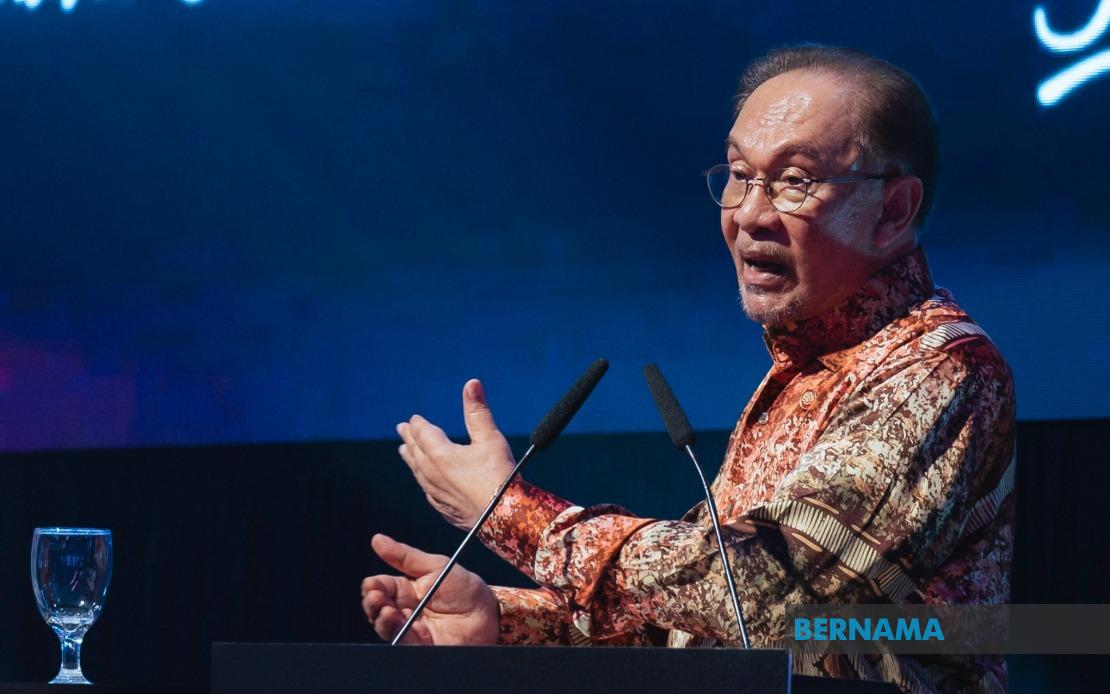
Prime Minister Datuk Seri Anwar Ibrahim's recent commentary on Taiwan has drawn scrutiny for acknowledging China's position that military options remain available should peaceful reunification efforts collapse. Yet interpreting these remarks as a call to arms would be a fundamental misreading of his underlying argument, which pivots instead on the strategic principle of deterrence—a concept well established in international relations and one that underpins how most nation-states approach their security and sovereignty.
Anwar's core contention rests on a straightforward proposition: no government voluntarily accepts the disintegration of its territory without putting up resistance. The Prime Minister employed Malaysia itself as an instructive parallel, suggesting that Kuala Lumpur would not passively tolerate the fragmentation of its federal structure. This analogy is not rhetorical flourish but rather a logical foundation for understanding how states preserve their integrity. When a nation renounces the possibility of defending itself by force, it removes a critical element from the calculus of potential adversaries—namely, that challenging the status quo carries real costs and risks.
The distinction between reserving the right to use force and actively seeking to deploy it forms the crux of deterrence theory. Throughout the Cold War and into the contemporary era, strategic stability has rested on the credible capacity for response, not its execution. The very existence of such capability, if believed by potential challengers, often renders its actual use unnecessary. This logic extends beyond great-power competition into the realm of regional and local conflicts. For Taiwan and the broader Cross-Strait question, Anwar's framework suggests that China views the maintenance of military options as essential to preventing what Beijing perceives as permanent separation—not because immediate conflict is desired, but because ambiguity about consequences discourages unilateral moves toward independence.
Within Malaysia's diplomatic posture, Anwar's position exhibits considerable sophistication. Kuala Lumpur maintains formal recognition of the People's Republic of China and does not accord Taiwan status as a separate sovereign state in official dealings, yet simultaneously sustains robust economic ties and people-to-people exchanges with Taipei. This balancing act has defined Malaysian statecraft for decades. By acknowledging that China's concerns over territorial integrity carry legitimacy from Beijing's perspective, Anwar is not endorsing coercion but rather demonstrating comprehension of how rival parties to a dispute perceive their own stakes. Malaysia cannot genuinely adhere to the One China policy while simultaneously dismissing the security anxieties that motivate that position.
Taiwan's perspective represents the inverse of this equation. Democratic Taipei regards itself as a sovereign, self-governing polity and rejects any framework that subordinates its self-determination to Beijing's territorial claims. From this standpoint, any international acknowledgment of China's right to employ force appears to legitimise the very coercion that Taiwan seeks to prevent. This is not a mere rhetorical objection but reflects fundamentally incompatible visions of what Taiwan's political status should be and how its future ought to be determined. The tension between these positions remains one of the most delicate fault lines in Asian geopolitics.
However, Anwar's remarks should not be conflated with enthusiasm for military confrontation across the Strait. Rather, they articulate a realist perspective grounded in how international politics actually functions. States do not predeclare acceptance of territorial dismemberment; doing so would render them vulnerable to pressure and coercion. Yet realism about deterrence does not preclude—indeed, it actively demands—parallel commitment to dialogue, negotiation, and peaceful settlement mechanisms. These are not contradictory impulses but complementary dimensions of statecraft.
For Malaysia and Southeast Asia more broadly, the implications of a Taiwan Strait conflict would be genuinely calamitous. The region's prosperity rests substantially on freedom of navigation, unimpeded commerce, and supply chain reliability. Taiwan Strait tensions already impose friction costs on regional trade; an actual military clash would prove economically ruinous and could drag ASEAN nations into geopolitical alignments that many prefer to avoid. Anwar's government has consistently advocated for restraint, dialogue, and the primacy of peaceful dispute settlement mechanisms—positions that remain crucial for regional stability.
The Malaysian position, properly understood, achieves a delicate equilibrium. By maintaining One China recognition, Anwar demonstrates respect for a foundational principle in Beijing's worldview. By refusing to endorse coercion and continuing to champion peaceful settlement, Malaysia signals that territorial claims, however legitimate they may appear to one party, cannot justify military aggression. By sustaining ties with Taiwan across economic and cultural domains, Kuala Lumpur affirms that diplomatic estrangement need not follow from One China policy. This tri-partite balance requires nuance and sophistication in both rhetoric and action.
Critics who worry that Anwar's remarks somehow legitimise military adventurism overlook the fundamental point: acknowledging that another state possesses military capacity and views it as deterrent is categorically different from urging that capacity's use. Deterrence logic depends entirely on the credible possibility that force might be employed if redlines are crossed. If that possibility evaporates entirely, the deterrent effect collapses, potentially inviting the very instability and conflict one seeks to prevent. This is not hypothetical; history demonstrates that revisionist powers become more aggressive when they perceive opposing states lack the will or capacity to resist.
Moving forward, Malaysia's challenge lies in maintaining this equilibrium while demonstrating consistent advocacy for dialogue and restraint. Anwar's intellectual framework—grounded in deterrence rather than warmongering—reflects a mature understanding of how states navigate competing interests in a multipolar, fractious world. The substantive test of Malaysian policy will be whether leadership in Southeast Asia can harness this understanding to encourage all parties to the Taiwan question toward greater restraint, reduced rhetoric, and expanded channels for dialogue that might ultimately produce outcomes preferable to military confrontation for everyone involved.

