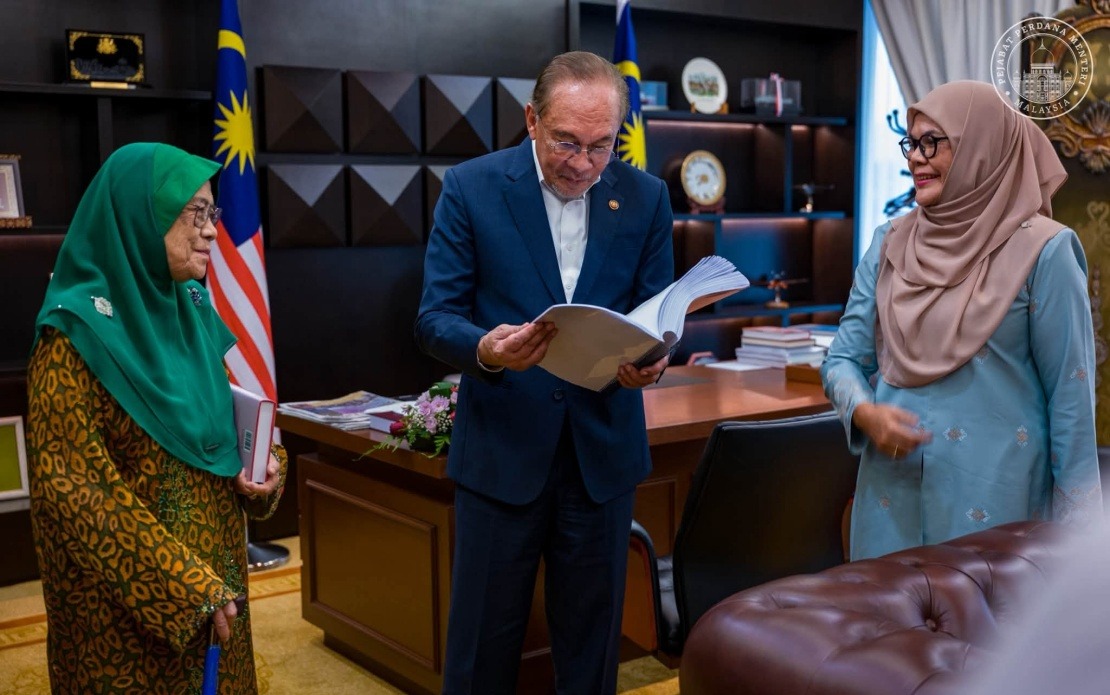
Prime Minister Datuk Seri Anwar Ibrahim has expressed hope that a newly published book capturing his philosophical ideas and leadership vision will become a lasting resource for Malaysians grappling with questions of governance and personal integrity. In a statement released through social media, Anwar disclosed that he had actively participated in the book's development process, offering detailed feedback on the manuscript before its completion. The project represents a deliberate effort to preserve and articulate the intellectual foundations that have guided the Prime Minister's political career and policy direction.
The book was authored by Professor Dr Salinah Ja'afar, a linguist and lecturer at the Academy of Malay Studies within Universiti Malaya. Ja'afar's academic background in language studies positioned her to capture the nuances and complexity of Anwar's thinking, translating his verbal and written communications into a coherent narrative structure suitable for publication. The work draws on Anwar's extensive life experiences, personal reading habits, and the formative moments that have shaped his approach to politics and governance throughout his career spanning several decades.
The scholarly credentials of the publication were further enhanced through the involvement of Professor Emeritus Datuk Dr Nik Safiah Abdul Karim, a renowned figure in Malaysia's academic and linguistic circles. Karim assumed the role of academic adviser during the manuscript's preparation and development phases, ensuring methodological rigour and intellectual integrity throughout the writing process. Her participation underscores the seriousness with which both Anwar and the publishing team approached the documentation of ideas that they believe possess enduring significance.
Anwar's involvement extended beyond simply providing access to his archives or permitting interviews. The Prime Minister underwent exclusive sessions with both scholars, allowing them to extract insights directly from him regarding his worldview, decision-making frameworks, and the philosophical underpinnings of his political positions. These interactions ensured that the book would not rely solely on secondary interpretations or journalistic accounts but would instead capture Anwar's own articulation of his thoughts and aspirations. The collaborative approach reflects a commitment to accuracy and authenticity in representing his intellectual legacy.
In his public comments, Anwar emphasised that the publication documents the interplay between his lived experiences and intellectual development. The Prime Minister acknowledged that his ideas and perspectives have been shaped by both practical exposure to Malaysia's political landscape and his engagement with significant works of thought across various disciplines. By making this connection explicit, Anwar suggests that understanding his philosophy requires recognising both the theoretical foundations and the real-world circumstances that informed his thinking.
The stated purpose of the book extends beyond biographical or hagiographical intent. Rather, Anwar articulated a hope that this documentation would serve a pedagogical function for coming generations of Malaysians. Specifically, he highlighted potential applications in discussions surrounding nation-building and the cultivation of personal values. These represent areas of persistent relevance in Malaysian public discourse, where questions about national identity, governance models, and ethical standards continue to generate significant debate among policymakers, academics, and the broader public.
For Malaysian readers and regional observers, the book's emergence reflects broader trends in how political leaders attempt to shape their legacies and influence future policy directions beyond their own tenure in office. In Southeast Asia, where oral traditions and political mentorship have historically played crucial roles in leadership transitions, the act of formally documenting a leader's philosophical framework represents both continuity with established patterns and adaptation to modern publishing conventions. The publication suggests Anwar's awareness that future generations may approach his ideas through written rather than oral transmission.
The involvement of female scholars, both as primary author and academic adviser, carries its own symbolic weight in Malaysian academia and publishing. Ja'afar and Karim represent distinguished voices in their respective fields, and their association with this project lends scholarly weight whilst also highlighting women's contributions to the intellectual documentation of national leadership. This detail may resonate particularly with Malaysian readers attentive to questions of gender representation in positions of intellectual authority.
From a practical standpoint, the book's potential utility as a reference document for policy discussions and academic curricula remains to be determined by market reception and institutional adoption. Universities, policy research centres, and government agencies could theoretically employ the work as foundational material for understanding the philosophical premises underlying current Malaysian governance approaches. Students of political science, public administration, and Southeast Asian studies might find the text instructive for understanding contemporary Malaysian political thought and practice.
The timing of the book's publication during Anwar's tenure as Prime Minister adds temporal dimension to its significance. Rather than waiting until his retirement or the end of his political career to authorise such documentation, the current release allows for engagement with living commentary and potential refinement of ideas through public discourse. This approach enables contemporaries to test Anwar's documented philosophies against actual policy implementation, examining whether governance practices align with articulated principles.
For regional observers, Anwar's investment in formal documentation of his intellectual framework reflects his consistent positioning as not merely a practitioner of politics but as a thinker engaged with broader questions about development, democracy, and social transformation. Throughout his career, he has cultivated an image as intellectually serious and philosophically grounded, distinguishing himself within Malaysian political circles through engagement with international thought leaders and participation in global forums addressing governance and development challenges.
The book project also suggests recognition within Anwar's circle that formal records and published documentation carry particular authority and durability in shaping historical narrative and political legacy. In an era of rapid information flow and contested interpretations, the commitment to a carefully researched, academically advised published work represents a strategic effort to establish authoritative record of his thinking. This conscious attempt to shape how future generations understand his contributions reflects sophisticated awareness of how political legacies are constructed and transmitted across time.

