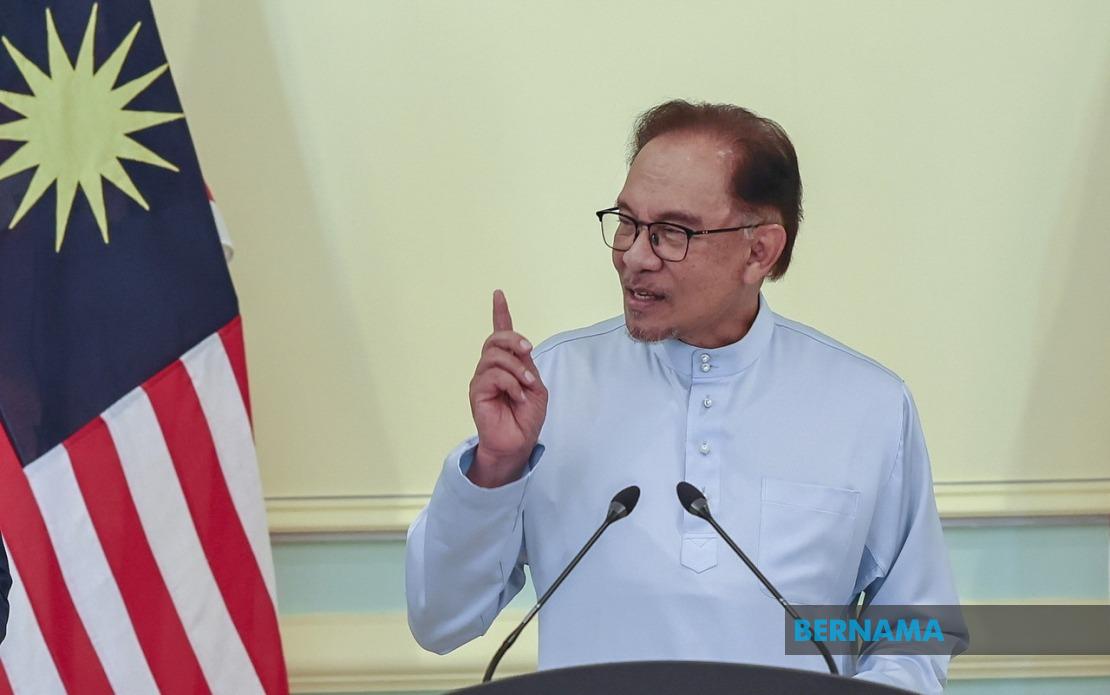
Prime Minister Datuk Seri Anwar Ibrahim's handling of the Gaza crisis reflects a sophisticated blend of moral conviction, legal argumentation and practical diplomacy that merits strong backing, according to UPNM Honorary Professor Dr Mizan Aslam. Rather than relying on rhetorical gestures alone, the Prime Minister has constructed a comprehensive framework addressing what has become far more than a bilateral dispute between two parties. The Gaza situation now stands as a stark indictment of how the international system has fractured, exposing fundamental weaknesses in the mechanisms designed to protect civilians and enforce global norms.
The humanitarian toll documented in Gaza underscores why this framing matters. After 1,000 days of conflict, the territory has witnessed 73,066 deaths, 173,514 injuries, and 5,400 cases of disability or amputation. Among these figures, 21,730 victims were children, with another 45,113 children injured and 59,054 rendered orphaned. These numbers transcend statistics; they represent a systematic erosion of human security that demands response beyond standard diplomatic channels. The infrastructure collapse compounds this tragedy, with over 90 percent of Gaza's built environment destroyed. Residential areas have been almost entirely affected, water systems have deteriorated to critical levels with 91 percent of households experiencing severe shortages, and sanitation infrastructure has essentially ceased functioning in much of the territory.
Malaysia's foreign policy response, as articulated through Anwar's leadership, extends beyond statements of solidarity. The country's decision to support South Africa's case before the International Court of Justice against allegations of genocide violations represents a calculated elevation of the issue into the realm of binding international accountability. This move distinguishes Malaysia's position from nations that restrict themselves to political condemnation. By backing a legal mechanism designed to establish culpability for crimes against humanity, Malaysia signals that it views the Gaza crisis as fundamentally a question of international justice rather than merely a conflict requiring humanitarian mitigation.
The diplomatic intensity of Anwar's approach becomes evident through examination of the multilateral channels he has activated. The Arab-Islamic Extraordinary Summit served as a platform for advancing several interconnected objectives: intensifying pressure for an end to violence, reinforcing support for the United Nations Relief and Works Agency for Palestine Refugees in the Near East (UNRWA), and mounting coordinated international advocacy against ongoing weapons supplies. These moves illustrate a recognition that middle-power nations like Malaysia can amplify their influence by mobilising collective positions within existing institutional frameworks rather than operating in isolation.
The humanitarian dimension receives practical expression through Malaysia's financial commitment. An initial allocation of RM100 million demonstrates that the government's concern translates into concrete resource deployment at a moment when the territory faces acute food insecurity affecting 1.97 million people. Within this population, 641,000 individuals experience famine conditions or catastrophic hunger levels. The healthcare system, already devastated by direct targeting of medical facilities, cannot adequately respond to emerging crises. Healthcare workers themselves have become casualties, with 1,723 deaths recorded and another 362 detained. The malnutrition statistics reveal a demographic collapse in progress: 466 deaths specifically attributed to malnutrition and 17,800 cases among children under five in 2025 alone, escalating to 68,996 cases of severe malnutrition in the same age group by May 2026.
Crucially, Anwar's diplomatic position extends beyond ceasefire rhetoric toward structural political resolution. The emphasis on establishing a sovereign and viable Palestinian state reflects an understanding that temporary conflict suppression without political settlement merely defers future crises. This perspective aligns with Malaysia's longstanding commitment to the Palestinian cause while distinguishing it from positions that accept indefinite occupation or fragmented autonomy arrangements as acceptable outcomes. The framework consciously rejects the notion that humanitarian assistance can substitute for genuine self-determination.
The analytical framework underlying Malaysia's approach draws from the doctrine of active non-alignment, a foreign policy tradition that permits the nation to adopt stances rooted in principle and values rather than great-power alignment. This orientation proves particularly relevant for Gaza, where Malaysia can advocate for civilian protection, humanitarian access, legal accountability and Palestinian sovereignty without requiring alignment with major powers. The doctrine enables smaller nations to exercise principled agency in spheres where direct military or economic leverage remains unavailable.
What distinguishes Anwar's diplomacy operationally is its refusal to isolate any single dimension of the crisis as sufficient. Some nations restrict themselves to humanitarian provision, implicitly accepting political realities. Others engage in legal mechanisms while providing no material assistance. Still others make political declarations without sustained institutional follow-up. Malaysia's approach integrates these elements into a coherent strategy that sustains pressure across multiple domains simultaneously. International courts receive support for accountability proceedings while UNRWA receives advocacy backing and RM100 million flows toward emergency relief.
The realistic assessment embedded in Anwar's positioning acknowledges Malaysia's inherent constraints. As a middle-power nation, Malaysia cannot unilaterally resolve the Gaza crisis through military intervention or coercive diplomacy. However, this limitation need not confine Malaysia to passivity. The alternative framework positions the country as a persistent voice ensuring that Gaza remains before international judicial forums, global policy conferences, diplomatic negotiating channels and the conscience of the international community. This approach transforms a structural constraint into an opportunity for sustained advocacy that transcends temporary political cycles.
The coherence of Malaysia's Gaza diplomacy ultimately rests on converting expressions of solidarity into mechanisms of accountability. Rather than permitting sympathy to dissipate into rhetoric, the framework anchors Malaysian positions in legal instruments, humanitarian institutions, and diplomatic networks designed to enforce consequences for violations. This translation of principle into institutionalised action represents the substance of what genuine diplomatic engagement demands in circumstances where the international system itself faces delegitimation. For Malaysian readers and Southeast Asian observers, the model demonstrates how principles need not yield to pragmatism when backed by sustained institutional pressure and material commitment.

