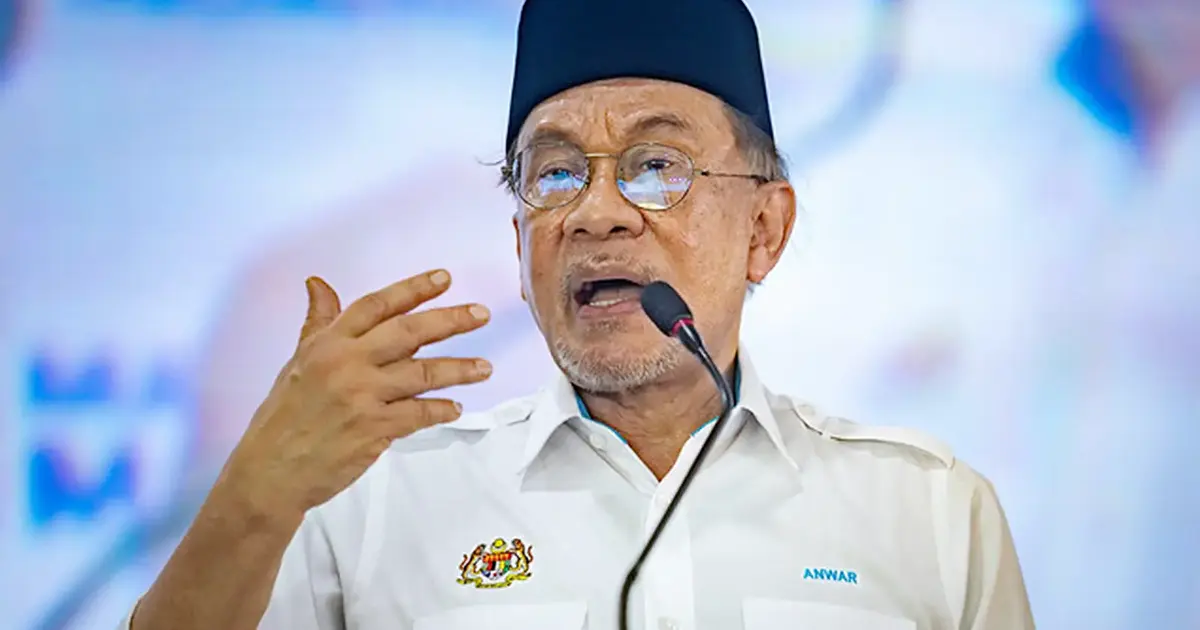
Prime Minister Anwar Ibrahim has issued a stern warning to members of his cabinet that they risk losing their ministerial posts if they launch attacks against fellow partners in the unity government during state election campaigns. The cautionary message underscores the delicate balance required to maintain the broad coalition that has governed Malaysia since late 2022, and reflects growing tensions as various political parties compete in forthcoming state-level contests.
Anwar's intervention signals deep concern about the potential damage that could be inflicted on the ruling coalition if individual ministers or their supporters weaponise their government positions during campaigning. In Malaysian politics, where state elections often serve as important barometers of public sentiment and can shift the landscape of federal alliances, the temptation for ambitious politicians to use their ministerial platforms to undermine rival coalition members has proven historically difficult to resist.
The prime minister made clear that ministerial accountability would be enforced. Those who are found to have misused their official status or government resources to campaign against other unity government partners would be asked to step down, effectively removing them from the cabinet. This represents a significant stick in Anwar's hand, as ministerial positions carry substantial prestige and practical benefits within Malaysia's political system.
The warning reflects practical political reality in Malaysia's coalition-based governance model. The unity government comprises parties with sometimes competing interests and electoral bases, making it necessary to establish ground rules about permissible conduct during election periods. Without such guardrails, internal fighting between coalition partners could spiral into public disputes that embarrass the government and give ammunition to opposition parties seeking to portray the ruling alliance as fractious and unstable.
Anwar's approach aims to distinguish between legitimate political competition and conduct that crosses ethical or practical lines. Ministers can presumably still campaign for their own party candidates, but they must refrain from using the machinery of government or their official standing to mount direct attacks on coalition allies. This calibrated approach attempts to preserve coalition unity while allowing for natural electoral competition within the system.
The timing of this warning suggests that state election campaigns have begun generating friction between coalition members. Malaysia has a regular cycle of state elections, with different states holding polls at different times, meaning that campaign seasons are nearly perpetual. This creates ongoing opportunities for tension unless disciplined messaging is maintained at the highest levels.
For Malaysian observers, Anwar's intervention demonstrates both the strength and fragility of the unity government structure. The prime minister clearly possesses sufficient authority to issue binding instructions to his cabinet, yet the very fact that such warnings are necessary indicates underlying strains. The coalition remains viable and functional, but requires active management to prevent internal rivalries from becoming destructive.
The implications extend beyond immediate electoral considerations. If ministers are willing to ignore the prime minister's directives and attack coalition partners anyway, it would signal that the government lacks sufficient internal discipline. Conversely, if the warning is heeded, it reinforces Anwar's leadership authority and demonstrates that the unity government can maintain cohesion even during competitive electoral periods. The next state election results may provide evidence of which scenario is unfolding.
For opposition parties, Anwar's warning presents both opportunity and challenge. The mere fact that such warnings must be issued could be portrayed as evidence of coalition dysfunction, potentially bolstering opposition claims that the unity government is inherently unstable. However, if the warning successfully prevents visible internal conflict, the opposition loses a potential narrative advantage.
From a governance perspective, the episode highlights the complexity of managing broad-based coalitions in Westminster-style parliamentary systems. Prime ministers in such systems must balance the need to accommodate coalition partners with the imperative to maintain party discipline and strategic direction. Anwar's approach represents an attempt to establish clear boundaries that protect coalition stability without requiring parties to abandon their electoral ambitions or suppress legitimate policy differences.
The situation also reflects broader Malaysian political evolution. The country's shift toward coalition-based governments, particularly following the 2022 election results that produced no single-party majority, has required political leaders to develop new skills and mechanisms for managing partners with divergent interests. Anwar's willingness to establish and enforce clear rules about acceptable political conduct during elections demonstrates adaptation to this new reality.
Moving forward, the effectiveness of Anwar's warning will depend on sustained enforcement and the political costs associated with violations. If ministers understand that attacking coalition partners genuinely risks their cabinet positions, compliance becomes more likely. However, if the threat is perceived as hollow or selectively applied, the warning's deterrent value diminishes significantly. The Malaysian political establishment will be watching closely to see whether Anwar follows through if violations occur, as this will establish precedent for managing coalition discipline.

