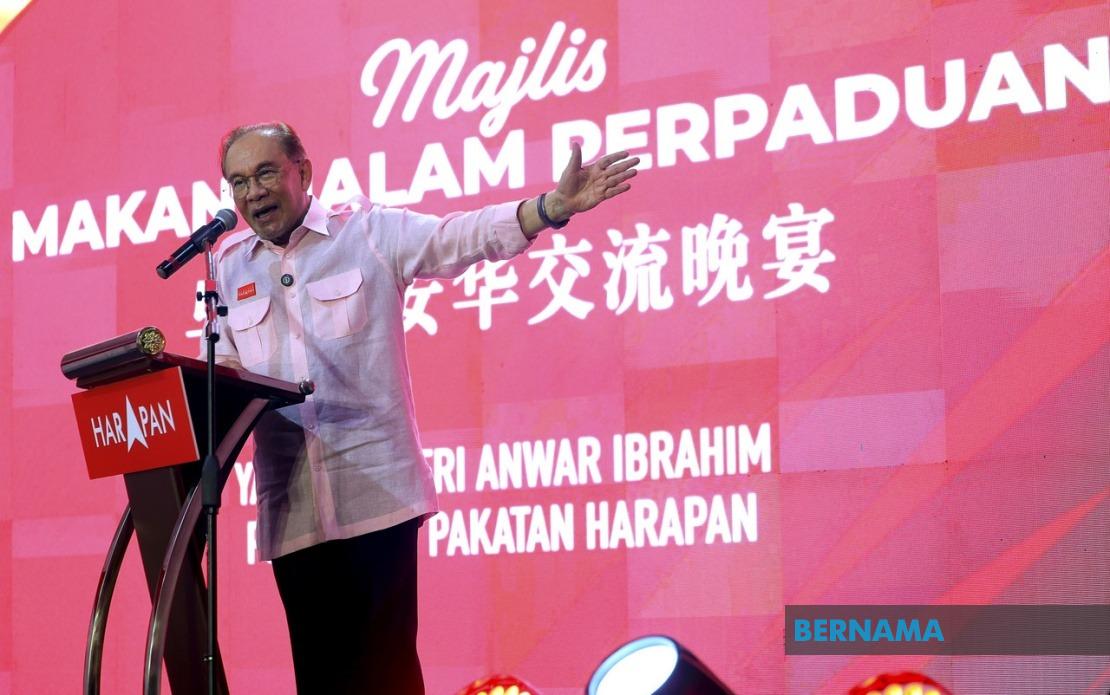
Prime Minister Anwar Ibrahim has launched a pointed critique of opposition political movements, suggesting their preoccupation with securing the menteri besar position reveals a troubling lack of focus on genuine public service. Speaking at a campaign dinner in Sikamat, the Pakatan Harapan chairman drew a stark contrast between what he characterised as rival camps already quarrelling over top leadership roles and his coalition's commitment to competent governance prioritising the wellbeing of all Negeri Sembilan residents.
Anwar's remarks come as the state prepares for elections scheduled for August 1, with early voting commencing on July 28. The intervention marks a deliberate attempt to shift campaign discourse away from localised political machinations and toward the broader question of administrative capability. By highlighting the opposition's apparent fixation with factional manoeuvrings, Anwar seeks to convince voters that the real choice before them is between organised, results-oriented administration and internally fractious alternatives prone to infighting.
The Prime Minister's comments reflect a strategic campaign argument that voters should withhold their support from parties demonstrating internal discord before polling day has even concluded. He reasoned that if opposition groups are already competing aggressively for the chief minister's office during the campaign phase, such divisions will inevitably intensify post-election, potentially undermining effective governance. This framing positions the electorate as having agency to prevent this scenario through their voting choices.
Anwar emphasised that Pakatan Harapan's approach centres on identifying capable administrators with demonstrated commitment to serving the population inclusively. He pointed to existing track records as evidence, rather than mere campaign promises or leadership ambitions. This emphasis on proven performance rather than political manoeuvring represents a deliberate contrast with what Anwar implied was opposition behaviour—prioritising personal advancement and positional competition over substantive policy delivery.
The campaign event featured several key figures from Pakatan Harapan's state leadership, including incumbent Menteri Besar Datuk Seri Aminuddin Harun, who is defending his position as the PH candidate for Linggi. Also present were Nor Azman Mohamad, contesting the Sikamat seat, and Datuk Muhammad Nazri Kassim, representing the Ampangan constituency. Their attendance underscored the coalition's leadership continuity argument.
Anwar specifically urged Negeri Sembilan voters to retain Aminuddin as menteri besar, citing the incumbent's administrative record. He highlighted what he described as effective state management characterised by integrity, freedom from corruption, and absence of power abuse—a clear implicit contrast with potential alternatives. The emphasis on anti-corruption credentials carries particular weight in Malaysian political discourse, where governance scandals have historically damaged public confidence in state administrations.
Beyond the menteri besar competition, Anwar also addressed what he termed problematic racial narratives being deployed during the election campaign. He characterised certain political quarters as deliberately amplifying ethnic divisions to secure electoral support—a common feature of Malaysian state elections where communal tensions can be instrumentalised. The Prime Minister positioned the Unity Government as offering an alternative approach grounded in fair, inclusive governance benefiting all population segments regardless of ethnic background.
Pakatan Harapan's economic and social policy platform, according to Anwar's presentation, encompasses expanded socio-economic allocations, expanded housing initiatives, and salary adjustments for civil servants—tangible benefits extended across all communities. This framing attempts to neutralise arguments that coalition governance privileges particular ethnic groups, instead presenting measured resource distribution as a defining feature of the Unity Government approach.
In the Negeri Sembilan contest, Pakatan Harapan is fielding candidates across all 36 state seats, with the coalition's internal allocation reflecting established power-sharing arrangements. The PKR party is contesting 16 seats, Democratic Action Party (DAP) eleven seats, and Amanah nine seats. This comprehensive participation signal indicates PH confidence in its state-level prospects and willingness to contest every available constituency rather than conceding territory to rivals.
The electoral mathematics in Negeri Sembilan carry significance beyond the state itself, as outcomes often signal broader trends affecting national political dynamics. A Pakatan Harapan victory would reinforce the Unity Government's claim to represent stable, competent administration capable of maintaining voter confidence. Conversely, significant opposition gains would suggest vulnerabilities in coalition messaging or performance that extend beyond Negeri Sembilan's borders.
Anwar's campaign intervention highlights the strategic importance national leadership places on state-level contests. Rather than delegating campaign messaging entirely to state-level figures, the Prime Minister's personal engagement indicates assessment of the race as consequential for overall coalition positioning. His focus on governance capacity and internal opposition divisions rather than on specific policy proposals suggests a strategy prioritising negative contrast over positive agenda articulation.
The campaign ahead will test whether such governance-focused arguments resonate with voters or whether localised concerns dominate electoral decision-making. State elections in Malaysia frequently turn on constituency-level issues, development grievances, and factional affiliations, potentially overshadowing national-level political narratives. Nevertheless, Anwar's emphasis on competent, inclusive administration versus factional infighting represents a deliberate framing choice reflecting confidence in this particular electoral argument's persuasive power.
With polling day approaching, both camps will intensify their respective campaigns. Pakatan Harapan's emphasis on administrative continuity and leadership stability contrasts with implicit opposition vulnerabilities regarding internal cohesion. Whether this messaging translates into electoral returns will become apparent when Negeri Sembilan voters cast their ballots on August 1.

