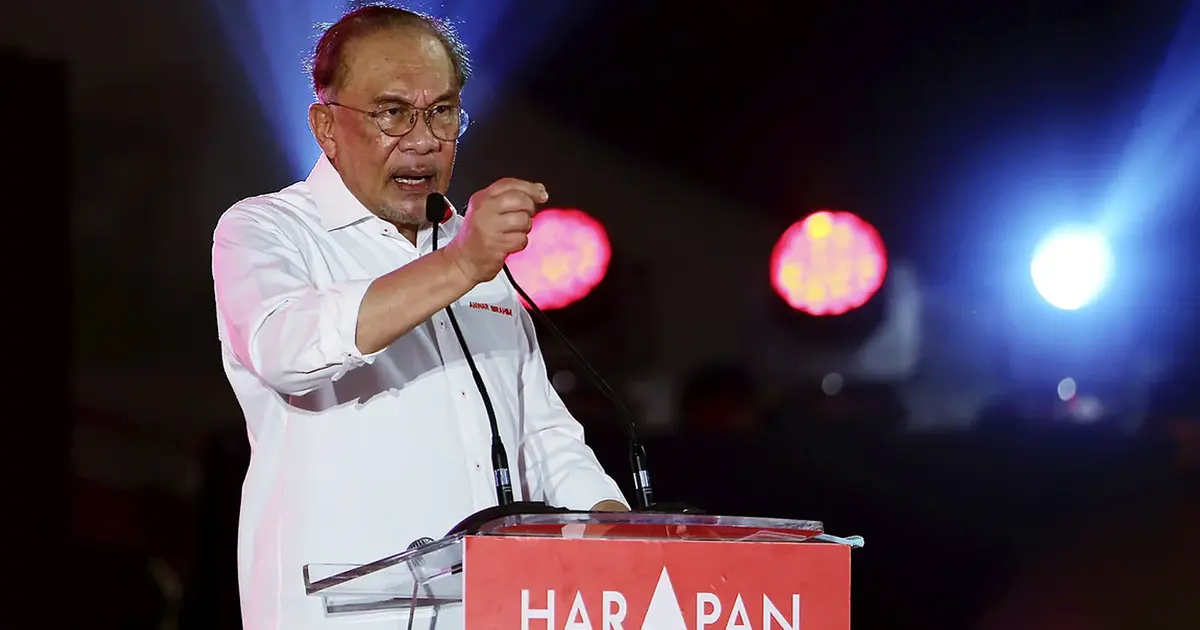
Prime Minister Anwar Ibrahim has issued a pointed warning to all political parties contesting the Negeri Sembilan state election, urging them to refrain from entangling the state's revered royal institution in campaign rhetoric and electoral manoeuvrings. As chairman of Pakatan Harapan, Malaysia's ruling coalition, Anwar stressed that matters concerning Negeri Sembilan's monarchy must remain insulated from the rough-and-tumble of political competition, a boundary he views as essential to upholding constitutional norms and public confidence in state institutions.
The statement reflects growing concern within government circles that the upcoming Negeri Sembilan election could become a flashpoint for institutional sensitivities. By explicitly addressing the issue ahead of intensive campaigning, Anwar has signalled that the federal administration takes seriously any attempt to draw the royal household into partisan disputes. This preemptive messaging demonstrates how even in Malaysia's more established states, electoral contests can create pressure to exploit symbolic and institutional friction for electoral gain—a temptation Anwar believes all parties must resist.
Negeri Sembilan occupies a distinctive constitutional position within Malaysia's federation, with the Duli Yang Maha Mulia Yang diPertuan Besar functioning as the head of state and custodian of customary Minangkabau traditions that remain deeply woven into the state's identity. The institution carries particular weight in the Minangkabau heartland, where concepts of adat (customary law) and royal stewardship command profound respect. Any attempt to politicise the Duli Yang Maha Mulia could therefore inflame sensitivities far beyond typical partisan disagreements, threatening to damage public respect for the monarchy and destabilise the social compact that underpins stable governance in the state.
Anwar's intervention underscores a broader principle embedded in Malaysia's constitutional framework: that the monarchy, while performing ceremonial and symbolic functions, should remain above the fray of everyday politics. This principle has historically served Malaysian democracy by ensuring that citizens across the political spectrum maintain loyalty to the Crown, regardless of which government holds executive power. When political actors blur this line—whether by invoking royal endorsement, speculating about royal preferences, or suggesting royal grievances with particular administrations—they risk eroding the institutional independence that makes constitutional monarchy functional and stabilising.
The timing of Anwar's remarks carries additional significance given the complex political dynamics that have characterised Negeri Sembilan in recent years. The state has experienced multiple shifts in administration and coalition alignments, creating a competitive environment where political actors may be tempted to utilise every possible advantage. By establishing clear boundaries now, Anwar aims to create expectations for the broader contest and position the ruling coalition as defender of institutional propriety—a framing that can resonate with voters concerned about political stability and respect for constitutional structures.
For Malaysian and Southeast Asian observers, the statement illustrates the delicate balance required to maintain stable democracy in a constitutional monarchy. Unlike purely republican systems where heads of state are routine political figures, Malaysia's system depends upon separating the monarchy's symbolic authority from the machinery of partisan competition. When that separation erodes, as it has in certain electoral cycles, public faith in both democratic processes and the monarchy itself can suffer. Anwar's intervention suggests the leadership recognises this risk and views prevention as preferable to remediation.
The directive also carries implicit messaging for opposition parties, which might otherwise be tempted to mobilise grievances—real or imagined—related to royal decisions or policies. By establishing that such tactics fall outside acceptable electoral conduct, Anwar has raised the political cost of such strategies and appealed to a norm-based conception of legitimate political competition. Whether all contending parties accept this framework remains to be seen, but the formal guidance from the nation's chief executive carries considerable weight in shaping campaign behaviour.
Practically speaking, parties will need to navigate their Negeri Sembilan campaigns without reference to royal preferences, alleged royal conflicts with particular candidates or administrations, or suggestions that the monarchy somehow favours one political option over another. This constrains the rhetorical toolkit available to candidates but protects the institution's neutrality and the state's ability to function smoothly regardless of electoral outcomes. The constraint also reflects democratic maturity—the recognition that sustainable competitive politics depends upon some things remaining genuinely above politics.
For Negeri Sembilan's electorate, Anwar's message provides reassurance that the election will be decided on policy platforms and leadership capacity rather than institutional intrigue. Voters can focus on bread-and-butter issues: economic development, service delivery, education and healthcare—matters where genuine differences between political parties merit voter attention and differentiation. An election conducted along these lines strengthens democratic legitimacy and produces governments with clearer public mandates for specific policy agendas.
The broader implications extend throughout Malaysia's political system, where the relationship between monarchy and electoral politics remains a subtle and sometimes contested terrain. By articulating clear expectations at the federal level, Anwar has contributed to a normative framework that other state-level contests can reference and emulate. As Malaysia matures as a democracy, establishing and reinforcing such norms becomes increasingly important for preventing democratic competition from spilling into institutional domains where it creates instability and corruption of public institutions.

