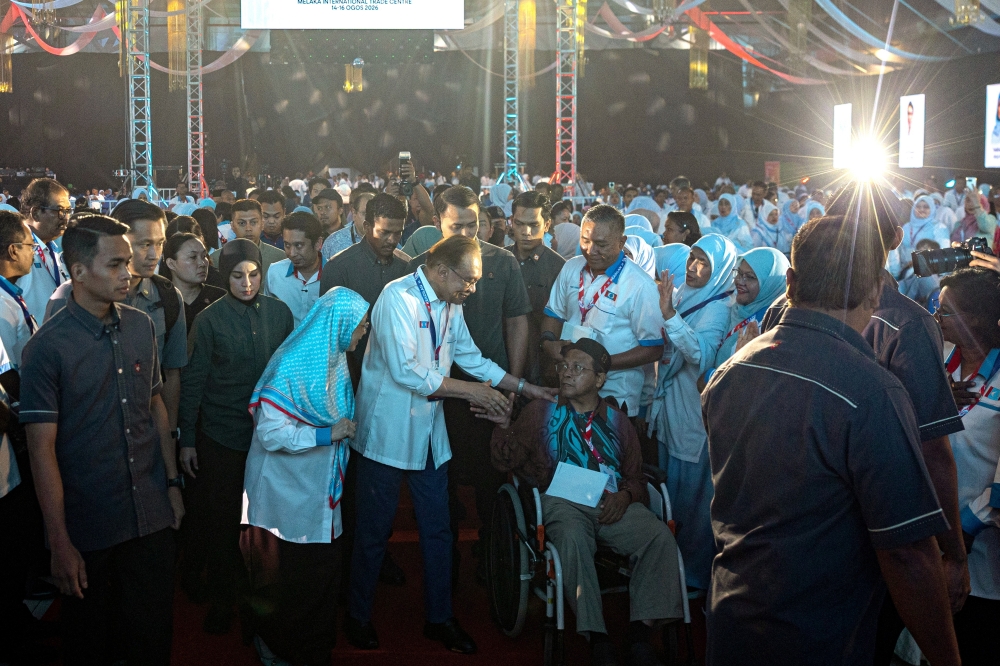
Prime Minister Anwar Ibrahim delivered a measured message to PKR delegates gathered in Melaka, emphasising that the ruling coalition's strategic decisions concerning Umno must be anchored in tangible benefits for ordinary Malaysians rather than reactive sentiment. Speaking in his capacity as both the nation's chief executive and the president of his party, Anwar framed the relationship between Pakatan Harapan's component parties and the traditional powerbroker as a matter requiring rational deliberation centered on governance outcomes.
The statement carries considerable weight given the fractious history between PKR and Umno, parties that have alternated between fierce opposition and cautious cooperation depending on the political climate. Anwar's emphasis on welfare-based decision-making suggests an attempt to anchor coalition discussions in measurable policy achievements rather than allowing historical grievances to dictate tactical choices. This approach reflects the practical challenges of managing a multiparty coalition where component members hold competing interests and divergent party bases with distinct priorities.
Anwar's framing of the issue as one of prioritising people's welfare over emotional reactions implies recognition that some PKR members harbour deep mistrust of Umno, rooted in decades of political rivalry and ideological differences. By explicitly invoking the people's welfare as the metric for evaluation, the Prime Minister appears to be signalling that pragmatism should override internal party sentiment when assessing engagement with rival political actors. This reasoning extends beyond personalised antagonisms to broader questions about what serves the electorate's material interests.
The context for these remarks centres on the evolving dynamics of Malaysia's ruling coalition since the 2022 election delivered a hung parliament, forcing unprecedented cooperation arrangements. Umno, despite losing federal power, retains substantial presence in state governments and wields considerable parliamentary leverage. Navigating this relationship has proven one of the most delicate balancing acts of Anwar's administration, requiring careful management to maintain cabinet stability while preserving the legitimate interests of PKR and its coalition partners.
For Malaysian readers, the significance of Anwar's message extends to broader questions about coalition governance and the sustainability of multi-party arrangements. The coalition model has proven necessary given Malaysia's increasingly fragmented electoral landscape, where no single party commands a clear majority. However, this fragmentation creates persistent tension between partners with conflicting visions. Anwar's appeal to welfare-focused criteria suggests an attempt to create objective benchmarks for decision-making that could transcend factional considerations.
Regionally, Malaysia's coalition arrangements have implications for how other Southeast Asian democracies manage multi-party governance. Countries including Thailand and Indonesia similarly grapple with coalition mathematics and the challenges of maintaining discipline across ideologically diverse partnerships. The emphasis on welfare-based evaluation rather than emotional governance offers a potential model for managing such relationships, though implementation remains considerably more challenging than articulation.
The remarks also reflect Anwar's position as a consensus-builder within Pakatan Harapan, a coalition that includes DAP, Amanah, and various other smaller parties alongside PKR. Managing these diverse interests while maintaining productive relations with Umno requires extraordinary diplomatic skill. By appealing to welfare considerations, Anwar attempts to elevate discussions above the interpersonal and historical animosities that frequently complicate coalition politics.
PKR's particular sensitivity regarding Umno stems from the party's origins in opposition to Umno-led governance and its core membership's experience of Umno political dominance. For many PKR members, the current arrangement represents a pragmatic necessity rather than a genuine political realignment. Anwar's speech appears designed to acknowledge these reservations while arguing that governance effectiveness must ultimately determine coalition management rather than unresolved historical disputes.
The broader Malaysian political context also involves state-level considerations. Umno-controlled state governments often operate with different priorities than the federal administration, creating friction points where coalition discipline tests its limits. Anwar's welfare-focused framework suggests a need for alignment between federal and state-level policies, with decisions evaluated based on demonstrable benefits to citizens across all jurisdictions governed by coalition partners.
Moving forward, this statement may serve as a reference point for coalition negotiations and strategic decisions. Should contentious issues arise regarding Umno's continued participation in government structures or cabinet positions, Anwar's articulation of welfare-based criteria could provide a framework for deliberation. Whether PKR members will consistently apply such criteria remains uncertain, particularly if specific decisions appear to benefit Umno at the expense of other coalition partners' perceived interests.
The Prime Minister's approach also reflects international trends in coalition governance, where pragmatism increasingly trumps ideological purity in managing multi-party arrangements. Democratic systems worldwide have witnessed similar evolution, with former adversaries finding themselves obliged to cooperate when no alternative provides viable governance options. Anwar's appeal to welfare considerations frames this transition not as political compromise but as rational administration guided by citizen interests.
Looking ahead, the sustainability of Malaysia's current coalition arrangement may well depend on whether its component parties can consistently prioritise welfare-based evaluation over emotional or historical grievances. Anwar's remarks suggest he understands this fundamental challenge and is attempting to establish decision-making principles that transcend factional disputes. Whether such principles can survive the pressures of competitive politics and safeguard the coalition through its next electoral cycle remains an open question that will have significant implications for Malaysian governance.

