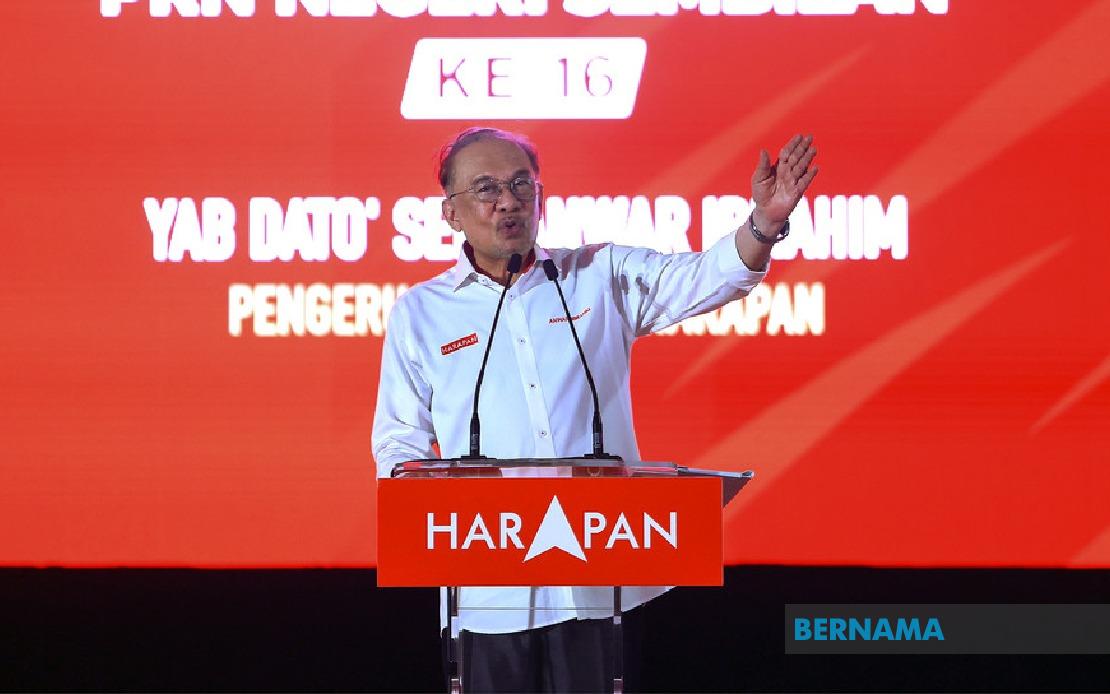
Prime Minister Datuk Seri Anwar Ibrahim has made a direct appeal to voters in Negeri Sembilan to sustain their backing for Pakatan Harapan in the 16th state election, framing the upcoming poll as critical to preserving the momentum of development and economic progress in the state. In a social media statement, Anwar stressed that re-electing the coalition would guarantee the continuation of infrastructure projects and public services that have begun transforming the state since 2018, while cautioning against allowing these gains to be interrupted by a change in administration.
As both Prime Minister and chairman of Pakatan Harapan, Anwar's intervention underscores the federal leadership's strategic priority on Negeri Sembilan at a time when coalitional politics in Malaysia remain fluid and competitive. The appeal effectively ties the state election to the broader narrative of stability and progress that the federal PH government has been advancing since returning to power in 2022. By positioning the election as a referendum on development continuation rather than a choice between contrasting ideological visions, Anwar is employing a pragmatic messaging strategy that emphasises tangible outcomes over partisan rhetoric.
Central to Anwar's argument is the performance record of Menteri Besar Datuk Seri Aminuddin Harun, whom the Prime Minister commended for leading Negeri Sembilan with integrity and humility since 2018. Anwar's characterisation of Aminuddin as "Tok Min" and his emphasis on the Menteri Besar's personal qualities suggest an attempt to build the election campaign around the incumbency advantage and the perceived competence of the existing state administration. This personalisation of the campaign reflects a broader trend in Malaysian electoral politics where individual leaders and their perceived track records increasingly influence voter behaviour, particularly in determining whether voters view a transition of power as risky or beneficial.
The cooperation between Negeri Sembilan's state government and the federal administration has been highlighted as fundamental to delivering development outcomes. This partnership narrative is significant for Malaysian regional politics, as it illustrates how federal-state coordination under aligned governments can accelerate project implementation. For voters in Negeri Sembilan, the implication is that a change in state administration that breaks this political alignment could potentially disrupt funding flows, bureaucratic efficiency, and the prioritisation of state-level projects within federal development frameworks. This argument carries particular weight in a state that has historically received substantial federal allocations for infrastructure modernisation.
Anwar's appeal carries additional weight given the competitive nature of Malaysian coalition politics. Negeri Sembilan has been a relatively stable Pakatan Harapan state, but the broader political landscape has seen significant shifts in recent years, with various coalitions gaining or losing ground in different regions. The Prime Minister's direct intervention suggests that the federal party leadership views the state election as consequential not merely for Negeri Sembilan's governance but for the broader health and trajectory of the Pakatan Harapan coalition at a time when it continues to consolidate its position following the 2022 general election.
The timing of Anwar's message, released well before nomination day on Saturday, reflects a methodical campaign strategy designed to build momentum and reinforce party messaging across all levels of PH's political apparatus. By initiating the campaign narrative early, the federal leadership seeks to establish the frame through which voters will evaluate candidates and parties once campaigning formally begins. This early intervention also signals to state-level PH machinery and candidates that the federal government is actively invested in the outcome, potentially boosting morale and resource allocation for campaign activities.
The election schedule—with nominations on Saturday, early voting on July 28, and polling on August 1—compresses the formal campaign period into a relatively brief window. This compressed timeline gives particular importance to pre-campaign messaging and the narrative framework established by senior leadership like Anwar. Voters exposed to the Prime Minister's appeal are likely to carry these arguments into their deliberations as the official campaign unfolds, making early positioning by federal leaders strategically valuable in shaping electoral outcomes.
From a regional Southeast Asian perspective, Anwar's emphasis on clean governance and stability reflects broader governance challenges across the region. Malaysia's transition to more competitive and dynamic coalition politics mirrors patterns seen in other mature democracies in Asia, where voters increasingly make decisions based on evaluations of administrative competence and development delivery rather than purely partisan affiliation. This shift suggests that Malaysian political parties, regardless of coalition, must increasingly demonstrate tangible results and maintain administrative credibility to retain voter support.
The appeal for continuation rather than change also reflects underlying economic considerations. Negeri Sembilan's development trajectory over the past six years has positioned it as a moderately prosperous state with improving infrastructure and economic prospects. Voters contemplating a change in administration must weigh the potential benefits of new leadership against the risk of disrupting this trajectory and the federal coordination that underpins it. This calculation likely favours incumbency, provided the current administration maintains public confidence in its competence and integrity.
Anwar's invocation of Islamic phrases—"Alhamdulillah" and "Insya-Allah"—also reflects an important dimension of Malaysian political communication. By grounding his appeal in religious language, the Prime Minister connects the secular argument about development continuity to deeper cultural and spiritual values shared by the predominantly Muslim electorate in Negeri Sembilan. This rhetorical approach allows PH to appeal to voters on multiple registers simultaneously: the practical argument about development, the institutional argument about stable governance, and the value-based argument about integrity and responsibility in public service.
The broader implication of Anwar's appeal is that Pakatan Harapan intends to approach the Negeri Sembilan election as a defensive campaign aimed at retaining control rather than as an opportunity to expand significantly. This defensive posture suggests confidence in the current administration's performance but also recognition that complacency could prove costly in a competitive political environment. The federal leadership's early engagement is designed to mobilise base support and prevent erosion of the incumbent coalition's voter coalition before opposition parties can build counter-narratives.
For Malaysian observers and political analysts, this election serves as a significant barometer of voter sentiment toward the current federal government's performance and the viability of Pakatan Harapan's continued governance. Success in Negeri Sembilan would affirm the coalition's ability to retain voter support in state contests, while defeat could signal broader challenges for PH ahead of future electoral cycles. Anwar's personal appeal thus carries weight beyond Negeri Sembilan, touching on questions about the stability and durability of Malaysia's current political settlement.

