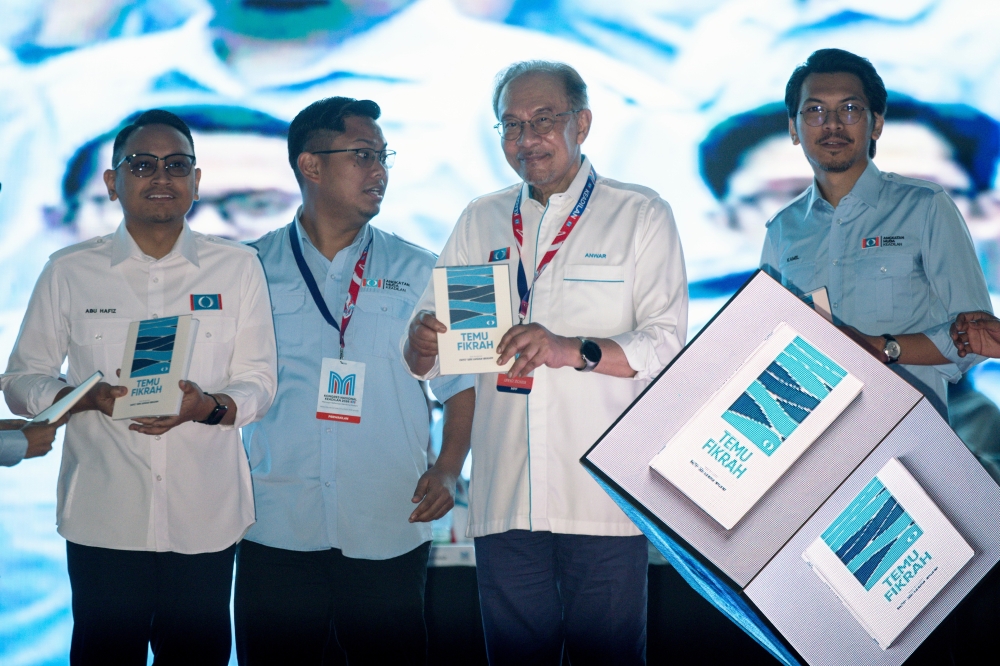
Prime Minister Datuk Seri Anwar Ibrahim launched Temu Fikrah in Melaka on August 16, positioning the initiative as a foundational document that blends ideological principles with practical guidance for Parti Keadilan Rakyat's youth wing. The manifesto-manual represents a structured attempt to channel youthful energy and innovation toward supporting the government's Madani governance agenda while simultaneously strengthening party cohesion among younger members who form an increasingly critical demographic in Malaysian politics.
The concept of Temu Fikrah—loosely translating to "gathering of ideas"—reflects PKR's broader effort to modernise its approach to party messaging and member engagement. Rather than relying solely on traditional political speeches or manifestos, the document serves a dual purpose: articulating the party's vision to external audiences while simultaneously functioning as an instructional guide for youth activists on how to embody and communicate party values at the grassroots level. This hybrid approach acknowledges the reality that today's political engagement, particularly among younger voters and party members, requires both ideological clarity and practical toolkits for action.
Courage emerges as a central pillar of the initiative, emphasising the need for PKR Youth to advocate boldly for principles of democracy, transparency, and accountability. In the Malaysian context, where political discourse has historically been constrained by concerns about sensitive matters, explicitly framing courage as a party value signals an intention to differentiate PKR as a vehicle for substantive political debate. This positioning carries particular significance given the party's role in the Pakatan Harapan coalition and its influence within government structures where policy decisions directly affect the nation's development trajectory.
Creativity as a governance principle reflects contemporary understanding that solutions to complex policy challenges require innovative thinking beyond conventional bureaucratic approaches. For PKR Youth—composed largely of university-educated professionals, digital natives, and emerging community leaders—this emphasis provides legitimacy for experimental approaches to constituent engagement, social media mobilisation, and evidence-based policy advocacy. The focus on creativity also subtly positions PKR as forward-thinking compared to rival parties, a distinction particularly relevant to urban and younger voter demographics that often prioritise progressive governance models.
The Madani governance framework, which has been central to the Anwar administration's messaging since taking office, emphasises prosperity, unity, and sustainability as interconnected governance objectives. By explicitly tethering Temu Fikrah to Madani principles, PKR Youth members receive direct instruction on translating abstract governmental goals into concrete community-level initiatives. This vertical alignment between party ideology, youth activism, and government policy represents a sophisticated attempt to prevent disconnects between party rhetoric and administrative action—a vulnerability that has historically weakened coalition governments in Malaysia.
Launching the initiative specifically in Melaka carries symbolic weight, as the state holds historical significance in Malaysian politics and represents a competitive electoral arena where youth mobilisation could prove decisive in future contests. The choice of venue signals confidence in PKR's organisational presence in Melaka while simultaneously positioning the party as engaged with regional dynamics beyond the federal capital. For Melaka residents and party members, the launch demonstrates direct attention from the Prime Minister to their locality, potentially reinforcing grassroots commitment to party structures.
The timing of Temu Fikrah's launch reflects broader political considerations surrounding coalition stability and electoral preparation. With mid-term elections looming and recent electoral setbacks in several states testing coalition unity, a renewed emphasis on internal party messaging and youth engagement serves multiple functions: it provides visible evidence of government accessibility and party dynamism, it strengthens mechanisms for translating party directives to grassroots activists, and it creates a rallying point around which diverse party factions can coalesce. For PKR specifically, managing internal tensions between reformist and establishment wings has required careful calibration; framing youthful activism through structured channels like Temu Fikrah offers a mechanism for channelling idealism productively.
The manifesto-manual format itself warrants consideration as a governance innovation. Rather than producing a dense policy document or inspirational tract divorced from practical application, the hybrid approach acknowledges that contemporary political engagement requires both vision and operational instruction. Youth members receive not merely exhortations to embody party values but concrete frameworks for translating those values into community organising, policy advocacy, and constituent service. This reflects lessons from political movements across the region that have successfully mobilised young populations through combining clear ideology with actionable programmes.
For the broader Malaysian political landscape, Temu Fikrah represents an attempt by government-aligned parties to recapture narrative terrain that opposition movements have occasionally dominated among younger voters. By explicitly emphasising creativity and courage as governance values, PKR Youth positions itself as aligned with generational aspirations for innovation and integrity rather than merely defending existing power structures. This becomes particularly important as Malaysia navigates technological disruption, climate challenges, and evolving social expectations that demand adaptive governance approaches.
The initiative also reflects recognition that party sustainability depends on effective transmission of ideology and values to newer generations of members. As Malaysia's political landscape becomes increasingly volatile and generational cohorts display distinct political preferences, mechanisms like Temu Fikrah that explicitly bridge generational divides become strategically essential. Young PKR members receive structured guidance on party positioning, while senior leadership gains insights into how emerging generations interpret and operationalise core party principles, creating feedback mechanisms that strengthen organisational coherence.

