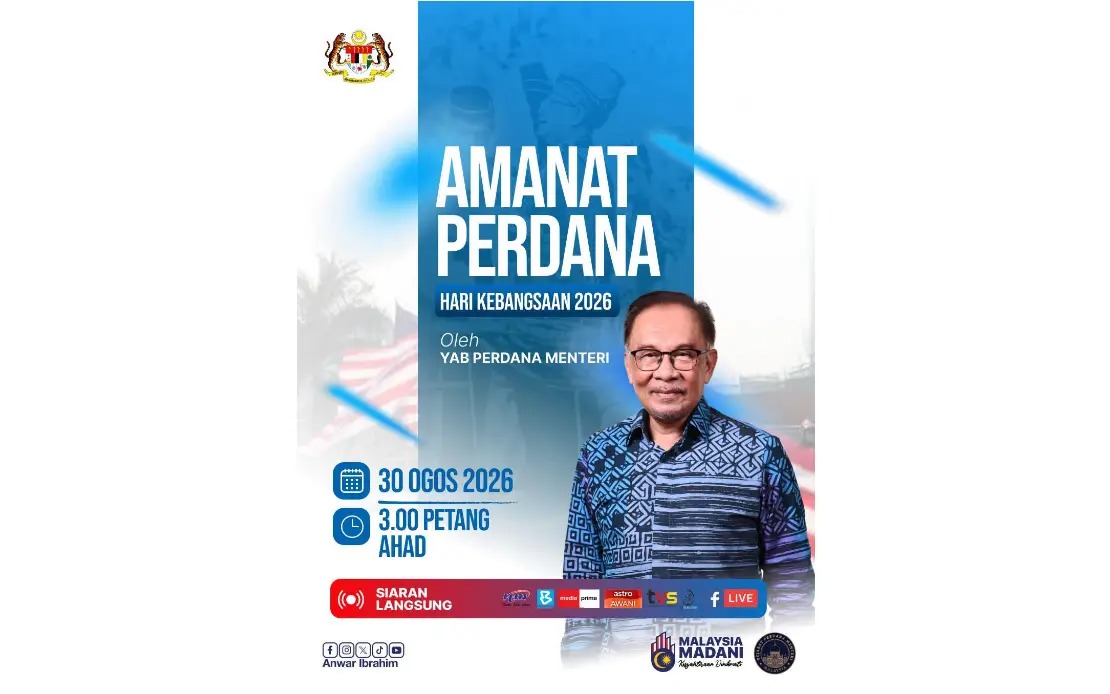
Prime Minister Datuk Seri Anwar Ibrahim will take the stage at the Putrajaya International Convention Centre tomorrow afternoon to deliver Malaysia's National Day address, an occasion he has signalled will feature the announcement of several significant policy initiatives aimed at addressing pressing concerns facing ordinary Malaysians. Through a Facebook statement released on Friday, Anwar indicated that his remarks would encompass a broad range of issues touching on citizens' day-to-day experiences and realities, while also serving as a moment for reflection on the nation's democratic legacy and the responsibilities incumbent upon the current generation of leaders and citizens alike.
The timing of Anwar's address comes as Malaysia approaches nearly seven decades since achieving independence, a milestone that the Prime Minister has framed as an opportunity to acknowledge the foundational sacrifices made by previous generations. In his statement, Anwar emphasised the historical struggle that preceded national sovereignty, noting how earlier leaders and ordinary Malaysians had endured considerable hardship—described in his words as involving sweat, blood, and tears—to establish the nation's independence. This historical perspective serves as more than mere ceremonial reflection; it establishes a narrative thread connecting Malaysia's post-colonial achievements to contemporary governance challenges that the current administration must navigate.
Beyond historical commemoration, Anwar has positioned the National Day address as a moment for introspection regarding how present-day Malaysians and policymakers should steward the independence that was bequeathed to them. He articulated this as a fundamental responsibility—not simply to inherit independence as a passive legacy, but to actively uphold it and ensure it remains meaningful within the contemporary context. This framing suggests that the initiatives to be announced may carry implications for how Malaysia defines and operationalises its sovereignty in addressing modern economic, social, and governance challenges that distinguish the 2020s from earlier post-independence decades.
Crucially, Anwar used his pre-address statement to appeal directly to the Malaysian public to channel National Day celebrations into concrete demonstrations of national unity and social cohesion. Rather than treating the occasion purely as a ceremonial holiday, he urged citizens to view it as an opportunity to consciously strengthen bonds across Malaysia's diverse racial and religious communities. This emphasis reflects broader concerns within the administration about managing social tensions and preventing divisive rhetoric that could fracture intercommunal relations—a priority that has become increasingly central to Malaysian political discourse in recent years.
The Prime Minister's call to reject incitement and resist narratives designed to sow hatred between communities of different backgrounds addresses a genuine challenge facing Malaysia's pluralistic society. By linking this appeal directly to National Day observance, Anwar attempted to frame national unity not as a peripheral concern but as foundational to the very independence the nation celebrates. In the Malaysian context, where periodic episodes of communal tension have occasionally strained the social fabric, such explicit reminders carry particular weight and reflect administrative anxiety about maintaining the delicate equilibrium that underpins Malaysia's multicultural model.
Anwar also connected national unity efforts to practical governance outcomes, specifically emphasising that the preservation of peace and citizen well-being depend fundamentally on the health of intercommunal relations. This linkage carries economic and social implications; persistent communal discord or fear-driven political mobilisation can deter investment, disrupt business continuity, and redirect public resources toward managing conflict rather than addressing development priorities. By grounding his unity appeal in tangible outcomes affecting ordinary Malaysians' material circumstances, the Prime Minister positioned social cohesion as not merely a moral imperative but as an instrumental necessity for effective governance and prosperity.
The announcement that key initiatives will be unveiled during the National Day address suggests that the government has deliberately selected this high-profile occasion to introduce policies or programmes intended to resonate with the broader Malaysian public. National Day addresses typically command substantial media attention and public interest, making them an optimal platform for unveiling initiatives that require immediate visibility and public awareness. The nature of these initiatives remains undisclosed ahead of the speech, though the Prime Minister's reference to issues affecting daily life suggests they may encompass economic, social welfare, or public service matters of direct relevance to ordinary Malaysians.
For regional observers and Malaysian stakeholders, the National Day address will offer insight into the current administration's policy priorities and how it intends to frame Malaysia's development trajectory and national identity during a period when several Southeast Asian nations are navigating significant economic and geopolitical transitions. The initiatives to be announced may signal the government's positioning on issues such as digital transformation, economic restructuring, climate action, or social investment—domains where Malaysia's choices carry implications extending beyond its borders.
The lead-up to this address also provides context for understanding contemporary Malaysian politics, where balancing national cohesion with reform agendas and satisfying diverse constituent expectations remains a continuous challenge for any governing coalition. Anwar's emphasis on historical gratitude combined with forward-looking policy announcements reflects an administration attempting to legitimise its governance through both nostalgic appeals to foundational national values and concrete demonstrations of its capacity to deliver tangible benefits to citizens. Whether the initiatives announced tomorrow achieve sufficient impact to shift public perceptions or reinforce existing political dynamics will become clearer in the weeks following the address.

