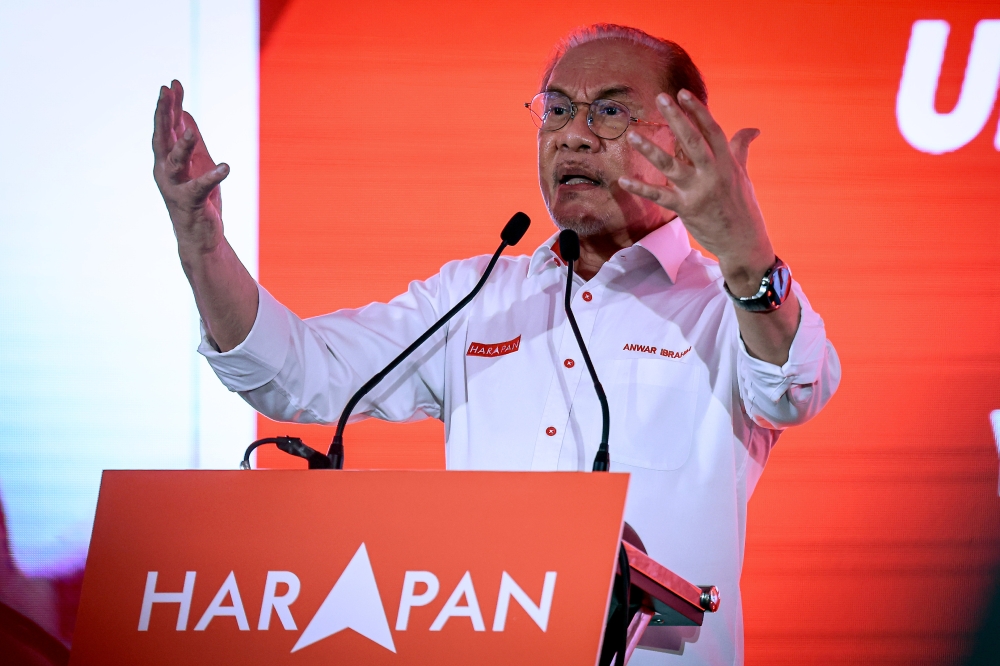
Prime Minister Datuk Seri Anwar Ibrahim has launched his campaign efforts in Negeri Sembilan, marking a significant moment for Pakatan Harapan's electoral strategy in the state. The campaign foray underscores the coalition's determination to build momentum heading into what analysts expect could be a crucial contest for the region's political future.
Anwar's presence in Seremban represents more than a routine political appearance. The Prime Minister's direct involvement signals that the ruling coalition views Negeri Sembilan as strategically important, with implications extending beyond the state itself. Negeri Sembilan has historically been competitive territory, and controlling the narrative there carries weight for broader national politics. The timing of this campaign push suggests Pakatan is working to shore up support while sentiment remains fluid among voters.
The campaign trail visit demonstrates Pakatan's multi-front approach to maintaining electoral viability. Rather than relying solely on state-level operators, the coalition is deploying its highest-profile national figure to energise grassroots support and demonstrate central leadership's commitment to the region. This approach reflects lessons learned from previous electoral contests, where personal campaigns by senior leaders often generate media attention and reshape local perceptions of candidate viability.
Negeri Sembilan's political complexion has evolved considerably over recent years. The state represents a microcosm of Malaysia's changing voter preferences, with growing urbanisation in areas like Seremban creating younger, more diverse electorates. These constituencies often respond well to messaging focused on economic management and governance quality—precisely the themes Anwar has emphasised throughout his tenure. His campaign in the state will likely concentrate on such bread-and-butter issues that resonate with middle-class voters concerned about living costs and employment prospects.
For Pakatan Harapan, maintaining momentum is operationally essential. Coalition partners must remain cohesive and demonstrate that their electoral partnership translates into tangible voter support. Fractures within the coalition or perceptions of weakness could embolden opposition parties to exploit divisions. Anwar's campaign appearance helps project unity and determination, sending internal messages to party machinery as much as reaching external voters. When the Prime Minister personally campaigns, it reinforces to party operatives that central leadership takes their state seriously.
The opposition, particularly Barisan Nasional and Perikatan Nasional, will closely monitor Pakatan's campaign activities in Negeri Sembilan. Opposition strategists recognise that if Pakatan gains ground in the state, it could establish a platform for further electoral advances. Conversely, if Pakatan's campaign struggles to gain traction despite Anwar's involvement, that weakness could become ammunition for opposition messaging nationally. The campaign thus serves as a testing ground for broader political narratives.
Anwar's leadership style emphasises direct engagement with constituencies and voters. His personal participation in campaign events reflects this approach, creating opportunities for face-to-face interactions that local politicians alone might not generate. Such engagement, while requiring significant time commitments from a sitting Prime Minister, serves multiple purposes: it energises party volunteers, attracts media coverage, and allows Anwar to assess grassroots sentiment firsthand. These insights often prove valuable for fine-tuning national messaging.
The broader electoral context cannot be ignored. Malaysia's political landscape remains fluid, with no party or coalition commanding overwhelming dominance. In such circumstances, every state contest carries implications for national stability and parliamentary arithmetic. Negeri Sembilan, while not the largest state, possesses enough constituencies to swing outcomes if margins prove tight. This explains why Pakatan is investing leadership capital in the state's campaign efforts.
Economic messaging will likely feature prominently in Anwar's campaign appearances throughout Negeri Sembilan. The state encompasses both rural agricultural areas and developed urban centres, requiring tailored approaches to different voter concerns. In towns and cities, messaging may emphasise job creation, investment attraction, and fiscal responsibility. In rural constituencies, agricultural support, rural development, and commodity prices would take precedence. Anwar's national perspective allows him to address these varied concerns within a coherent economic framework.
Pakatan's campaign push in Negeri Sembilan also reflects the coalition's understanding that electoral contests are won through sustained effort rather than last-minute mobilisation. By deploying senior leadership early in the campaign cycle, Pakatan signals that it intends to compete seriously rather than concede ground to opponents. Such early engagement allows coalitions to identify weaknesses in organisation or messaging and address them before election day arrives.
The campaign moment highlights how Malaysian politics increasingly revolves around leader personalities and coalition brand management. Voters often evaluate coalitions partly through the lens of their senior figures. Anwar's profile as an economic manager and administrator appeals to pragmatic voters focused on governance competence rather than ideological purity. This positioning offers Pakatan strategic advantages in urban and semi-urban constituencies where such considerations predominate.
Looking forward, Anwar's Negeri Sembilan campaign should be understood as part of a longer-term electoral strategy. The coalition is laying groundwork for contests that may emerge within the next electoral cycle, whenever that materialises. By maintaining visible leadership engagement and demonstrating coalition unity, Pakatan hopes to preserve its electoral coalition and prevent defections that could undermine its parliamentary position or electoral prospects. The campaign thus serves both immediate political purposes and longer-term strategic objectives for the ruling coalition.

