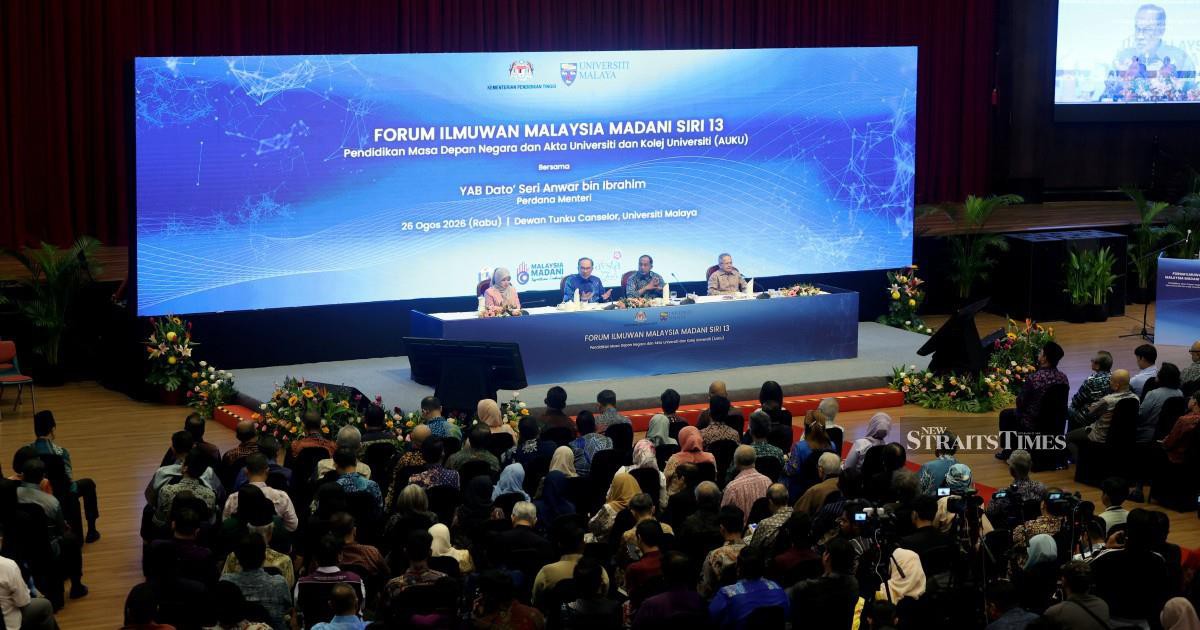
Prime Minister Datuk Seri Anwar Ibrahim has asked university students and education stakeholders to place confidence in the government's commitment to comprehensive reform, signalling that the administration is taking the contentious AUKU university law seriously despite the lack of immediate action. The Universities and University Colleges Act, commonly known as AUKU, remains one of Malaysia's most debated pieces of legislation, and Anwar's remarks indicate that reform remains on the national agenda even as the government prioritises other policy priorities.
The AUKU law, enacted during the British colonial era and retained after independence, has long been a focal point of criticism from student activists, civil society organisations, and academics who argue that its provisions unduly restrict fundamental freedoms including political expression, association, and assembly on campus grounds. The legislation prohibits university students and staff from engaging in political activities and demonstrations, ostensibly to maintain campus tranquillity but in practice limiting democratic participation among young people during their formative years. For generations of Malaysian students, AUKU has represented a symbol of state control over intellectual discourse and the free exchange of ideas that should characterise university life.
Anwar's appeal for "time and space" suggests the government recognises the urgency of addressing student concerns while acknowledging that legislative reform cannot happen overnight or in isolation from broader considerations about campus governance, institutional autonomy, and public order. The Prime Minister's framing indicates an administration caught between genuine reform impulses and practical constraints—whether budgetary, political, or administrative—that may slow the pace of legislative change. This measured approach may frustrate activists who have been campaigning for AUKU's abolition for decades, yet it reflects the complexity of unwinding legislation that has structured Malaysian higher education for so long.
The government's planned "comprehensive improvement measures" likely extend beyond simply repealing AUKU in its entirety. True reform would require establishing alternative frameworks for maintaining campus safety and institutional order while expanding student rights to engage in political discourse, join student unions, and participate in democratic processes. Such measures might include new codes of conduct, revised disciplinary procedures, clearer definitions of permissible campus activities, and mechanisms for student representation in university governance. These supporting structures would need to be carefully designed to protect legitimate university interests without resurrecting the blanket prohibitions that AUKU currently imposes.
For Malaysian university students, particularly those at large campuses like the University of Malaya and Universiti Kebangsaan Malaysia, AUKU reform carries profound implications for campus life and student political culture. Young people in their late teens and twenties are excluded from participating in political campaigns, organising demonstrations, or even displaying political symbols on campus—restrictions that fundamentally differ from student freedoms in many comparable democracies. The inability to engage politically during university years means that an entire generation of Malaysians develops its political consciousness under state-imposed constraints, potentially affecting long-term civic participation patterns and democratic culture.
The broader Southeast Asian context highlights Malaysia's outlier status regarding student freedoms. Neighbouring countries including Thailand, Indonesia, and the Philippines have all substantially reformed or eliminated equivalent restrictions on campus political activity in recent decades, allowing universities to function as spaces where diverse ideas can be tested and debated. Malaysia's AUKU stands as a residual colonial legacy, more restrictive than many peer institutions across the region, and reform would bring Malaysian higher education into greater alignment with international norms regarding academic freedom and university autonomy. This regional comparison strengthens the case for reform among policymakers seeking to enhance Malaysia's position as an education hub.
Stakeholder buy-in remains essential for successful AUKU reform. University administrators, who have managed campuses under AUKU's restrictions for decades, may harbour concerns about maintaining order if political activity is permitted. Faculty members, particularly senior academics, hold diverse views about the desirability and pace of change. Student organisations, civil rights groups, and education activists will scrutinise any proposed measures to ensure they deliver genuine freedom rather than cosmetic adjustments. Achieving consensus among these constituencies while moving legislative reform forward represents a significant political management challenge, explaining why Anwar emphasises the need for stakeholder trust and patience.
The economic dimension of higher education reform also influences timing and approach. Malaysia has invested considerably in developing its universities as regional research and education hubs, competing for international students and faculty. Restrictions on campus freedom, including AUKU provisions, sometimes feature in international criticism of Malaysian higher education and may discourage talented international academics from accepting positions. Modernising university governance frameworks, including AUKU reform, thus serves economic development goals alongside ideological commitments to democratic values and student rights.
Anwar's statement represents a recognition that AUKU reform cannot simply be declared by executive fiat—the law must be changed through parliamentary legislation, requiring majority support and coordination among government agencies responsible for education, security, and public order. The complexity of harmonising reform across multiple departments, consulting stakeholders, and drafting replacement legislation that addresses concerns from all sides inevitably extends the timeline. By publicly requesting patience while committing to comprehensive improvement, Anwar positions the government as responsive to student and civil society demands while maintaining realistic expectations about implementation timelines.
The path forward will likely involve a gradual loosening of restrictions through regulatory reform and selective legislative amendments before considering wholesale repeal. Such an incremental approach, while frustrating to reform advocates, may prove more politically sustainable and practically effective than attempting comprehensive legislative overhaul in a single parliamentary session. University administrators would gain time to prepare new governance structures, and policymakers could evaluate how expanded freedoms function in practice before proceeding to subsequent reform phases. This measured progression would ultimately require the patience and trust that Anwar is now explicitly requesting from students and stakeholders invested in transforming Malaysia's higher education governance.

