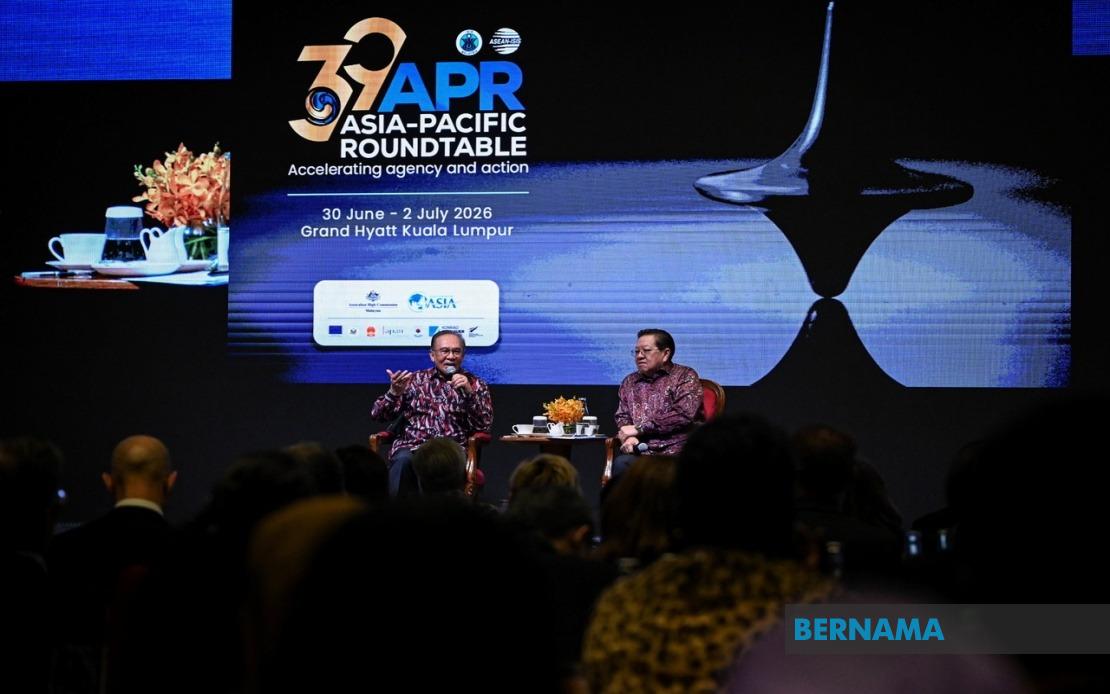
Prime Minister Datuk Seri Anwar Ibrahim has firmly rejected the prevailing pessimism surrounding maritime tensions in the South China Sea, asserting instead that peaceful resolution remains achievable through diplomatic channels and respect for international legal frameworks. Speaking at the 39th Asia-Pacific Roundtable in Kuala Lumpur on Thursday, Anwar dismissed alarmist rhetoric that portrays conflict as an inevitable outcome, positioning Malaysia as a voice for pragmatic engagement rather than confrontation in one of the world's most strategically sensitive waterways.
The Prime Minister's intervention represents a deliberate pushback against the conflict narrative that has dominated regional discourse, particularly as great power competition intensifies across the Indo-Pacific. By publicly stating his skepticism of what he termed "phobia about the potential threat," Anwar is signalling that Malaysia intends to maintain its balanced approach to the South China Sea disputes, avoiding polarisation between competing strategic interests while pursuing concrete avenues for resolution.
Central to Anwar's optimistic assessment is Malaysia's bilateral relationship with China, which he characterised as fundamentally sound despite longstanding maritime boundary disagreements. His references to direct conversations with President Xi Jinping and Premier Li Qiang underscore the channel of high-level communication that Malaysia has cultivated, suggesting that both nations have chosen to compartmentalise their disputes rather than allowing them to poison broader diplomatic ties. This approach reflects Malaysia's traditional strategy of maintaining constructive relations across major power divides, a posture particularly important given the country's economic interdependence with China.
Anwar emphasised that China has publicly committed to the United Nations Convention on the Law of the Sea, the foundational international instrument governing maritime conduct and territorial claims. This reference carries significant weight, as it grounds discussion within established legal frameworks rather than allowing disputes to devolve into power politics. The Prime Minister's invocation of UNCLOS suggests that while disagreements persist over maritime boundaries and resource rights, both Malaysia and China nominally subscribe to the same legal architecture, creating space for negotiation based on mutually recognised principles.
The ongoing negotiations for an ASEAN-China Code of Conduct represent the institutional mechanism through which the region hopes to manage tensions constructively. Anwar's reaffirmation of this process reflects Malaysia's investment in multilateral approaches that distribute responsibility for maintaining stability across multiple actors rather than concentrating it in bilateral relationships. The Code of Conduct, despite years of negotiation and competing interests, remains the most concrete framework through which ASEAN nations and China are attempting to establish rules governing conduct in disputed waters, from naval operations to fishing activities.
A critical aspect of Anwar's remarks involves his warning against excessive focus on military confrontation scenarios. He cautioned that narratives centred on the prospect of warfare in the region risk becoming self-fulfilling prophecies, potentially influencing policy choices and military posturing. This observation speaks to a persistent tension in regional security studies: the balance between honestly acknowledging risks and avoiding rhetoric that inadvertently accelerates the conditions one seeks to prevent. Malaysia, as a smaller player in these geopolitical contests, has incentive to promote de-escalatory language and preventative diplomacy.
Anwar also highlighted the mechanism through which ASEAN has historically preserved regional peace: sustained direct communication among leaders who have developed personal relationships and trust over time. This reference to ASEAN's internal cohesion acknowledges that the organisation's effectiveness depends not merely on institutional structures but on the willingness of member states' leadership to engage regularly and resolve differences before they harden into formal disputes. Malaysia itself occupies a position where it must balance its ties to China with its commitments to ASEAN solidarity, making this emphasis on personal diplomacy particularly relevant to its own strategic positioning.
Turning to broader multilateral architecture, Anwar signalled Malaysia's intention to advocate for reforms of global institutions, specifically naming the United Nations and the World Trade Organisation. This agenda reflects frustration within the region that existing international institutions inadequately represent the interests and voices of developing nations and emerging economies. Such reform efforts carry implications for how maritime disputes are arbitrated, how trade-related grievances are resolved, and how regional security issues are elevated to international attention.
The Prime Minister's acknowledgement of historical border disputes, illustrated through reference to the Cambodia-Thailand border issue, contextualises South China Sea disagreements within a longer chronology of territorial legacies inherited from colonial administration. By characterising these as historical rather than contemporary provocations, Anwar subtly reframes them as relics of the past that rational modern states can resolve through negotiation. His expression of confidence in sustained dialogue for the Cambodia-Thailand situation signals optimism that similar intractable disputes can yield to patient diplomacy and mutual interest in stability.
For Malaysian readers and policymakers, Anwar's remarks underscore the government's commitment to a non-confrontational approach to the South China Sea despite legitimate maritime claims and environmental concerns. This positioning reflects Malaysia's geographic and economic realities: the country cannot afford confrontation with China while simultaneously depending on regional stability for trade and investment flows. The Prime Minister's emphasis on dialogue and mutual trust, therefore, represents not naïveté but calculated statecraft suited to Malaysia's circumstances and capabilities.

