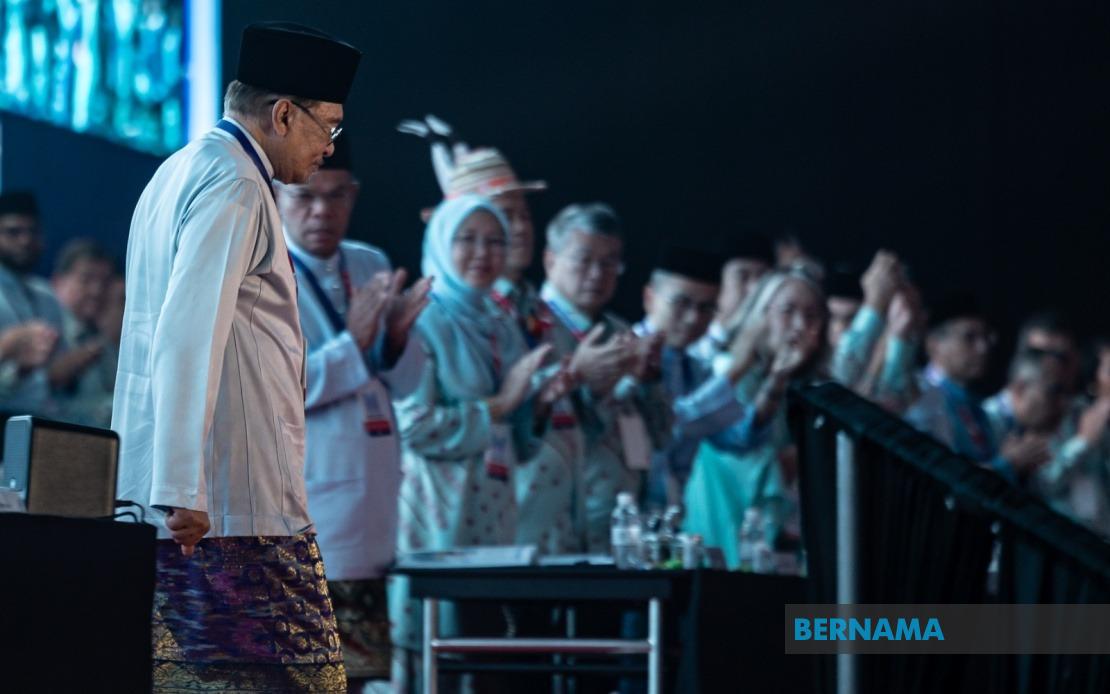
Prime Minister Datuk Seri Anwar Ibrahim has firmly rejected allegations that the MADANI Government treats some states unfairly, instead emphasising that federal allocations to all regions have grown substantially under his administration's watch. Speaking at the 2026 PKR National Congress at the Melaka International Trade Centre in Ayer Keroh, Anwar addressed longstanding questions about regional resource distribution that have periodically surfaced in Malaysian political discourse, particularly among states seeking larger development budgets.
The Prime Minister provided detailed financial comparisons to substantiate his position, demonstrating that budget commitments have risen across diverse regions regardless of their political alignment or geographical location. Federal allocation to Sabah, for instance, has climbed 35 per cent from RM13 billion in 2022 to RM17.6 billion in 2026, while Sarawak experienced an even steeper increase of 48 per cent, rising from RM10.2 billion to RM15.1 billion over the same period. These figures represent substantial real additions to state coffers rather than nominal adjustments.
Beyond the eastern Malaysian states, Anwar highlighted increases in several peninsular regions. Terengganu's budget trajectory exemplifies this pattern, growing from RM6 billion in 2022 to RM8.1 billion by 2026, reflecting a 35 per cent boost. Similarly, Johor experienced expansion from RM10.2 billion to RM14.6 billion, demonstrating that growth transcends state boundaries and political affiliations. The Prime Minister's enumeration of gains across Kedah, Kelantan, Perlis, and Johor suggests a deliberate effort to showcase equitable distribution across the federation.
Anwar's rebuttal addresses a persistent criticism that occasionally emerges in Malaysian politics, where opposition-controlled or politically disadvantaged states periodically claim inadequate federal support. By itemising specific allocations, the Premier attempted to reframe the conversation from subjective grievances to objective budgetary data, a strategy designed to neutralise political narratives about discrimination. His reference to Sabah's increased spending under the current administration, coupled with a rhetorical question about whether previous governments faced similar complaints, implicitly contrasts his tenure with predecessor administrations.
The emphasis on differentiated allocations according to state priorities rather than uniform distribution reflects contemporary development policy thinking in Malaysia. The government's approach acknowledges that states possess varying infrastructure needs, population densities, and development stages, necessitating tailored resource allocation rather than mechanistic equality. This philosophy aligns with the MADANI agenda's stated commitment to targeted development addressing specific regional challenges.
For Malaysian readers and businesses operating across states, these budgetary commitments carry tangible implications. Increased state allocations typically translate into expanded infrastructure projects, improved public services, and enhanced development opportunities. The growth percentages cited represent significant capital injections that could stimulate local economies, create employment, and improve public facilities across affected regions. The combined allocations to the enumerated states total tens of billions of ringgit, underscoring the scale of federal investment in sub-national development.
The timing of these comments at the PKR Congress carries political significance beyond the budgetary discussion itself. As Malaysia approaches electoral cycles and as intra-coalition dynamics evolve, affirming commitment to equitable regional development helps solidify support among state-level party structures and political leadership. For PKR members representing various states, such assurances provide political ammunition when addressing constituent concerns about federal neglect or preferential treatment of rival jurisdictions.
The Prime Minister's response also implicitly addresses concerns within opposition-controlled states or those with mixed political representation, suggesting that the MADANI Government bases allocation decisions on developmental need rather than partisan calculus. This messaging becomes particularly important in Malaysia's federal system, where state governments often represent different political coalitions than the federal government, potentially creating tensions around resource distribution and development priorities.
From a Southeast Asian perspective, Malaysia's approach to sub-national resource allocation mirrors broader regional trends toward decentralised governance and state-level autonomy in development planning. Comparable economies across the region grapple with similar questions about equitable regional distribution within federal or quasi-federal frameworks. The specificity of Anwar's budgetary claims suggests a government confident in its fiscal management and willing to defend its allocation methodology against political challenges.
Analysts monitoring Malaysian governance will note that while the figures presented demonstrate real budget growth, the question of whether these allocations translate into proportional development outcomes remains separate from budgetary commitments alone. Implementation capacity, project execution efficiency, and resource absorption rates vary across states, meaning that budget increases do not automatically guarantee equivalent developmental progress. Nevertheless, the substantial percentage increases Anwar cited do indicate genuine escalation in federal financial commitments to state-level development.
Looking forward, the Prime Minister's statements suggest the government intends to maintain this growth trajectory through its medium-term planning horizon. Sustaining such increases amid broader fiscal pressures and competing national priorities will require careful budgetary management and continued economic growth to generate sufficient revenue. The figures cited extend to 2026, implying that subsequent administrations will inherit expectations for continued investment in regional development across multiple states.
For state governments and local stakeholders, these commitments provide a framework within which to plan development initiatives and coordinate with federal agencies on funding availability. The transparency regarding allocation levels, while politically motivated, does establish benchmarks against which future performance can be measured, potentially enhancing accountability within Malaysia's system of federal-state fiscal relations.

