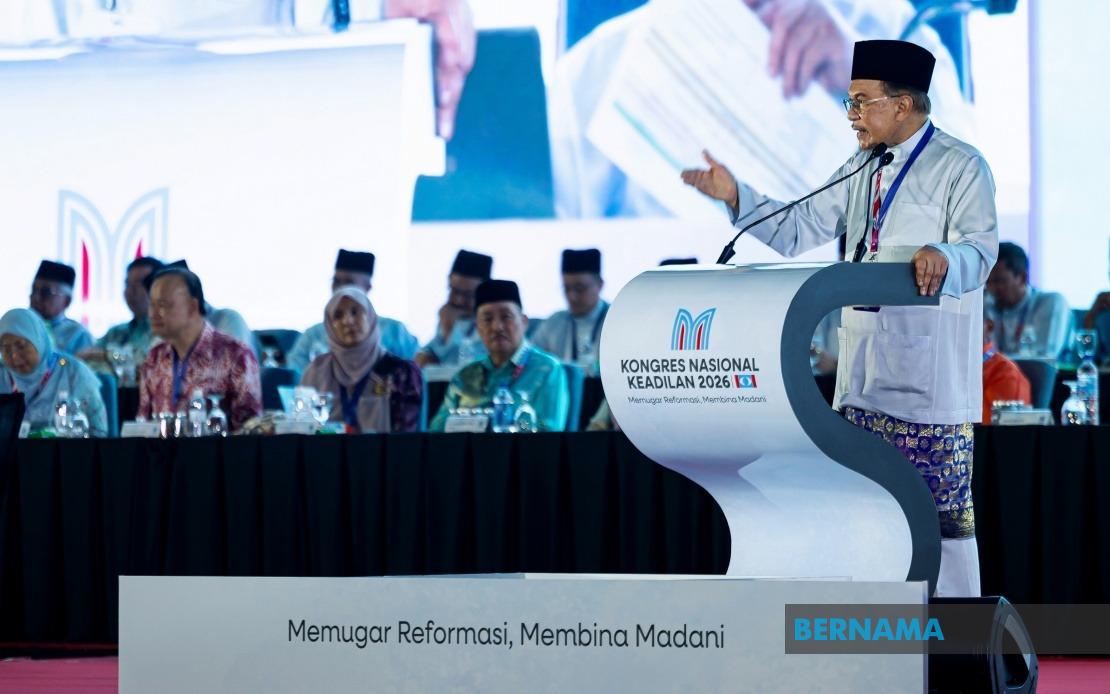
Prime Minister Datuk Seri Anwar Ibrahim has firmly rejected suggestions that his working relationship with Deputy Prime Minister Datuk Seri Dr Ahmad Zahid Hamidi has fractured, describing such characterisations as rooted in misperception rather than fact. Speaking at the 2026 PKR National Congress in Melaka on August 15, Anwar stressed that the bilateral ties between the two leaders remain constructive despite recent public commentary questioning the stability of their partnership.
The Prime Minister's remarks directly addressed claims made by former UMNO Youth chief Khairy Jamaluddin, who alleged in the preceding day that trust between Anwar and Ahmad Zahid had reached historic lows. Rather than engaging in defensive rhetoric, Anwar reframed the criticism as reflective of Khairy's worldview, which he characterised as inherently conflict-focused rather than constructive. This measured response signals Anwar's determination to prevent internal political chatter from becoming a matter of state concern.
Anwar's perspective, articulated during his presidential address to party delegates, emphasises dialogue and consensus-building as mechanisms for resolving disagreements within and between the components of the Unity Government formed after the 15th General Election. He contrasted his own approach with that of his critics, positioning himself as champion of a reconciliatory political posture while suggesting that others default to confrontational tactics when facing challenges. This framing carries implications for how the government intends to manage coalition tensions going forward.
The timing of these clarifications is noteworthy given escalating friction between Barisan Nasional and Pakatan Harapan, the two main blocs within the Unity Government arrangement. A particular flash point emerged during the Negeri Sembilan State Election, where BN opted to collaborate with Perikatan Nasional rather than maintain the federal coalition's unified stance. Such incidents have fuelled speculation about the durability of the arrangement that has underpinned Malaysia's governance since late 2022.
Acknowledging Ahmad Zahid's instrumental role in facilitating the original Unity Government coalition, Anwar used his congressional address to offer public recognition of the Deputy Prime Minister and UMNO's contribution to political stabilisation following the tumultuous 2022 transition. By explicitly thanking Ahmad Zahid for his stewardship as both BN chairman and UMNO president, Anwar signalled that despite recent policy divergences, he values the partnership and considers it foundational to Malaysia's current political settlement. This gesture, delivered before party activists, carries symbolic weight within PKR's base.
The disagreements surfacing between the coalition partners reflect genuine substantive differences rather than personal animus, according to Anwar's framing. Policy disagreements on electoral cooperation, resource allocation, and regional governance are being portrayed as manageable through established dialogue mechanisms rather than as indicators of systemic breakdown. This perspective matters for investor confidence, civil service morale, and public perception of governmental stability during a period when Malaysia faces economic and geopolitical pressures.
Khairy's intervention in this debate, while framed as concerned observation, potentially reflects residual tensions within UMNO itself regarding the party's direction and its relationship with the broader opposition coalition. As a prominent voice who has been sidelined from ministerial consideration, his commentary may represent a faction within the party concerned about diluted UMNO influence within the Unity Government framework. The public nature of his remarks suggested an attempt to shift the narrative around coalition stability before the 2026 PKR congress.
For Malaysian political observers and stakeholders, Anwar's statements provide reassurance about the functioning of the cabinet and coalition management structures even as underlying strains become more visible. The Prime Minister's insistence on maintaining and defending the working relationship with Ahmad Zahid, despite mounting pressure from both within and outside the coalition, demonstrates commitment to preserving the political arrangements that have enabled governance continuity since 2022. How long this commitment can withstand intensifying disagreements, particularly over electoral strategy and resource distribution among coalition components, remains an open question.
The broader context includes competing pressures from base supporters within both PKR and UMNO who view the Unity Government as a pragmatic compromise rather than an ideal outcome. Anwar's framing of coalition management as requiring persistent peaceful engagement reflects his understanding that the alternative—coalition collapse—would benefit neither major political bloc and would introduce destabilising uncertainty into Malaysian politics. This calculus likely explains his defensive posture in response to Khairy's commentary and his determination to publicly affirm Ahmad Zahid's standing and contribution.

