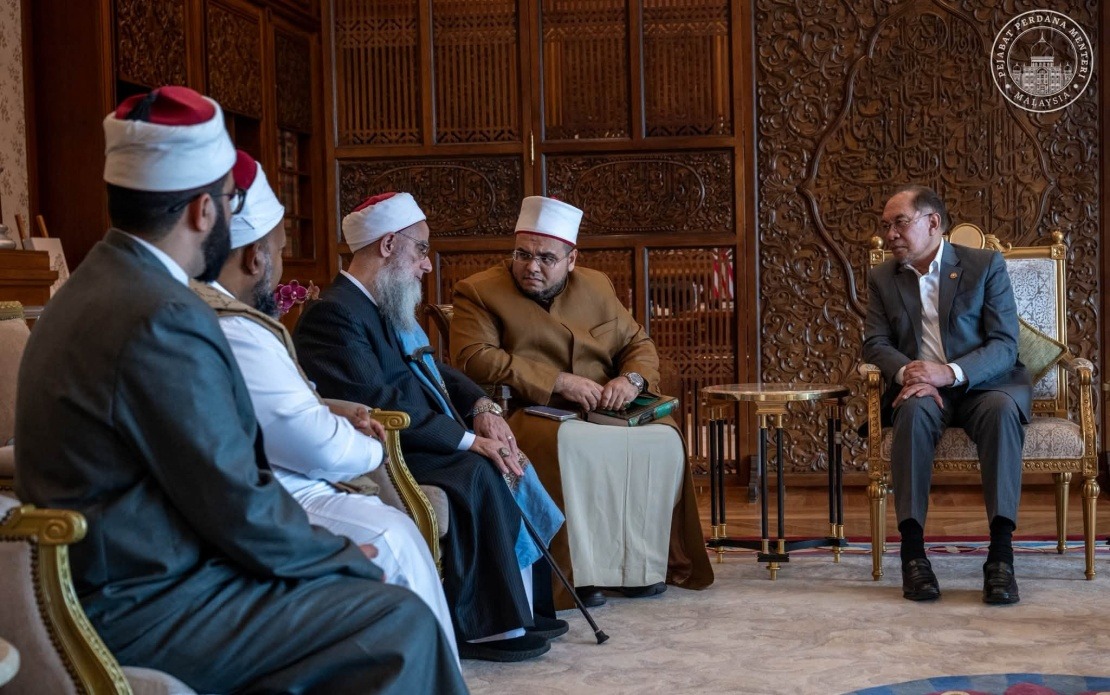
Prime Minister Datuk Seri Anwar Ibrahim received a visit from prominent Egyptian Islamic scholar Sheikh Dr Mustafa An-Nadwi Al-Hasani Mansurah at his Putrajaya office, marking an engagement that underscores the Malaysian government's commitment to interfaith dialogue and scholarly exchange. The meeting, which took place on July 20, reflects the administration's broader strategy of engaging respected international Islamic figures to strengthen Malaysia's position as a centre for moderate, knowledge-based Islamic discourse in the region.
In publicising the encounter through social media, Anwar characterised Sheikh Dr Mustafa as an influential religious authority whose work centres on advancing moral principles and intellectual rigour, particularly within the discipline of hadith scholarship. The Egyptian scholar, who hails from Mansurah, has built a reputation as a serious academic rather than a populist preacher, distinguishing him from many contemporary religious figures who prioritise broad appeal over substantive learning. This positioning is significant for Malaysia's diplomatic messaging, as it signals that the country's leadership values theological scholarship grounded in traditional Islamic epistemology.
The Prime Minister emphasised Sheikh Dr Mustafa's lineage within established Islamic scholarship, noting his role as a distinguished student of the late Sheikh Abul Hasan Ali al-Nadwi, a towering twentieth-century Islamic intellectual whose works on Islamic civilisation and contemporary Muslim society remain influential across the Muslim world. This mentorship relationship adds considerable weight to Sheikh Dr Mustafa's credentials and suggests that his visit carries implications beyond ceremonial courtesy. Al-Nadwi's legacy as a bridge-builder between traditional Islamic learning and modern contexts aligns closely with Anwar's own intellectual positioning within Malaysian Islam, where he has long advocated for combining Islamic principles with pragmatic governance.
Anwar's public reflection on the meeting highlighted a tension he perceives in contemporary intellectual life: the tendency for sensationalism to overshadow serious scholarship and genuine wisdom. By invoking this theme in connection with Sheikh Dr Mustafa's visit, the Prime Minister implicitly critiques the current media and social environment where attention-grabbing narratives often crowd out substantive discourse. For Malaysian observers, this message carries particular resonance given ongoing debates within the country about the role of Islamic discourse in public life and the competing pulls between viral religious content and scholarly inquiry.
The Prime Minister used poetic language to describe the nature of knowledge and wisdom, characterising them as arriving quietly and gently like morning dew, yet possessing transformative power. This metaphor reflects a distinctly Islamic intellectual tradition that values hiddenness and subtlety over ostentation, a value system that contrasts sharply with contemporary digital communication norms. By framing knowledge in these terms during the reception of an international scholar, Anwar reinforced a particular vision of Islamic leadership and intellectual authority that privileges depth over visibility.
During their discussions, Anwar and Sheikh Dr Mustafa exchanged views on contemporary global affairs and reviewed the Egyptian scholar's scheduled knowledge sessions and lectures throughout his Malaysian visit. These sessions presumably addressed audiences of religious scholars, community leaders, and educated Muslims seeking to deepen their understanding of Islamic sciences. The inclusion of such scholarly programming during a high-profile visitor's stay suggests that the Malaysian government views the promotion of serious Islamic learning as part of its soft power strategy and cultural diplomacy.
Anwar publicly acknowledged Sheikh Dr Mustafa's counsel and prayers for Malaysia's national unity and prosperity, gratefully accepting the gesture as validation of Malaysia's multifaith approach to governance. The emphasis on prayers for Malaysian unity carries particular weight in the Malaysian context, where religious and ethnic harmony remains a cornerstone of national policy and a recurring concern for political leadership. By highlighting these prayers, Anwar positioned the visiting scholar as offering spiritual support for Malaysia's pluralistic model, lending international Islamic legitimacy to the domestic narrative of religious coexistence.
The Prime Minister reciprocated by offering prayers for Sheikh Dr Mustafa's continued health, intellectual productivity, and capacity to guide Muslim communities with wisdom, moderation and compassion. The specific invocation of moderation reflects a key policy priority for Anwar's administration, which has consistently emphasised Islam's moderate interpretation and the rejection of extremist ideologies. By linking these values explicitly to the Egyptian scholar, Anwar suggested that international Islamic authorities aligned with this vision represent the desired direction for Islamic thought and practice.
The visit occurs within a broader context of Malaysia's efforts to position itself as a hub for Islamic scholarship and moderate religious thought in Southeast Asia. By receiving high-calibre international Islamic scholars and facilitating their engagement with Malaysian audiences, the government reinforces its credentials as a steward of Islamic learning. For Egypt, the visit represents an opportunity to strengthen cultural and diplomatic ties with a significant Southeast Asian Muslim-majority nation, while also promoting the work of contemporary Islamic scholars trained within Egypt's rich educational traditions.
From a regional perspective, such engagements contribute to a network of intellectual and spiritual connections that transcend formal diplomatic channels. They signal to observers across the Muslim world that Malaysia remains open to scholarly dialogue and committed to advancing Islamic knowledge as a force for social stability and moral guidance. For Malaysian Muslims, particularly the educated and intellectually engaged segments, the hosting of respected international scholars validates local efforts to engage seriously with Islamic sciences and suggests that the government actively supports such pursuits.
The timing of Sheikh Dr Mustafa's visit and Anwar's public reception also reflects Malaysia's positioning within broader geopolitical currents affecting the Islamic world. By engaging with prominent contemporary Islamic scholars, particularly those with traditional credentials and international standing, the Malaysian government strengthens its soft power and cultural influence. This approach complements Malaysia's diplomatic strategy of building relationships across the Muslim world and maintaining relevance in discussions about Islam's future in an increasingly complex global environment.

