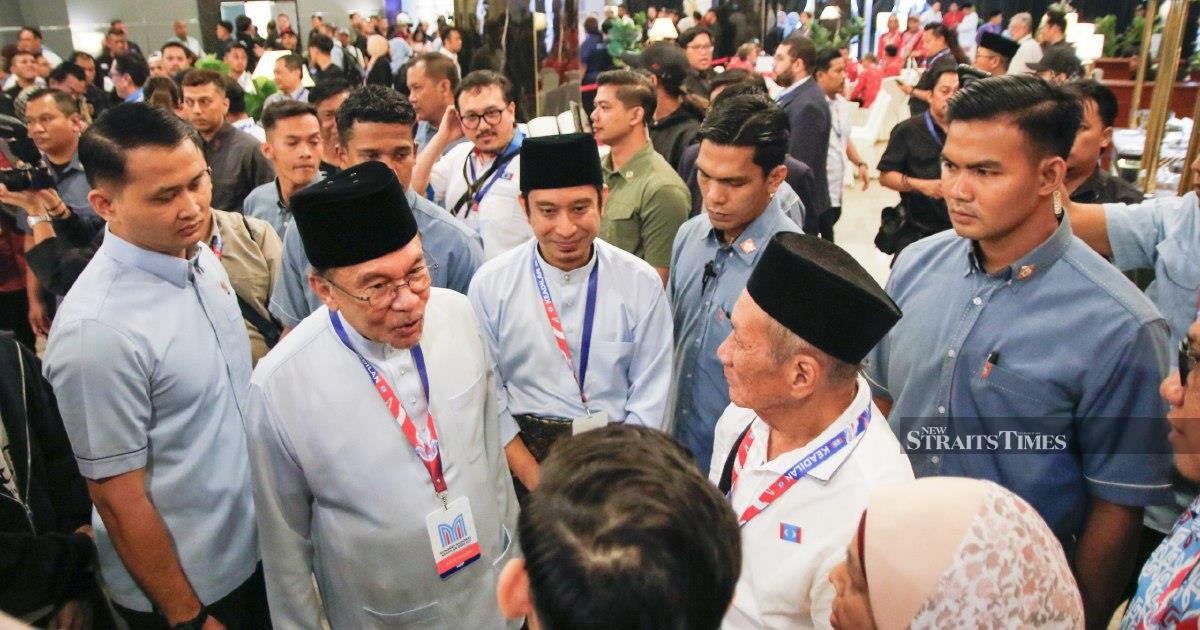
Prime Minister Datuk Seri Anwar Ibrahim has publicly refuted suggestions that his partnership with Deputy Prime Minister Datuk Seri Dr Ahmad Zahid Hamidi has deteriorated, maintaining instead that their collaboration continues to operate smoothly within Malaysia's leadership structure. Speaking in Ayer Keroh, Anwar addressed mounting speculation about potential discord between the two most senior positions in government, emphasising that their working relationship remains constructive despite mounting scrutiny from political observers.
The denial comes at a sensitive moment for Malaysia's ruling coalition, where maintaining visible unity between the Prime Minister and his deputy carries significant weight in sustaining confidence in the administration. Any genuine fracture between these two offices could reverberate across the broader political landscape, affecting not only the stability of the current government but also the cohesion of the Pakatan Harapan and Barisan Nasional alliance that forms the parliamentary majority. Anwar's intervention suggests the government recognises the potentially destabilising effect of persistent rumours about internal leadership divisions.
The emphasis on ties remaining "good at the national level" represents careful language that merits examination. By specifying the national tier, Anwar's statement appears designed to distinguish between high-level government function and whatever dynamics may exist at other echelons within their respective political organisations. This nuance suggests that while the Prime Minister and Deputy Prime Minister maintain sufficient working cohesion for state business, there may be underlying complexities in how their separate political bases interact or compete for influence within the broader coalition framework.
Anwar and Zahid represent distinctly different political constituencies within Malaysia's power structure. The Prime Minister leads Keadilan Rakyat as head of Pakatan Harapan, while Zahid commands considerable influence within the United Malays National Organisation (UMNO) and consequently within Barisan Nasional. This structural reality means their relationship operates simultaneously as both a partnership of necessity and a balance between potentially competing interests. For Anwar to assert the relationship's health explicitly signals recognition that these tensions require public reassurance.
The coalition government itself remains a relatively novel configuration for Malaysian politics, having consolidated only in recent years. The bridging of what were historically opposing blocs—Pakatan Harapan and Barisan Nasional—into a functioning majority represents an ongoing experiment in Malaysian governance. The ability of leaders from these separate traditions to demonstrate genuine cooperation proves essential to justifying this arrangement to their respective party bases and to the broader electorate.
Speculation about rifts between senior leaders often surfaces in Malaysian politics during periods when legislative priorities diverge or when parliamentary arithmetic becomes tighter. The government's ability to command comfortable majorities depends partly on maintaining discipline and apparent unity among coalition partners. Should substantive friction emerge between Anwar and Zahid, managing parliamentary business becomes considerably more challenging, as do efforts to advance major legislative initiatives that require coalition-wide support.
The timing of Anwar's statement also warrants consideration within the broader context of Malaysia's political calendar and economic challenges. The administration faces mounting pressures on multiple fronts, from fiscal management to addressing living cost concerns that resonate across Malaysian society. Internally focused leadership disputes consume political energy and media attention that the government arguably requires for focusing on substantive policy delivery and economic management.
Historically, Malaysian prime ministers have found it necessary to periodically affirm the strength of their working relationships with key cabinet colleagues and coalition partners. Such statements serve multiple audiences simultaneously—reassuring investors and international observers about government stability, signalling confidence to party members, and deflecting opposition attempts to exploit perceived internal weaknesses. Anwar's intervention follows this established pattern of proactive relationship management at the highest levels.
For Southeast Asia's broader business and investment communities, Malaysia's government stability carries particular significance. Regional investors and international partners assess political cohesion as a factor in their confidence about Malaysia's direction and the reliability of its policy environment. When speculation about leadership friction circulates, such constituencies watch for official responses as indicators of underlying stability or vulnerability. Anwar's timely denial serves to contain potential ripple effects into confidence metrics that could affect currency movements, investment flows, or credit assessments.
The Deputy Prime Minister's portfolio traditionally encompasses significant responsibilities across multiple sectors, and Zahid's influence extends deep into UMNO's machinery and consequently into parliamentary representation. The seamless functioning of government depends on these various power centres working in sufficient coordination. Anwar's emphasis on national-level functionality represents an assertion that despite any complexities, the machinery of government continues operating according to design.
Looking forward, maintaining this articulated partnership will require continued demonstration of joint purpose and coordinated decision-making. Any major divergence in public positions between the Prime Minister and Deputy Prime Minister on significant policy matters could undermine the reassurance Anwar has just provided. The coalition government's sustainability depends substantially on such demonstrations of functional unity, even where underlying political interests might occasionally diverge.

