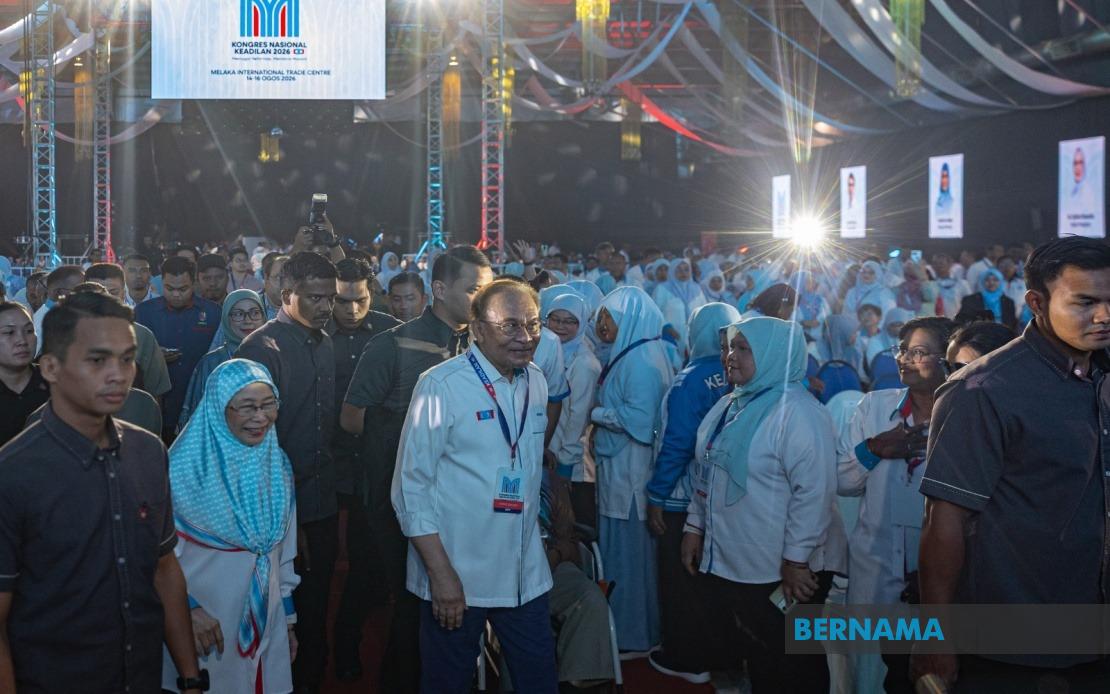
Prime Minister Datuk Seri Anwar Ibrahim has doubled down on his administration's commitment to sustaining the federal-level partnership with UMNO-Barisan Nasional, framing the decision as essential to Malaysia's continued economic progress and political equilibrium. Addressing delegates at the Parti Keadilan Rakyat National Congress 2026 in Melaka on August 16, Anwar underscored that pragmatic coalition management must supersede internal pressures or individual political ambitions when governing the country. His remarks come as a deliberate reassurance to stakeholders at a moment when coalition dynamics have faced scrutiny and speculation about the durability of the Unity Government arrangement.
The Prime Minister's intervention reflects a deliberate strategic calculation within Malaysian politics. The Unity Government, which brings together PKR, DAP, Amanah, and the BN component parties under a shared governing framework, represents one of the most complex coalition arrangements attempted in Malaysia's post-independence history. By publicly reaffirming the UMNO-BN partnership, Anwar seeks to eliminate uncertainty that could destabilise investor confidence, complicate legislative planning, or embolden rival factions within the coalition to test the boundaries of the arrangement. The emphasis on "what has happened recently" hints at underlying tensions, though Anwar chose not to elaborate, instead opting for a tone of measured statesmanship.
Anwar's framing of political decisions as a choice between personal interest and national good carries particular weight given Malaysia's fraught political history. The country has experienced multiple coalition reconfigurements, defections, and confidence-of-supply withdrawals that have repeatedly destabilised governments and disrupted policy implementation. By explicitly stating that decisions should not be "driven by personal interests, positions or anger," the Prime Minister positioned his administration as above the factional jostling that has often characterised Malaysian coalition politics. This messaging serves multiple audiences simultaneously: reassuring investors and international partners of governmental stability, signalling to PKR members that principled governance takes precedence, and subtly reminding BN partners that the arrangement rests on mutual commitment rather than temporary convenience.
The economic dimension of Anwar's statement carries particular salience for Malaysian readers. Since the formation of the Unity Government, Malaysia has sought to project an image of political reliability conducive to foreign direct investment and economic recovery following the disruptions of recent years. Regional and international investors closely monitor Malaysian political stability as a bellwether for Southeast Asian investment climate. A fractious coalition or public signals of imminent realignment would send negative signals to capital markets, potentially weakening the ringgit, spooking foreign investors, and complicating the government's fiscal management objectives. Anwar's emphasis on "economic growth" as a cornerstone of the continued partnership directly addresses these market considerations.
The choice of venue—the PKR National Congress—was strategically significant. Rather than addressing Parliament, civil service, or international audiences, Anwar spoke directly to his own party's grassroots membership. This setting allowed him to acknowledge internal Party members' concerns about UMNO-BN cooperation whilst simultaneously binding PKR to the coalition framework through a solemn public commitment. For PKR delegates who may harbor reservations about working alongside UMNO—a party that governed Malaysia for six decades and was implicated in numerous governance controversies—Anwar essentially requested party discipline in service of a larger national objective. The message was: concerns about partners' past conduct must yield to present imperatives of governmental functionality.
The implicit acknowledgment that "some have asked about our relationship with UMNO and BN" reveals fissures within the broader coalition structure that required public healing. These questions likely emerged from various constituencies: opposition leaders seeking to exploit any daylight between coalition members, BN politicians testing the depth of PKR's commitment, and PKR members questioning the rationale for partnering with the party their coalition partners had campaigned against. By addressing these concerns transparently, Anwar attempted to foreclose speculation and demonstrate decisive leadership. His invocation of "wisdom" suggested that continuing the partnership reflects sophisticated political judgment rather than expediency or capitulation.
For Malaysian political observers, this statement represents a crucial data point in ongoing calculations about the Unity Government's trajectory. The coalition has demonstrated unexpected durability since its formation, surviving internal disagreements and external pressures that many analysts predicted would unravel it within months. Anwar's reaffirmation suggests the Prime Minister believes the arrangement offers more value through stability than through the uncertain possibilities of coalition reconstruction. This assessment reflects his judgment that PKR, as the largest party within the coalition, derives sufficient benefit from participating in government to justify sustained partnership with ideologically and historically distinct partners.
The broader regional context amplifies the significance of Anwar's comments. Southeast Asian governments increasingly face pressure to demonstrate policy consistency and governmental durability in an era of trade tensions, geopolitical realignment, and economic uncertainty. Malaysia's demonstrated ability to maintain a broad coalition whilst advancing policy objectives offers a model—albeit imperfect—of inclusive governance. Anwar's emphasis on choosing stability over personal advancement implicitly positions Malaysia as a maturing democracy capable of transcending personality-driven politics, a subtle but important positioning in regional diplomatic and economic contexts.
Looking forward, Anwar's commitment signals that the Unity Government coalition framework will likely persist through the remaining tenure of the current Parliament, absent major unforeseen developments. This provides businesses, civil society organisations, and foreign partners with reasonable confidence in the stability of Malaysia's governance structure. The Prime Minister's words thus function as both an internal consolidation mechanism for the coalition and an external reassurance signal to stakeholders dependent on governmental continuity. Whether this commitment can withstand the inevitable pressures of coalition dynamics, factional disagreements, and electoral politics remains an ongoing test of Malaysian political maturity.

