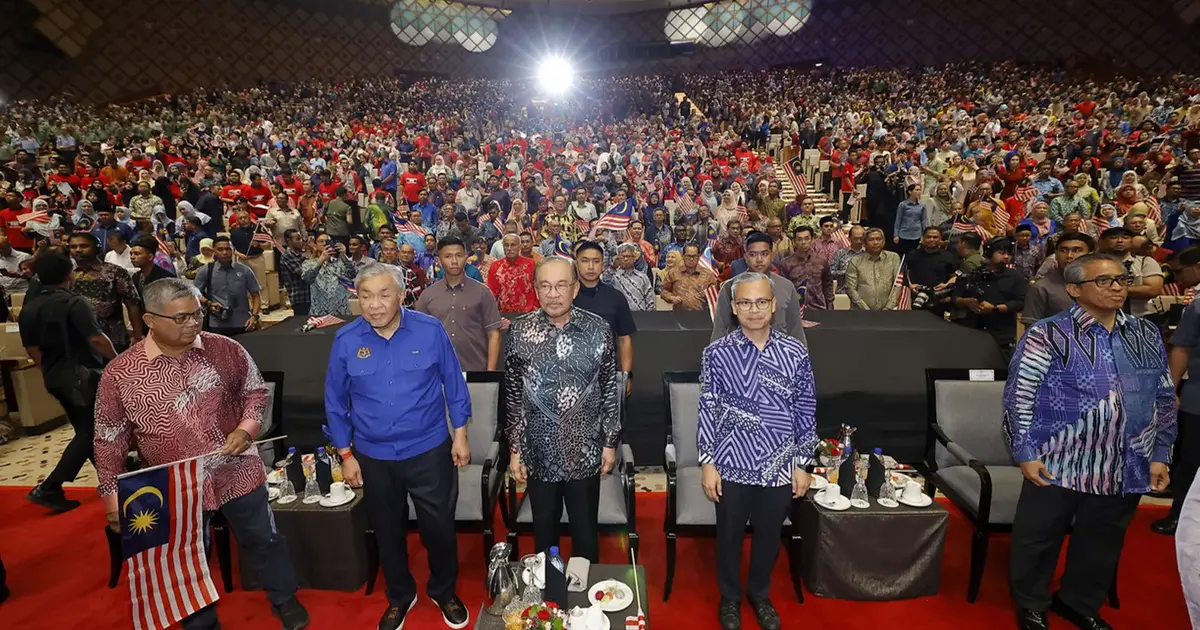
Prime Minister Anwar Ibrahim has committed to returning billions of ringgit in seized funds directly to the Malaysian people, positioning the decision as a cornerstone of his administration's broader economic redistribution philosophy. The announcement underscores the government's determination to demonstrate that recovered assets—particularly those historically accumulated through corruption and illicit activities—should benefit ordinary Malaysians rather than remaining locked in state coffers or bureaucratic limbo.
This pledge reflects a fundamental ideological shift in how Malaysia's leadership approaches the stewardship of public resources. Under previous administrations, seized assets often disappeared into government accounts with minimal transparency regarding their allocation or deployment. Anwar's position signals that his government views recovered wealth not as additional revenue for state operations but as rightfully belonging to citizens whose taxes and national resources were originally diverted through corrupt practices. The philosophical underpinning suggests a more participatory approach to national wealth management, where ordinary Malaysians become stakeholders in the fruits of anti-corruption efforts rather than remaining passive observers.
The significance of this commitment extends beyond mere symbolism. Malaysia has witnessed repeated high-profile corruption scandals over decades, with billions of ringgit allegedly flowing through illicit channels. The 1Malaysia Development Berhad scandal alone highlighted how institutional frameworks can be weaponised for personal enrichment at massive scale. Successive governments have seized assets from implicated individuals and entities, yet the mechanisms for deploying these recovered funds have remained opaque. Anwar's explicit statement about returning such wealth to the rakyat represents a departure from that ambiguity and speaks to accountability demands that have intensified across Malaysian society.
The practical implementation of such a pledge presents substantial complexities. Determining the appropriate mechanisms for distributing funds across a population of over 33 million requires careful consideration of logistics, fairness, and administrative capacity. Whether distributions would occur through direct transfers, infrastructure projects benefiting communities, education initiatives, healthcare enhancements, or some combination thereof remains unclear. Each approach carries distinct advantages and challenges. Direct payments offer transparency and individual agency, while targeted social investments might generate broader developmental benefits. The government will need to articulate a clear framework explaining how it intends to operationalise this commitment.
For Southeast Asian observers, Malaysia's approach carries regional implications. As several nations across the region grapple with corruption and asset recovery, the precedent set by explicitly committing to return seized funds to citizens could influence neighbouring governments' policies. If implemented effectively, Malaysia could demonstrate a model where anti-corruption efforts generate tangible benefits for ordinary people rather than simply transferring wealth from one institutional structure to another. Conversely, implementation failures or perceived inequities in distribution could undermine the initiative's credibility and discourage similar efforts elsewhere.
The announcement also carries domestic political dimensions. Anwar's government has consistently emphasised reform and anti-corruption as core pillars of its administration since returning to power. Opposition figures have historically questioned whether anti-corruption efforts truly benefit the broader population. By explicitly committing to return seized funds to the rakyat, Anwar's government attempts to demonstrate that its governance principles translate into concrete benefits for ordinary Malaysians. This positioning becomes particularly significant as the administration navigates complex coalition politics and seeks to consolidate support among voters concerned about economic distribution and institutional fairness.
The economic context surrounding this pledge warrants attention. Malaysia faces pressures from inflation, currency fluctuations, and adjusting growth trajectories following pandemic disruptions. While returning seized funds to citizens might ease short-term economic pressures for beneficiaries, the government must balance such distributions against demands for public investment in infrastructure, healthcare, and education. The articulation of this commitment suggests confidence in Malaysia's fiscal position to accommodate both redistributive initiatives and continued public spending on essential services.
Transparency mechanisms will prove critical to the initiative's success and credibility. Citizens will expect clear accounting of which seized assets are being returned, in what amounts, through which channels, and with what timeline. Without robust transparency frameworks, even well-intentioned redistributive efforts risk accusations of political favouritism or elite capture. The government's willingness to implement independent oversight of the return process would substantially strengthen public confidence and demonstrate genuine commitment to institutional accountability.
Looking ahead, Anwar's commitment represents a test case for whether Malaysian governance can effectively bridge anti-corruption enforcement with equitable wealth redistribution. The success or failure of this initiative will likely influence public perceptions of government legitimacy and the viability of similar wealth-recovery initiatives across the region. For ordinary Malaysians, the pledge offers potential tangible benefits, contingent upon transparent and equitable implementation mechanisms that remain to be detailed and refined through the policy-making process.

