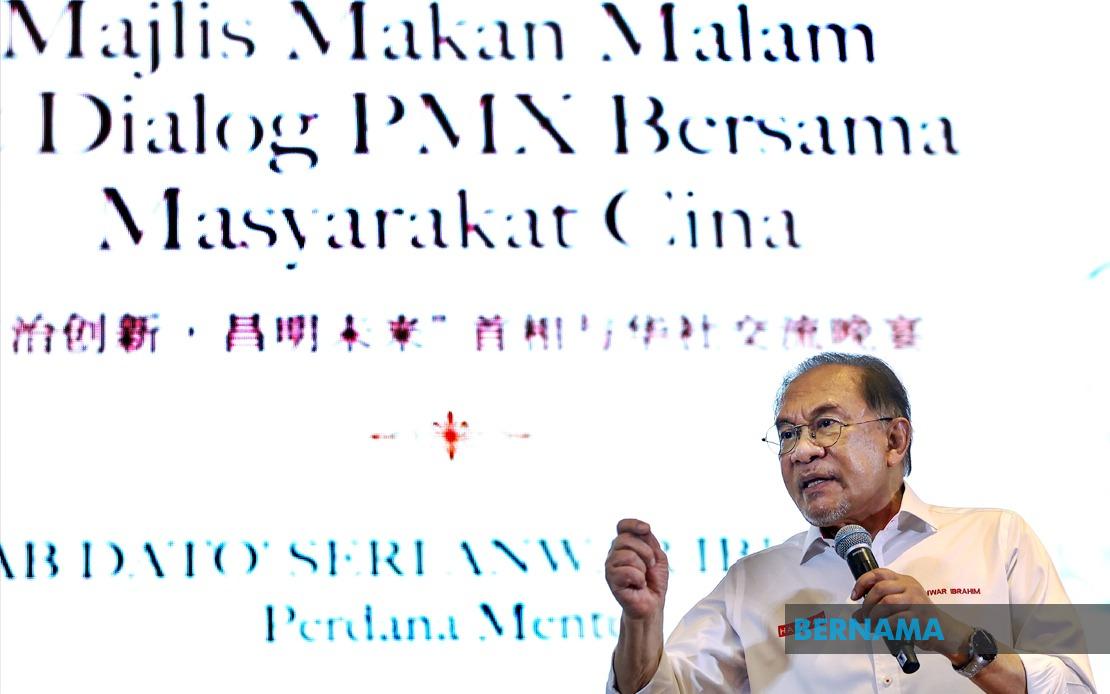
Prime Minister Datuk Seri Anwar Ibrahim used an address to the Chinese community in Johor Bahru on July 4 to reiterate his overarching vision for the nation, framing his tenure around principles of inclusivity and institutional integrity. Speaking at a community dinner, Anwar articulated a vision of Malaysia as a thriving, united country where leadership extends equally to all groups regardless of ethnic or religious background. The remarks reflected his emphasis on bridging communal divides at a time when Malaysian politics continues to grapple with issues of representation and confidence in public institutions.
At this stage of his political career, Anwar indicated that his principal concern centres on establishing a governing record rooted in transparency and equitable service delivery. The Prime Minister's focus on legacy-building is noteworthy given the complex political landscape he navigates, where coalition unity remains fragile and public trust in governance institutions has been tested by successive administrations. By emphasising his personal commitment to impartiality, Anwar appeared to position himself as a custodian of institutional values rather than merely a political figurehead. This framing carries significance for how his administration manages the delicate balance between advancing policy agendas and maintaining a perception of even-handed governance.
Anwar's assertion that every Malaysian citizen holds equal importance to his government extends beyond rhetorical flourish. In practical terms, this message speaks to minority communities who have historically expressed concerns about representation in policy formulation and resource allocation. The Chinese community, one of Malaysia's largest and most economically significant groups, has long maintained particular interest in government outreach and assurances of fair treatment. By directly addressing this community and stressing his government's commitment to serving all Malaysians, Anwar sought to reinforce confidence among constituencies who view transparent, merit-based governance as essential to their interests and security within the federation.
The Prime Minister's candid reflection on age and mortality—noting that he is already old and contemplating his eventual retirement—injected a personal dimension into his political message. This humanising touch, where Anwar expressed a desire to be remembered as someone who loved the Malaysian people and was loved in return, moves beyond conventional political messaging. It suggests a leader conscious of his finite time in office and thus focused on substance over the accumulation of power for its own sake. For Malaysian voters fatigued by decades of scandals and institutional erosion, such language carries resonance, though its practical translation into policy outcomes remains the measure by which such commitments will ultimately be judged.
Anwar's emphasis on collective national stewardship—his call for Malaysians to regard the nation as a shared responsibility to be safeguarded together—addresses a foundational challenge facing the country. Malaysia's multi-ethnic, multi-religious composition has historically required political leaders to articulate visions of common purpose that transcend sectarian interests. The Prime Minister's invocation of solidarity and mutual care reflects an understanding that institutional weakness and social fragmentation frequently emanate from perceptions that government favours certain groups over others. By stressing that success requires unified effort regardless of background, Anwar positioned inclusive governance not merely as a moral imperative but as a practical necessity for national prosperity.
The attendance of Parti Keadilan Rakyat vice president and Selangor Menteri Besar Datuk Seri Amirudin Shari at the event underscored the political coalition's commitment to community engagement. PKR, as the largest component of the governing coalition, plays a central role in translating Anwar's stated commitments into administrative practice. Amirudin's presence alongside the Prime Minister signalled party unity and reinforced messaging around inclusive governance at both federal and state levels. For the Selangor government, which administers the most developed and economically significant state in the federation, such coordination between federal and state leadership carries particular weight in shaping public confidence and policy outcomes.
The location of the address—Johor Bahru, capital of Johor state—held geographic significance. As Malaysia's southern gateway and a state with substantial Chinese commercial and professional communities, Johor represents a crucial political battleground. The state's electoral dynamics have shifted considerably in recent years, and outreach to established communities signals Anwar's administration's priority in consolidating support across different regions and demographics. Direct engagement with community leaders in Johor specifically reflects awareness of the state's political importance and the need to maintain bridges with constituencies that have expressed concerns about national governance trajectories.
Anwar's framing of leadership in terms of service rather than power accumulation addresses a persistent challenge in Malaysian politics: restoring institutional legitimacy after decades of governance marked by patronage networks and centralised decision-making. The articulation of a commitment to fair, clean leadership serving all Malaysians implicitly acknowledges that previous administrations fell short of these standards. Whether through independent anti-corruption institutions, transparent budgeting, or merit-based appointments, demonstrating tangible commitment to these principles will determine whether his words translate into renewed public confidence or remain unfulfilled political rhetoric.
The Prime Minister's remarks also carry implications for Southeast Asian regional stability. A Malaysia governed transparently and perceived as treating all communities fairly strengthens democratic institutions across the region and provides a counternarrative to authoritarian governance models. Malaysia's experience—balancing competing interests within a diverse society while maintaining institutional integrity—holds lessons for neighbouring countries navigating similar challenges. Anwar's emphasis on inclusive governance thus extends beyond domestic political messaging to influence regional perceptions of democratic governance and institutional resilience in Southeast Asia's most economically advanced Muslim-majority democracy.

