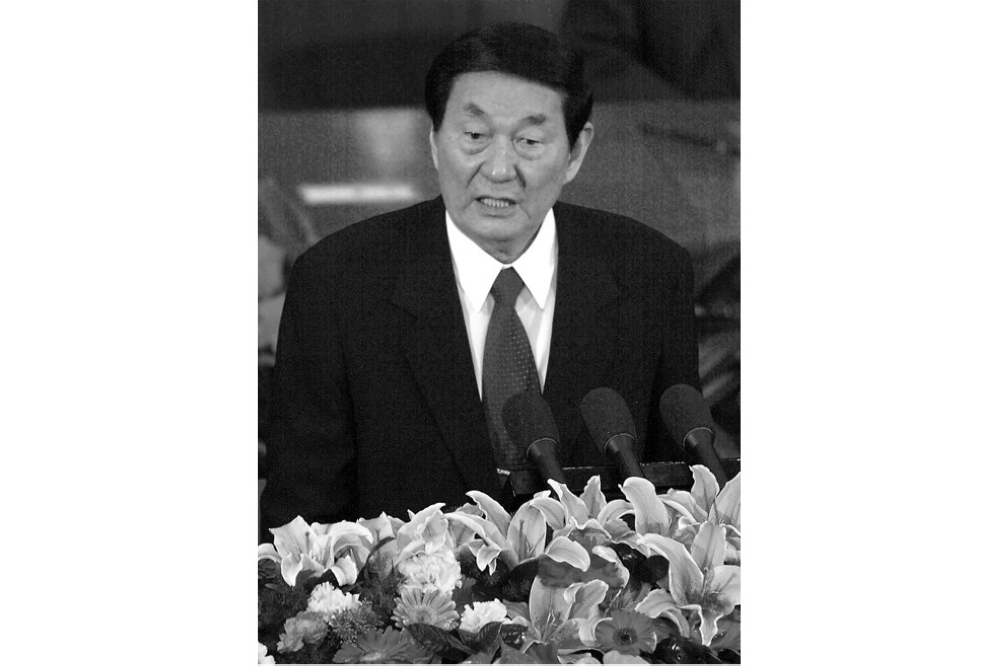
Prime Minister Datuk Seri Anwar Ibrahim extended his sympathies to the family and government of China following the death of former Premier Zhu Rongji, underscoring the departed statesman's instrumental role in advancing bilateral relations between the two nations. Anwar's public recognition of Zhu reflects the enduring respect Malaysia's leadership maintains toward pivotal figures in Beijing's political establishment, particularly those who shaped China's engagement with Southeast Asia during transformative decades.
Zhu Rongji, who served as China's Premier from 1998 to 2003 during a critical period of economic liberalisation and structural reform, was recognised by Anwar as more than a political counterpart but a personal acquaintance whose vision extended beyond domestic concerns. The former Premier's tenure coincided with China's accession to the World Trade Organization in 2001, a milestone that fundamentally altered global trade dynamics and positioned Chinese investment and commerce as increasingly significant for neighbouring economies including Malaysia. Through this lens, Anwar's characterisation of Zhu as a "good friend" carries weight beyond ceremonial diplomacy, acknowledging specific strategic choices that benefited Malaysia's economic interests.
During his leadership, Zhu championed pragmatic economic policies and international engagement that created pathways for deeper Malaysian-Chinese cooperation. His administration pursued targeted foreign investment and established frameworks for sustained bilateral dialogue, elements that Malaysian policymakers valued as essential to leveraging the economic opportunities arising from China's rapid development. Anwar's tribute implicitly recognises that the institutional foundations of contemporary Malaysia-China relations—encompassing trade partnerships, infrastructure collaboration, and cultural exchanges—were partially constructed during Zhu's years in office.
The timing of Anwar's condolence carries symbolic importance for Malaysian diplomacy. As Prime Minister navigating complex geopolitical currents in Southeast Asia, Anwar has consistently emphasised the value of maintaining robust ties with major powers while preserving Malaysia's strategic autonomy. His acknowledgement of Zhu's contributions signals continuity in Malaysia's approach toward China, suggesting that despite shifting administrations in both capitals, the fundamental commitment to deepening economic and institutional linkages remains constant. This messaging proves particularly relevant as Malaysia balances relationships across multiple great powers in an era of heightened strategic competition.
Zhu's premiership witnessed significant expansion of Chinese engagement across Southeast Asia, including substantial investments in infrastructure, manufacturing, and resource extraction. For Malaysia specifically, enhanced bilateral mechanisms and increased commercial activity during this period laid groundwork for later major projects and partnerships. The deepening of Malaysia-China ties under Zhu's stewardship occurred within a regional context where Southeast Asian nations were simultaneously diversifying their external partnerships, making his role in establishing durable institutional frameworks particularly consequential.
Anwar's personal relationship with Zhu also reflects Malaysia's diplomatic tradition of cultivating longstanding connections with successive generations of Chinese leadership. Such relationships often transcend individual tenures and contribute to institutional memory that facilitates smoother negotiations and mutual understanding during periods of political transition. By publicly honouring Zhu, Anwar reinforces Malaysia's commitment to relationship continuity with Beijing's political elite, potentially signalling openness to deepening cooperation across multiple dimensions as opportunities arise.
The death of prominent figures in neighbouring governments invariably prompts reflection on shared interests and the trajectory of bilateral relations. In Zhu's case, his economic modernisation agenda and openness to international engagement created conditions favourable to Malaysian participation in China's development story. Malaysian companies gained access to Chinese markets, while Chinese enterprises found opportunities in Malaysia's strategic location and business-friendly environment. This mutually beneficial dynamic, partially attributable to Zhu's policy orientation, continues generating tangible benefits for both nations' commercial sectors.
Anwar's tribute underscores Malaysia's recognition that peaceful, prosperous interstate relations depend substantially on the quality of personal relationships among leaders and on shared understanding of mutual interests. As China remains among Malaysia's most significant economic partners—both as a destination for Malaysian commodities and a source of foreign investment—maintaining cordial ties with Beijing's political establishment remains strategically important. The gesture of mourning Zhu signals Malaysia's investment in these relationships and its appreciation for historical figures whose decisions shaped contemporary geopolitical realities.
Looking forward, Anwar's comments may also serve to emphasise Malaysia's commitment to pragmatic engagement with China despite global tensions and competing pressures. Rather than adopting a posture of strategic distance or ideological positioning, Malaysia's leadership has consistently opted for economic and diplomatic cooperation grounded in mutual benefit. Zhu's legacy as a reformer and proponent of international engagement aligns well with this Malaysian approach, making his passing an occasion for reaffirming these shared values and the continued importance of sustained bilateral partnership for both nations' prosperity.

