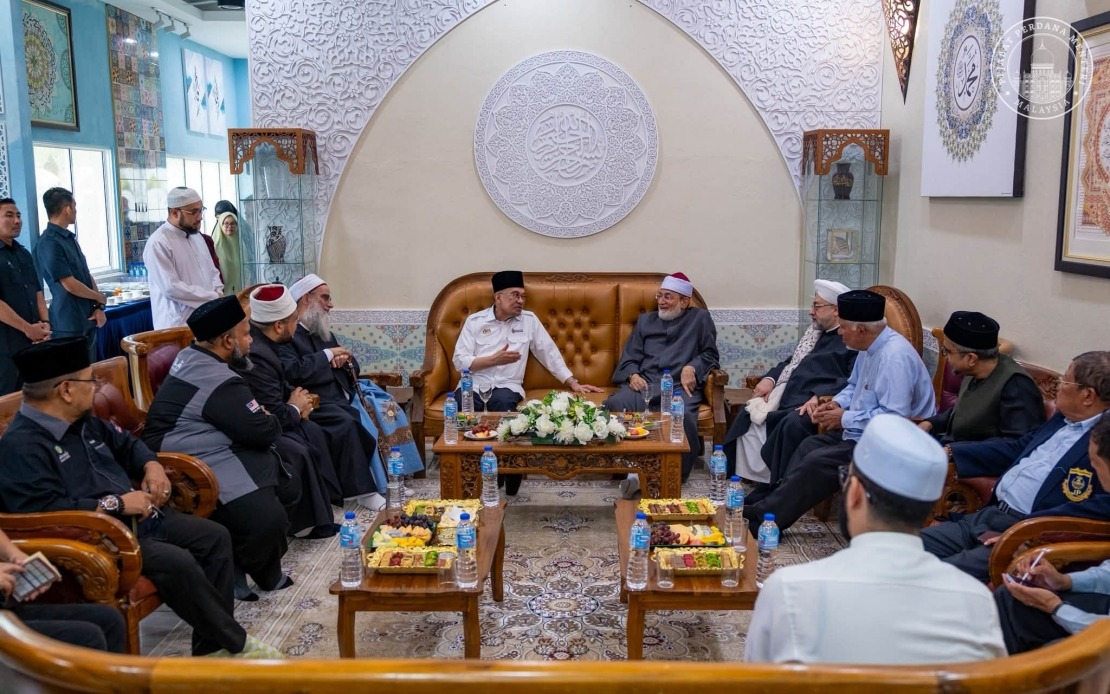
Prime Minister Datuk Seri Anwar Ibrahim made time in his schedule to meet with three prominent Islamic scholars who are visiting Malaysia, reflecting the government's commitment to engaging with internationally recognised religious figures and fostering deeper Islamic knowledge within the country.
The three scholars represent different specialisations within Islamic scholarship. The delegation included Egyptian hadith scholar Al-Fadhil Al-Allamah Al-Muhaddith Syeikh Dr Mustafa al-Nadwi Al-Hasani, whose expertise in hadith studies places him among the foremost collectors and authenticators of prophetic traditions. Joining him was Al-Fadhil Al-Allamah Al-Muqri' Syeikh Dr Ahmad Isa Al-Ma'sarawy, a world-renowned Quranic reciter known for his mastery of tajweed and melodic renderings of the Quran. The third visitor was Al-Fadhil Al-Syeikh Maulana Al-Sayyid Afeefuddin Al-Jailani, who holds the distinguished position of grand custodian overseeing the waqf properties, mosque, and maqam—the spiritual shrine—associated with Syeikh Abdul Qadir Al-Jailani, a revered Islamic saint with significant following throughout Muslim communities.
The meetings occurred at Nasyrul Quran, a centre dedicated to Quranic studies and Islamic education. This venue selection underscores the scholarly nature of the engagements and the focus on promoting Islamic learning and wisdom. By hosting these figures at such a facility, the Prime Minister signalled Malaysia's serious investment in becoming a hub for Islamic knowledge dissemination across the Southeast Asian region.
In remarks shared via social media, Anwar described the encounters as providing him an opportunity to inquire into the wellbeing of his distinguished guests, whilst simultaneously seeking their spiritual guidance and prayers. The Prime Minister emphasised his gratitude towards the scholars' willingness to travel to Malaysia and contribute their considerable expertise towards elevating Islamic education and understanding within Malaysian society. This exchange reflects a broader diplomatic approach that positions Malaysia as a welcoming destination for Islamic intellectual discourse.
The significance of such meetings extends beyond mere courtesy visits. Malaysia has positioned itself as a moderate Islamic nation and a bridge between various Muslim communities. By engaging with internationally prominent Islamic scholars, the government reinforces this positioning and demonstrates openness to diverse Islamic thought and practice. The presence of scholars from Egypt—a major centre of Islamic learning home to institutions like Al-Azhar—particularly signals Malaysia's connection to mainstream Islamic jurisprudence and scholarship.
The Prime Minister's public acknowledgment of these meetings through social media serves multiple purposes. It communicates to Malaysian Muslims the government's dedication to strengthening Islamic education and practice within the country. Simultaneously, it sends international signals about Malaysia's commitment to advancing Islamic knowledge and promoting harmony within its multi-religious society. The statement emphasised hopes that these scholarly visits would generate greater knowledge, spiritual blessings, and affection for Islamic teachings amongst Malaysians.
For Southeast Asia broadly, such engagements carry implications beyond Malaysia's borders. The region's substantial Muslim population—comprising over 250 million individuals across Indonesia, Malaysia, Brunei, and parts of Thailand and the Philippines—represents a significant audience for Islamic educational initiatives. When leading scholars visit and engage with government leadership, it can influence the trajectory of Islamic learning and interpretation throughout the region's Muslim communities.
The meeting also reflects contemporary approaches to faith-based diplomacy. Rather than treating religion as a marginal concern, the Prime Minister's willingness to prioritise encounters with Islamic scholars demonstrates how modern governance integrates spiritual and intellectual dimensions. This approach acknowledges that for many Malaysians, Islamic guidance and knowledge constitute central aspects of their civic and personal identities.
The scholars' participation in sharing knowledge and wisdom represents a concrete contribution to Malaysia's educational landscape. Hadith scholars preserve and authenticate the recorded sayings and practices of Prophet Muhammad, providing foundational knowledge for Islamic jurisprudence and ethics. Quranic reciters preserve the melodic and rhythmic traditions of Quranic recitation, which many Muslims consider an art form deserving serious study and mastery. The custodian role of waqf properties connects these scholars to institutional Islam and charitable structures that have sustained Muslim communities for centuries.
The Prime Minister's expressed desire to build a society that is simultaneously virtuous, knowledgeable, and harmonious reflects Malaysia's stated aspirations regarding religious and social development. The emphasis on harmony carries particular weight in Malaysia's multi-communal context, where peaceful coexistence between Muslim and non-Muslim communities remains an ongoing achievement requiring continuous attention and dialogue. Framing Islamic knowledge-sharing within this broader framework of societal harmony suggests that strengthening Islamic education is compatible with, rather than contradictory to, Malaysia's pluralistic values.
Looking forward, such engagements often lead to longer-term collaborations. Visiting scholars may establish connections with Malaysian Islamic institutions, contribute to educational programmes, or inspire local initiatives in Islamic learning. The presence of internationally recognised figures can elevate the standards and reputation of Malaysia's Islamic education sector and attract further scholarly engagement.
The meeting ultimately illustrates how Malaysia continues navigating its identity as both a Muslim-majority nation and a multicultural society. By publicly welcoming prominent Islamic scholars and engaging seriously with their knowledge and counsel, the government demonstrates confidence in Islam's role within Malaysian society whilst maintaining the inclusive, harmonious approach that has characterised the nation's development.

