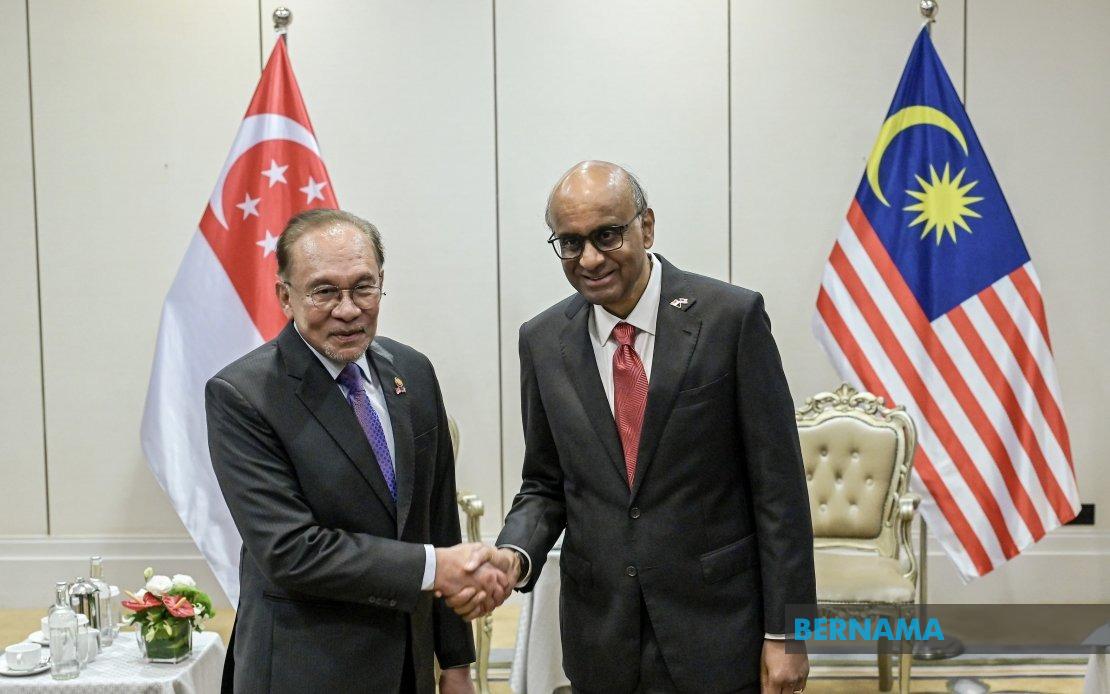
Prime Minister Datuk Seri Anwar Ibrahim hosted Singapore President Tharman Shanmugaratnam for a formal courtesy meeting on Monday as part of the Singapore leader's three-day state visit to Malaysia. The 40-minute engagement took place in Kuala Lumpur and represented a continuation of high-level diplomatic exchanges between the two neighbouring nations. The gathering brought together senior officials from both governments, including Malaysia's Foreign Minister Datuk Seri Mohamad Hasan, Investment, Trade and Industry Minister Datuk Seri Johari Abdul Ghani, and Entrepreneur and Cooperatives Development Minister Steven Sim Chee Keong, alongside their Singaporean counterparts.
President Tharman's arrival in Malaysia was marked by a state welcoming ceremony held at Istana Negara, where he was received by Yang di-Pertuan Agong Sultan Ibrahim. The three-day visit, scheduled from July 13 to 15, came at the invitation of the Malaysian King and serves as a reciprocal gesture following Sultan Ibrahim's state visit to Singapore in May 2024. Such ceremonial exchanges underscore the importance both nations place on maintaining robust bilateral relations at the highest levels of government.
The economic dimension of Malaysia-Singapore relations provides crucial context for these diplomatic engagements. Singapore occupies a commanding position in Malaysia's external trade architecture, functioning as the country's second-largest trading partner globally whilst simultaneously holding the distinction of being Malaysia's most significant trading partner within the ASEAN bloc. This dual significance reflects the deeply integrated nature of the two economies and their mutual dependence on seamless commercial flows.
Recent trade figures underscore the vitality of this economic partnership. Throughout 2025, bilateral commerce between Malaysia and Singapore reached RM402.35 billion, equivalent to approximately US$93.97 billion, representing a modest 1.5 per cent increase compared to the previous year. More impressive momentum emerged during the first five months of 2025, when bilateral trade jumped 14.5 per cent to RM189.90 billion, or US$47.87 billion, compared with the RM165.93 billion recorded in the corresponding period of 2024.
These trade metrics carry particular significance for Malaysian policymakers and business leaders. The acceleration in growth during early 2025 suggests that underlying economic fundamentals between the two nations remain sound, despite global uncertainties. For Malaysian exporters and importers, Singapore continues to serve as a critical gateway for supply chain activities, regional distribution networks, and financial services that facilitate broader Southeast Asian commerce.
The timing of President Tharman's visit also reflects broader regional dynamics within ASEAN. As the bloc seeks to strengthen economic integration and navigate geopolitical complexities, the quality of bilateral relations between its largest economies becomes increasingly consequential. Malaysia and Singapore's ability to maintain constructive engagement provides a stabilising influence within the regional grouping and demonstrates that neighbour nations can manage their differences whilst pursuing shared prosperity.
From Malaysia's perspective, the visit offers opportunities to discuss trade facilitation measures, investment opportunities, and collaborative initiatives that could further accelerate bilateral commerce. Both nations have long recognised the mutual benefits of improved logistics, harmonised regulatory standards, and investment promotion schemes. The presence of the Trade and Investment Minister at the formal meeting suggests these commercial dimensions featured prominently in discussions.
Singapore's strategic importance extends beyond commerce. As a major financial centre and technology hub, Singapore influences investment flows throughout Southeast Asia. Malaysian companies increasingly use Singapore as a springboard for regional expansion, whilst Singaporean investors maintain substantial interests across various Malaysian sectors. This interdependence creates powerful incentives for both governments to sustain stable, predictable relations.
The ceremonial nature of the state visit, complete with formal welcomes and high-level meetings, reflects diplomatic protocol whilst also sending signals about relationship health to international observers and domestic constituencies in both nations. In an era when global attention often focuses on tensions or friction between countries, such visible manifestations of friendly relations carry value in their own right.
Looking forward, the trajectory of Malaysia-Singapore economic integration will likely remain influenced by broader regional and global trends. Digital trade, sustainable commerce, and supply chain resilience have become central concerns for both governments. The strong trade growth recorded in early 2025 suggests that joint efforts to facilitate business and investment continue bearing fruit, even as both nations navigate evolving trade patterns and technological transformation.
For Malaysian stakeholders, maintaining this positive momentum requires continued commitment to business-friendly policies, infrastructure development, and regulatory clarity. Singapore's experience as a high-income economy with sophisticated institutional frameworks offers benchmarks against which Malaysian authorities measure their own competitiveness. Whilst the two nations operate at different development levels, their substantial economic integration means that comparative advantages and specialisation patterns benefit both sides.
The visit also provides occasion for addressing any bilateral issues that may have accumulated since the previous high-level engagement. Whether concerning land use, environmental matters, transportation corridors, or other shared concerns, such meetings create structured opportunities for diplomatic dialogue. The presence of multiple senior ministers suggests that discussions likely extended beyond ceremonial pleasantries to substantive policy matters affecting the bilateral relationship.

