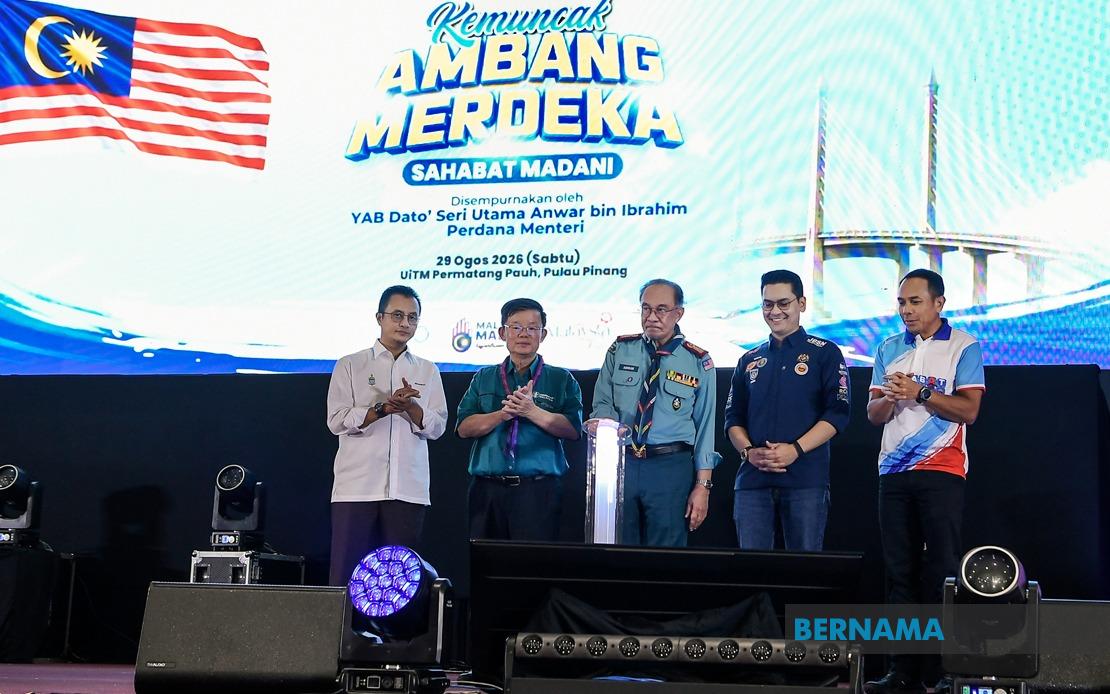
Prime Minister Datuk Seri Anwar Ibrahim has formally unveiled Sahabat MADANI, a national volunteer movement that represents a structured approach to grassroots community engagement and social welfare delivery. The launch, held at Universiti Teknologi MARA (UiTM) Permatang Pauh in Bukit Mertajam as part of the Ambang Merdeka Sahabat MADANI 2026 programme, marks a significant expansion of the government's volunteer infrastructure ahead of anticipated general elections. The initiative has already amassed 11,060 registered volunteers across the country, signalling substantial early uptake of the scheme among Malaysians willing to engage in organised community service.
The Sahabat MADANI framework operates as the practical manifestation of the government's "Malaysia MADANI: Kesejahteraan Dinikmati" aspiration, which translates to shared wellbeing enjoyed by all Malaysians. According to statements from the Implementation Coordination Unit of the Prime Minister's Department (ICU JPM), the movement transcends conventional political volunteerism by positioning itself as a bridge between government institutions, civil society volunteers, and local communities. Rather than serving as a purely political mobilisation mechanism, the initiative claims to focus on delivering measurable outcomes in areas where government services have not reached or where community-level intervention can provide supplementary support.
The breadth of Sahabat MADANI's operational scope reflects an ambitious vision for volunteer engagement in Malaysia. The movement targets vulnerable populations including at-risk children who have abandoned formal schooling, economically disadvantaged families requiring direct assistance, and youth seeking practical career development and entrepreneurial opportunities. Additionally, the framework includes disaster relief and crisis management functions, positioning volunteers as an immediate response mechanism during emergencies when traditional bureaucratic channels may prove too slow. This multifaceted approach suggests the government recognises that social welfare delivery requires flexibility and rapid mobilisation at the community level rather than top-down implementation alone.
A particularly noteworthy dimension of Sahabat MADANI is its deliberate emphasis on cross-ethnic and cross-religious participation. The ICU JPM's statement explicitly references the movement's commitment to bringing together Malaysians from diverse ethnic, religious, and socioeconomic backgrounds to work collaboratively on shared community challenges. In Malaysia's context, where communal harmony remains a perennial concern and political discourse frequently emphasises divisive narratives, this inclusive positioning carries significant symbolic weight. By framing volunteer service as inherently unifying and positioning it against "divisive sentiments," the government appears to be attempting social cohesion through grassroots engagement rather than top-level pronouncements.
The timing of Sahabat MADANI's launch coincides strategically with Malaysia's National Day celebrations, linking the volunteer initiative to broader themes of national independence and collective responsibility. The ICU JPM's messaging explicitly connects Sahabat MADANI to the spirit of Merdeka, suggesting that contemporary Malaysian nationhood requires not merely ceremonial patriotism but active contribution to nation-building through service. This rhetorical framing positions volunteerism as an expression of patriotism, potentially mobilising historical consciousness around independence struggles to motivate sustained community participation.
For Malaysian readers evaluating this initiative, several practical implications warrant consideration. The existence of 11,060 registered volunteers across a nation of approximately 34 million people, while demonstrating genuine initial interest, represents a relatively small mobilised base that would need substantial expansion to deliver comprehensive community coverage. The sustainability of volunteer engagement depends significantly on whether participants perceive tangible impact from their efforts and receive adequate training, coordination, and emotional support. Malaysian civil society organisations have historically found that volunteer retention rates decline sharply after initial enthusiasm wanes, particularly when volunteers are not connected to clear organisational structures or when their contributions feel tangential to actual decision-making.
The framework's emphasis on transparency and responsiveness to community needs suggests an attempt to differentiate Sahabat MADANI from previous volunteer initiatives that critics have sometimes characterised as primarily serving political party interests rather than genuine social welfare. By instituting mechanisms whereby services supposedly respond to communities' stated needs rather than top-down priorities, the programme claims to embody principles of accountability and subsidiarity. However, the practical realisation of such responsiveness would require genuine feedback mechanisms, resource allocation flexibility, and willingness to acknowledge when government priorities diverge from community preferences—elements that remain difficult to assess from launch announcements.
From a regional Southeast Asian perspective, Sahabat MADANI reflects broader trends among democratic governments seeking to rebuild social capital and legitimacy through structured volunteerism. Indonesia, Thailand, and the Philippines have similarly pursued national volunteer frameworks as mechanisms for both delivering public goods and fostering social cohesion. The success or failure of Malaysia's initiative will likely influence how other Southeast Asian democracies approach volunteer mobilisation. Notably, Malaysia's multiethnic composition presents particular challenges and opportunities compared to more ethnically homogeneous neighbours, potentially making cross-communal volunteer coordination either a source of significant resilience or persistent tension depending on implementation realities.
The initiative's focus on tackling poverty, corruption, injustice, and hardship positions Sahabat MADANI within Malaysia's broader development agenda under Anwar Ibrahim's administration. The choice to emphasise anti-corruption messaging through volunteer engagement reflects a recognition that institutional reform alone cannot address endemic corruption without cultivating cultural change through widespread civic participation. Similarly, by involving young people specifically and urging them to reject divisive sentiments, the government appears to recognise that generational renewal of social norms requires active engagement of youth in constructive national projects rather than merely condemning divisiveness rhetorically.
Looking forward, the sustainability and impact of Sahabat MADANI will depend on factors extending well beyond the current 11,060 volunteers. Volunteer coordination requires substantial administrative infrastructure, training programmes, liability insurance considerations, and ongoing motivation strategies. The government will need to demonstrate that volunteer efforts genuinely complement rather than substitute for required government service delivery and that participation across ethnic and religious lines materialises in practice rather than remaining aspirational. Whether Sahabat MADANI becomes a genuine engine of social transformation or primarily serves pre-election mobilisation purposes will become apparent through careful observation of implementation in coming months.

