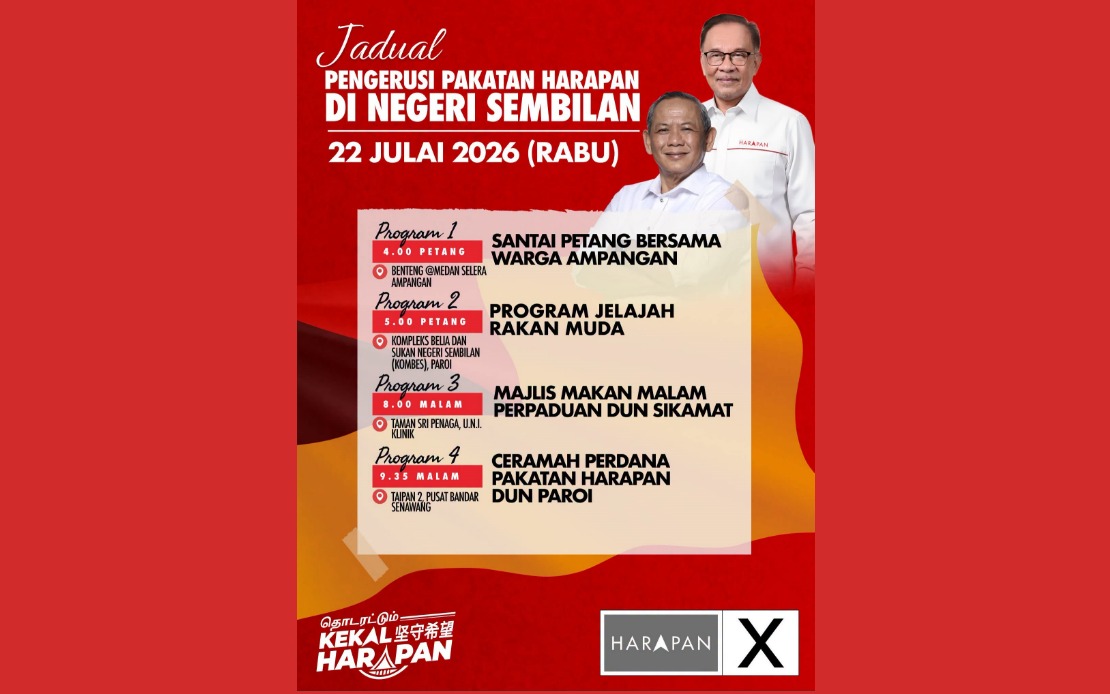
Prime Minister Datuk Seri Anwar Ibrahim will conduct an intensive campaign sweep across Negeri Sembilan today, marking a significant escalation in Pakatan Harapan's efforts to retain power in the state assembly elections. The PKR president's presence on the fifth day of the campaign period signals the coalition's determination to maintain its grip on the state government currently led by Datuk Seri Aminuddin Harun, with senior leadership now directly engaging voters across multiple constituencies.
Anwar's itinerary encompasses four separate engagements spanning the afternoon and evening, each carefully choreographed to maximise media coverage and demonstrate coalition unity. Beginning at 4 pm, he will participate in a community gathering at Benteng @ Medan Selera Ampangan, followed by a youth-focused programme at the Negeri Sembilan Youth and Sports Complex in Paroi at 5 pm. The schedule continues with a constituency dinner in Sikamat before culminating in a major rally in Senawang, designed to energise party workers and showcase grassroots support.
The strategic deployment of the Prime Minister reflects both confidence and underlying competitive pressures within Negeri Sembilan's electoral landscape. His direct involvement amplifies the messaging around Pakatan Harapan's campaign platform, which was formally introduced on Monday and comprises ten core policy commitments centred on economic development and inclusive governance for the state. By appearing alongside local candidates and engaging directly with constituents, Anwar seeks to translate federal-level credibility into state-level electoral gains.
Pakatan Harapan's contest structure demonstrates the coalition's resource commitment to the election. The alliance is fielding candidates in all 36 state seats, with the distribution reflecting agreed power-sharing arrangements: PKR contests sixteen seats, Democratic Action Party eleven, and Amanah nine. This comprehensive slate indicates PH intends to maximise its parliamentary representation rather than ceding any seat to opposition forces, suggesting internal polling data shows competitive races across the state.
The timing of Anwar's campaign visit coincides with a crucial phase in the election cycle. The Election Commission has scheduled early voting for July 28, with general polling set for August 1, providing a narrow window for campaigns to crystallise voter preferences. By appearing now, during mid-campaign, Anwar can influence undecided voters while momentum remains fluid, rather than waiting until the final stretch when messaging becomes repetitive and voter attention fragments.
Negeri Sembilan holds particular significance within Malaysia's broader political architecture. The state has historically served as a bellwether of coalition strength, and PH's performance here will carry implications extending beyond the state itself. A strong victory would reinforce Anwar's narrative of coalition unity and popular mandate, while a marginal result could invite internal questioning about PH's electoral machinery and message effectiveness. This makes the state election more than a local contest—it functions as a referendum on the federal government's standing.
The campaign reflects evolving patterns in Malaysian electoral politics, where Prime Ministers routinely canvas multiple constituencies, blurring traditional distinctions between federal and state-level campaigns. Anwar's physical presence across four different areas within a single day maximises his visibility while economising on time, an approach that depends heavily on sophisticated logistics and security arrangements. This intensive approach has become standard practice among ruling coalition leaders seeking to demonstrate hands-on engagement with electoral processes.
The community engagement component of today's schedule—particularly the youth-focused programme—indicates PH's awareness that capturing younger voters remains essential to broadening its electoral coalition. Youth participation has become increasingly volatile in recent Malaysian elections, with this demographic showing willingness to punish perceived government inaction on issues ranging from employment to housing affordability. By dedicating specific programme time to engaging young voters, Anwar signals responsiveness to generational concerns beyond generic policy announcements.
Pakatan Harapan's manifesto, which Anwar will promote throughout today's engagements, provides substantive anchors for campaign messaging. The ten commitments outlined in the platform presumably address constituencies' immediate concerns while articulating a broader vision of state development. Rather than relying solely on personality-driven appeals, the coalition grounds its pitch in concrete policy proposals, a strategy that typically performs well among voters fatigued by empty political rhetoric. Anwar's role today involves translating these abstract commitments into relatable language resonating with different audiences across diverse constituencies.
The opposition's counter-campaign strategy remains a background factor shaping PH's tactical decisions. Although the source material does not explicitly detail opposition positioning, the intensity of PH's effort suggests competitive races in multiple constituencies. The decision to deploy the Prime Minister reflects assessment that direct leadership intervention can shift marginal contests, an assumption that carries risks if voters view such intervention as desperate or heavy-handed.
From a Southeast Asian perspective, Negeri Sembilan's election matters beyond Malaysia's borders. The state's democratic processes contribute to regional perceptions of Malaysia's democratic health and governance standards. A well-managed, competitive election reinforces Malaysia's standing as a functioning democracy within a region sometimes characterised by democratic backsliding. PH's campaign conduct and electoral approach therefore carry subtle diplomatic implications alongside domestic political importance.
Looking ahead to August 1, today's activities represent a critical juncture in determining whether PH maintains state control or faces a potential loss that could destabilise the federal coalition. Anwar's personal engagement level will either energise ground-level party workers or, if turnout remains disappointing despite his presence, raise questions about PH's capacity to mobilise supporters effectively. The coming days will clarify whether his campaign intervention yields tangible electoral dividends.

