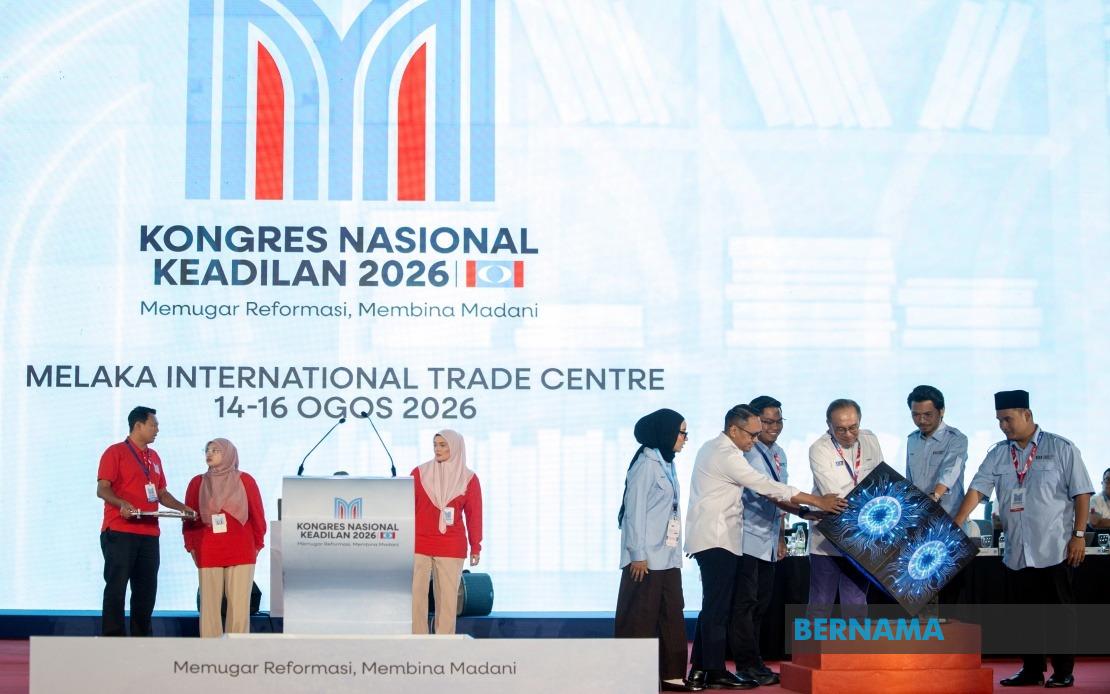
Prime Minister Datuk Seri Anwar Ibrahim launched a significant new publication in Melaka on behalf of Parti Keadilan Rakyat's youth movement, signalling the party's commitment to ideological grounding and systematic cadre development amid Malaysia's complex political landscape. The 113-page document, co-authored by AMK chief Muhammad Kamil Ahmad Munim and executive committee member Ashraf Ahmad Hadi, represents an attempt to crystallise the party's contemporary thinking on governance challenges and youth engagement in an era demanding both pragmatism and principle.
Anwar's decision to personally unveil this publication underscores its strategic importance within PKR's organisational architecture. Rather than treating youth mobilisation as an afterthought to electoral campaigns, the Prime Minister framed the guide as integral to national recovery itself. His remarks moved beyond routine political messaging to articulate a deeper philosophical position: that sustainable nation-building cannot rely solely on technical expertise or administrative efficiency, but demands what he termed "civilisational renewal"—a concept implying that Malaysia requires fundamental recalibration of values and development priorities.
The timing of this launch carries particular significance. Anwar's reference to the concurrent adoption of an unnamed framework suggests the publication aligns with broader policy initiatives, possibly including updated development blueprints or governance reforms. This synchronisation indicates PKR's effort to position itself as intellectually responsive rather than reactionary, capable of linking youth idealism with concrete policy direction. For Southeast Asian observers, this demonstrates how Malaysian political parties are attempting to deepen institutional capacity beyond personality-driven leadership, a pattern increasingly visible across the region.
Central to Anwar's messaging was a pointed critique of shallow activism and performative politics. He explicitly cautioned AMK members that wielding political power represents a moral burden rather than licence for self-aggrandisement. This language carries obvious relevance to Malaysian politics, where questions of integrity and accountability remain contested terrain following decades of institutional erosion. By emphasising that youth leadership entails "piety and moral integrity" as tests rather than mere aspirational language, Anwar articulated expectations likely reflecting internal concerns about maintaining party discipline and ideological coherence.
The publication's role as a cadre-building resource illuminates PKR's longer-term strategic thinking. Rather than investing primarily in short-term electoral mobilisation, the party is apparently investing in systematic knowledge transmission about its founding principles and the concept of "Reformasi." This approach mirrors practices adopted by more institutionalised regional parties, suggesting recognition that Malaysia's political system demands deeper roots than seasonal campaigns can provide. For younger members, the guide offers narrative continuity linking present-day political participation to historical struggles for democratic reform.
Anwar's emphasis on the nation's need for "extraordinary creativity, intellectual courage and spiritual resilience" reframes how Malaysian society might address inherited governance challenges. His language suggests that merely replacing individuals in power proves insufficient; rather, transformation demands that a new generation internalise different methodologies and ethical frameworks. This philosophical positioning matters considerably in Malaysian context, where political transitions often occur without corresponding shifts in institutional culture or developmental assumptions.
The mention of "past injustices and leakages" obliquely references Malaysia's well-documented corruption and institutional dysfunction, without descending into partisan blame-laying. This framing allows younger members to understand their role within a narrative arc spanning multiple decades, positioning current political participation as part of an extended reform project. Such historical consciousness potentially insulates party members against both cynicism and the opportunism that can characterise youth wings dominated by short-term career calculation.
For Southeast Asian political analysts, PKR's investment in formalised ideological transmission through publications represents an interesting counterpoint to the region's general trend toward personalised, charismatic leadership models. While Malaysian politics remains dominated by individual political actors, this publication effort suggests recognition that sustainable political movements require institutional scaffolding and deliberate knowledge management. Whether such efforts prove effective depends partly on whether AMK members actually engage with the material and whether party leadership consistently models the principles the guide articulates.
The guide's intended function in shaping "knowledgeable and principled members" who remain "steadfast in upholding the mandate of the party's struggle" implicitly acknowledges challenges PKR has faced regarding internal discipline and ideological clarity. Youth wings across Southeast Asia frequently struggle with balancing enthusiastic recruitment against careful vetting of underlying commitment to core principles. By creating structured educational resources, PKR attempts to solve this perennial party-building problem through systematic rather than ad hoc methods.
Anwar's personal involvement in launching this relatively modest publication—a 113-page guide rather than a major legislative initiative—signals that he considers youth ideological formation strategically important to his broader political project. This emphasis deserves attention from those seeking to understand how Malaysian political leaders prioritise time and symbolic capital. The decision suggests that for Anwar, constructing durable institutional foundations matters as much as managing immediate governance demands.
The implications extend beyond PKR itself. If this publication and accompanying cadre-building efforts successfully create a generation of party members motivated by principles rather than patronage, it could establish benchmarks affecting Malaysia's entire political culture. Conversely, if the guide remains a symbolic gesture disconnected from actual party practice, it will merely illustrate the persistent gap between aspirational rhetoric and institutional reality that characterises much of Malaysian politics and governance.

