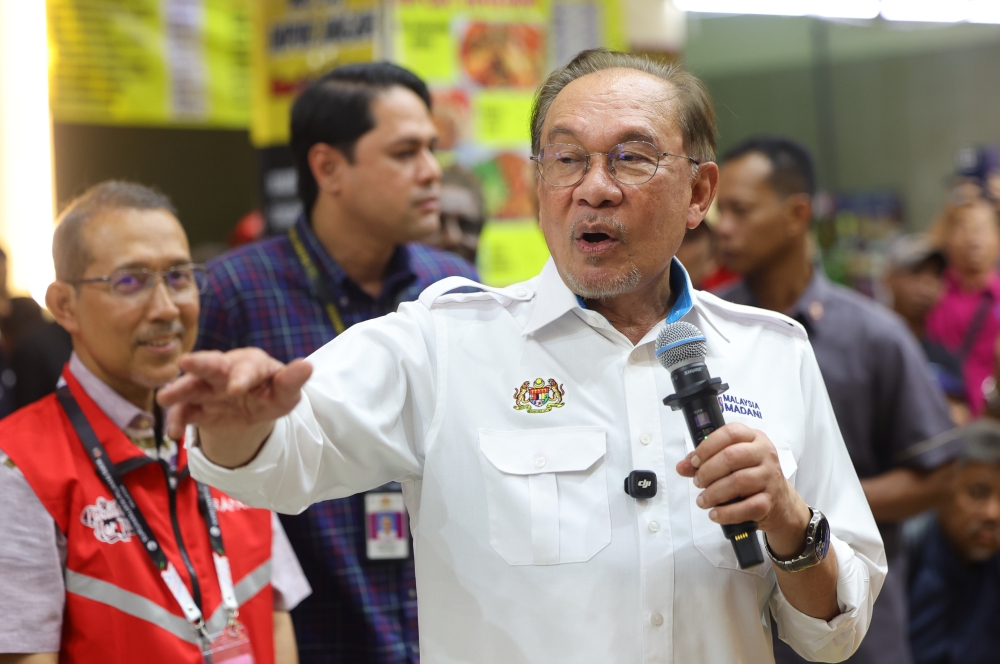
Prime Minister Datuk Seri Anwar Ibrahim has significantly ramped up his political presence in Negeri Sembilan as the campaign enters its decisive closing phase, with an unusually dense itinerary spanning multiple constituencies and community engagement events across the state. The heightened activity reflects the strategic importance the federal leadership places on securing strong electoral performance in Negeri Sembilan, where historical voting patterns have shown the state remains a competitive battleground between major political coalitions.
The intensive scheduling demonstrates a calculated approach to maximising face-to-face contact with voters during the final window before polling day. Rather than concentrating efforts in a single area, Anwar's team has choreographed movements across several parliamentary and state constituencies, a tactic designed to generate local media coverage and demonstrate personal commitment to constituents across the state's diverse regions. This ground-level engagement complements broader national campaign messaging and serves to reinforce the government's connection to ordinary Negeri Sembilan residents navigating economic and social concerns.
Negeri Sembilan's significance in the broader electoral equation cannot be understated. The state occupies a delicate position within Malaysia's political landscape, historically swinging between competing blocs and serving as an important bellwether for national sentiment. A strong showing would provide valuable momentum for Anwar's coalition heading into the final campaign phase, while conversely, any underperformance could generate narratives about waning support in traditionally receptive territories.
The decision to dedicate substantial prime ministerial time to the state reflects internal polling and assessment suggesting the race remains competitive. Campaign strategists evidently believe personal appearances by the head of government can shift voting intentions, particularly among undecided voters who may be influenced by direct interaction with national leadership. This approach has become standard practise in Malaysian electoral politics, where symbolic gestures and high-profile visits frequently correlate with media attention and public perception management.
Beyond the tactical campaign considerations, Anwar's presence in Negeri Sembilan carries implications for the state's political establishment and local party structures. Senior party figures and state-level politicians benefit from association with the Prime Minister, gaining credibility and visibility that translates into grassroots support. Simultaneously, the visits serve to validate and energise the party machinery at district and divisional levels, reinforcing hierarchical party discipline and mobilisation capacity during the critical pre-election period.
The packed schedule format itself merits examination as a campaign strategy. Multiple back-to-back engagements maximise media output, create the impression of unstoppable momentum, and provide organisers with numerous photo opportunities and soundbite moments suitable for digital distribution. In Malaysia's media environment, where traditional and social media channels overlap significantly, such intensive activity generates multiple content streams that reach voters through diverse platforms and at varying intervals.
Negeri Sembilan presents particular demographic and geographic characteristics that influence campaign mechanics. The state encompasses both urban and rural constituencies with distinct voter profiles and concerns. Urban areas may prioritise economic opportunities and cost-of-living pressures, while rural districts might emphasise infrastructure investment and agricultural support. A differentiated messaging strategy across multiple stops allows the leadership to address these varied concerns within a single visit, making the intensive itinerary a practical necessity rather than mere political theatre.
The timing of this acceleration, positioned in the campaign's final stretch, reflects standard political doctrine regarding momentum building and last-minute persuasion. Undecided voters frequently make final choices in the closing days, and high-visibility leadership engagement can catalyse decision-making. Additionally, from an organisational standpoint, intensive final activities serve to galvanise party workers and volunteers, ensuring maximum turnout mobilisation efforts on election day itself.
For Malaysian observers and regional political watchers, Anwar's Negeri Sembilan push illuminates broader patterns in contemporary Malaysian electoral competition. The state continues functioning as a critical proving ground where national political trends become locally manifest. Results here frequently signal broader shifts in voter sentiment and coalition performance, making intensive final-phase campaigning a rational investment of prime ministerial resources and attention.
The positioning also demonstrates the premium placed on personal political capital in Malaysian politics. Despite sophisticated polling, data analytics, and professional campaign infrastructure, direct leader visibility and engagement remain potent tools for electoral success. Anwar's decision to personally undertake the demanding schedule, rather than delegating these activities to subordinate figures, sends a message about the importance he and his coalition assign to the Negeri Sembilan outcome.

