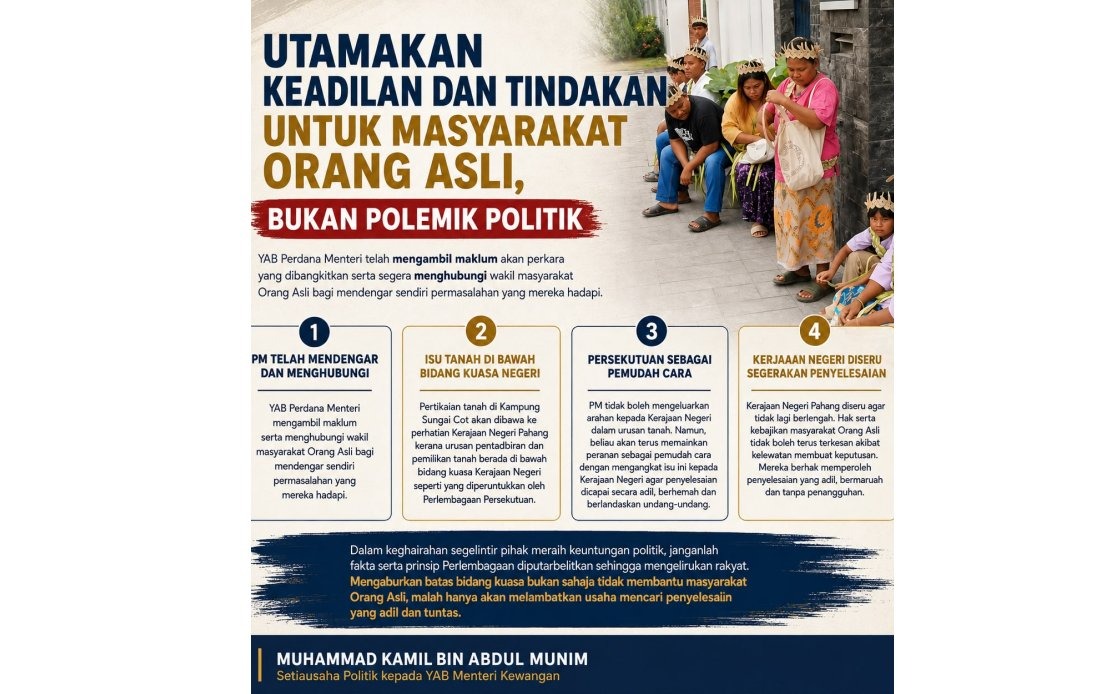
Prime Minister Datuk Seri Anwar Ibrahim is positioning himself as an intermediary in efforts to untangle a complex land ownership dispute involving indigenous Orang Asli residents in Kampung Sungai Cot, located in the Maran district of Pahang. Through his political secretary Muhammad Kamil Abdul Munim, Anwar has signalled that while constitutional limitations prevent the federal government from directly intervening in matters of state land administration, the Prime Minister remains actively engaged in pushing for a timely resolution that upholds the legal and customary rights of the community.
The articulation of this position reflects the delicate balance between federal and state authority enshrined in Malaysia's constitutional framework. Land administration, ownership registration, and disputes fall squarely within the purview of individual state governments under the Federal Constitution. This jurisdictional boundary means Anwar cannot unilaterally direct Pahang to resolve the matter according to his preferences, regardless of his political authority at the national level. Nevertheless, the Prime Minister's office has sought to distinguish between powerlessness and indifference, emphasising that he has personally reached out to community representatives to understand their grievances firsthand.
The intervention appears calibrated to address criticism from those who may view the federal government's role as insufficient. Muhammad Kamil's statement carries a subtle rebuke of what he characterises as opportunistic politicking, cautioning against distorting facts or constitutional principles for partisan advantage. This framing suggests that some quarters have accused the administration of inadequate responsiveness to Orang Asli concerns. By emphasising the Prime Minister's direct engagement with community leaders and his commitment to raise the issue with Pahang authorities, the statement attempts to counter such allegations while remaining honest about constitutional constraints.
For the Orang Asli communities across Malaysia, land disputes represent a recurring and often intractable challenge. Historical patterns of land encroachment, competing claims, and inadequate recognition of customary land rights have left many indigenous settlements in legal limbo. Kampung Sungai Cot exemplifies these broader systemic issues. The involvement of the Prime Minister's office, even in an ostensibly facilitatory capacity, signals acknowledgment at the highest levels of government that such disputes demand urgent attention and fair adjudication rather than prolonged administrative inertia.
Muhammad Kamil's call for the Pahang State Government to act expeditiously carries implicit pressure, suggesting that delays in decision-making constitute a continuing injustice. The statement emphasises that the dignity and welfare of the Orang Asli residents should not remain hostage to bureaucratic sluggishness or political calculations. This rhetorical emphasis on speed and fairness may reflect frustration with the pace at which state authorities have addressed the matter, or it may represent a coordinated effort between federal and state leadership to accelerate resolution. Either way, it signals that the issue has reached a level of political salience requiring visible commitment from senior federal officials.
The constitutional realities underlying this dispute illuminate broader tensions in Malaysia's federal system. State governments jealously guard their control over land matters, viewing federal overreach as a threat to their autonomy. Yet citizens of those states, including marginalised communities such as the Orang Asli, increasingly look to the federal government for protection and intervention when state institutions appear unresponsive. Anwar's approach attempts to navigate this tension by respecting formal jurisdictional boundaries while exercising whatever informal influence the Prime Minister's office possesses to incentivise state action.
For Malaysian indigenous communities more broadly, the Kampung Sungai Cot case represents both a test of the current administration's commitment to Orang Asli welfare and a microcosm of structural challenges that no single government initiative can easily resolve. Land disputes among the Orang Asli are not merely technical legal matters; they reflect centuries of dispossession, marginalisation, and the collision between customary land systems and colonial-era legal frameworks that remain largely unchanged. Genuine resolution requires not only adjudication of the specific Kampung Sungai Cot claim but potentially broader reform of how land administration recognises and protects indigenous rights.
The Prime Minister's personal involvement, as indicated by his direct contact with community representatives, underscores a political calculation that Orang Asli constituencies matter to the federal government's broader agenda and legitimacy. Whether this translates into tangible outcomes depends significantly on the willingness of Pahang State Government to prioritise the matter and the capacity of existing legal and administrative frameworks to accommodate indigenous land claims without creating precedents state governments fear. Anwar's leverage lies in his ability to generate political costs for inaction while his constraints reflect the constitutional architecture he must respect as Prime Minister.
Moving forward, the resolution of the Kampung Sungai Cot dispute will likely hinge on negotiations between federal and state actors, informed by input from legal experts, indigenous representatives, and affected residents. The involvement of the Prime Minister's office may accelerate this process by elevating the matter's profile and ensuring it receives sustained attention rather than being shelved. However, the ultimate power to decide rests with Pahang authorities, who must balance recognition of Orang Asli claims against competing interests and their own fiscal and administrative capacity to implement remedial measures.

