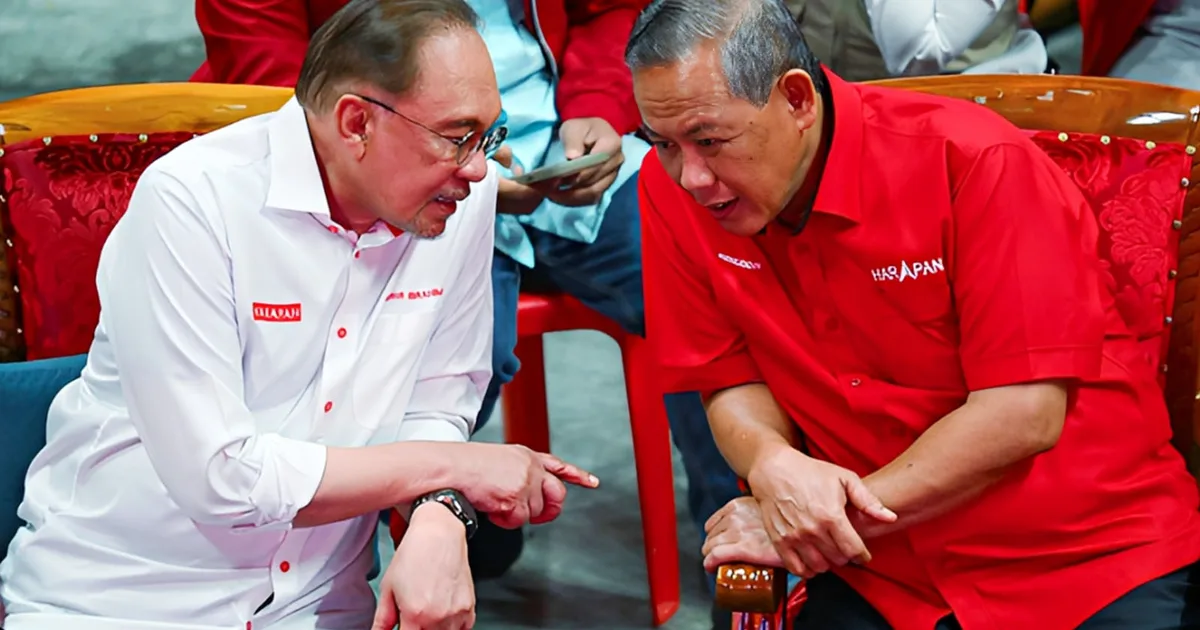
Anwar Ibrahim has underscored the enduring relevance of Aminuddin Harun in shaping Malaysia's emerging political leadership, praising the former Negeri Sembilan menteri besar for embodying the character traits that the nation's democratic ecosystem desperately requires. The PKR president's remarks reflect a broader conversation within the coalition about institutional knowledge, political maturity, and the generational handover of power that remains unresolved across the country's competing political camps.
The context surrounding Anwar's statement becomes clearer when examining Aminuddin's recent experience as menteri besar, a position from which he stepped down following electoral challenges in Negeri Sembilan. Rather than engaging in the acrimonious blame-shifting that has become distressingly commonplace in Malaysian politics, Aminuddin chose to accept the outcome with equanimity and without directing recriminations at colleagues or party structures. For a political establishment frequently characterised by finger-pointing, denial, and fractious internal disputes following electoral disappointments, such composure stands out markedly.
Anwar's elevation of this conduct as exemplary speaks to deeper anxieties within PKR and the broader Pakatan Harapan coalition regarding how their members—particularly those ascending the political hierarchy—handle adversity. The transition from the idealism of opposition politics to the sobering realities of governing has proven destabilising for numerous political figures across the spectrum. Younger party members, ambitious for advancement and sometimes lacking the experience to contextualise setbacks within longer political trajectories, occasionally resort to destructive internal manoeuvres when faced with disappointing results. Aminuddin's example offers a counternarrative to this pattern.
The mentorship dimension that Anwar emphasises carries particular weight given Malaysia's persistent leadership succession challenges. Unlike some established democracies with transparent mechanisms for identifying and developing future senior figures, Malaysian political parties have historically relied on informal networks and personal patronage to groom potential successors. This opaque system has occasionally resulted in leadership transitions marked by uncertainty, internal conflict, and questions about competence. By explicitly valorising Aminuddin's presence as a mentor figure, Anwar signals that PKR is consciously attempting to formalise and legitimise the role that experienced former office-holders can play in institutional continuity.
Aminuddin's background provides substantial credentials for such a role. His experience navigating Negeri Sembilan politics, a state long dominated by traditional institutions and careful power management, equipped him with understanding of consensus-building, stakeholder management, and the peculiar challenges of leading states with significant royal influence. These are skills that younger leaders require exposure to, particularly those who may advance to positions where monarchical institutions play meaningful roles. The practical wisdom derived from wrestling with such complexities cannot be quickly transmitted through formal training; it demands mentorship and apprenticeship models.
The timing of Anwar's remarks also warrants consideration within the evolving dynamics of Malaysian coalition politics. Pakatan Harapan continues to navigate considerable internal tensions regarding resource allocation, position distribution, and strategic direction. Divisions between DAP, PKR, and Amanah—to say nothing of the complicated relationship with Bumiputera-focused parties—create constant friction points. Investing symbolically in figures like Aminuddin, who commands respect across these internal divisions without representing a particular ideological pole, may serve to reinforce coalition cohesion. His neutrality on contentious intra-coalition questions renders him a safer focus for institutional continuity narratives.
For Malaysian readers observing these developments, several implications emerge. The emphasis on Aminuddin's graciousness following electoral loss reflects a philosophy increasingly needed in the country's volatile political environment. As Malaysia faces growing polarisation, economic pressures, and questions about institutional integrity, the quality of its political leadership becomes ever more consequential. Leaders who respond to disappointment with reflection rather than recrimination, who prioritise institutional health over personal vindication, genuinely matter for democratic stability.
The broader Southeast Asian context amplifies this significance. Across the region, transitions of power have frequently been accompanied by instability, factional conflict, or erosion of institutional norms. Thailand's repeated military interventions, Myanmar's slide into authoritarian collapse, and Cambodia's concentration of power all represent cautionary tales. Malaysia's ability to navigate its own generational transitions peacefully, with experienced figures gracefully stepping aside while remaining available for guidance, represents a democratic asset worth preserving and consciously cultivating.
Anwar's positioning of Aminuddin as mentor also reflects recognition that effective governance requires not merely policy competence but also political acumen shaped by lived experience in complex environments. Younger leaders require exposure to figures who have navigated genuine electoral accountability, who understand how abstract principles interact with ground-level political realities, and who can model integrity under pressure. The informal mentorship relationships that Anwar references thus serve functions that formal training programmes cannot adequately address.
The challenge facing PKR and its coalition partners involves translating this rhetorical valorisation of mentorship into systematic institutional practice. Identifying appropriate roles for experienced figures, creating conditions where their knowledge genuinely influences decision-making, and ensuring that mentorship relationships operate transparently rather than becoming sources of hidden factional influence all require deliberate structural innovation. Without such institutionalisation, Anwar's invocation of Aminuddin's example risks remaining merely aspirational—worthy sentiment that fails to reshape actual party behaviour or developmental practices.
Ultimately, Anwar's comments represent an implicit acknowledgement that Malaysian politics requires cultural transformation. Moving from a system where power is guarded jealously, where stepping aside is perceived as weakness, and where electoral defeat triggers destructive internal conflict demands leadership that visibly and credibly models alternative approaches. If Aminuddin's example genuinely influences how PKR and its coalition partners develop future leaders, the reverberations could extend well beyond a single party's internal dynamics.

