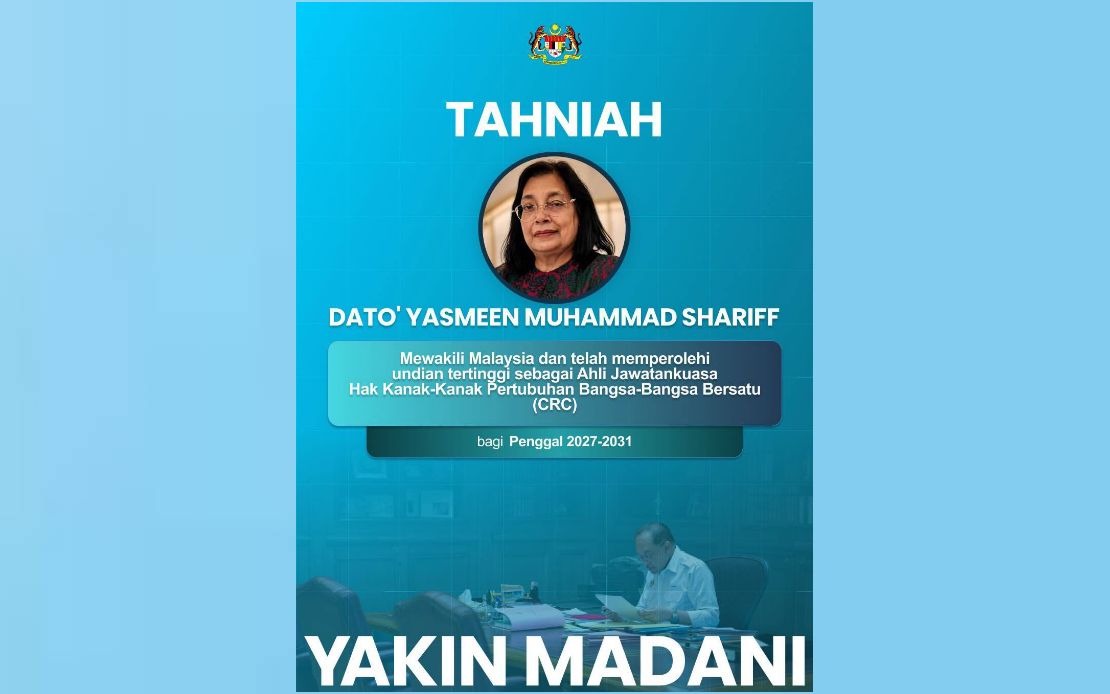
Prime Minister Datuk Seri Anwar Ibrahim has expressed his congratulations to Datuk Yasmeen Muhamad Shariff following her successful election to the United Nations Committee on the Rights of the Child, effective from 2027 through 2031. The appointment, announced via the Prime Minister's social media channels, underscores what Anwar characterises as growing international recognition of Malaysia's engagement with global child welfare initiatives. The selection carries significance beyond individual achievement, with Anwar framing the outcome as a reflection of international confidence in the nation's broader diplomatic standing and commitment to substantive human rights work at the multilateral level.
Yasmeen secured her position through a decisive vote held during the 21st Meeting of States Parties to the Convention on the Rights of the Child at the United Nations headquarters in New York. The ballot saw her receive 136 votes from the 189 States Parties present and participating in the election process. This commanding majority—representing approximately 72 percent support among voting members—suggests substantial international consensus regarding her suitability for the independent expert role. The size of her winning margin indicates that her candidacy transcended typical geopolitical divisions often present in UN committee elections, potentially reflecting recognition of her professional credentials and prior service record.
What renders Yasmeen's selection particularly noteworthy is that this constitutes her second appointment to the prestigious committee structure. She previously served as a member during the 2013-2017 term, marking a decade-long interval between her successive elections. This continuity in international recognition suggests that her first tenure generated positive impressions among voting states, sufficient to warrant reselection despite the competitive nature of UN committee elections. Few experts achieve this level of reappointment to UN bodies, as the process typically introduces fresh representation across successive terms. Her return to the committee potentially signals consistency in Malaysia's approach to children's rights advocacy and allows the nation to maintain institutional memory within this influential monitoring mechanism.
As a committee member, Yasmeen will function in a personal capacity as an independent expert rather than as a government representative, a distinction crucial to understanding the UN Committee on the Rights of the Child's operational framework. This independence is foundational to the committee's credibility, as the body's primary function involves reviewing compliance by signatory nations with their obligations under the Convention on the Rights of the Child. Members are expected to evaluate state performance impartially, including assessment of their own countries' implementation records. This arrangement occasionally creates tension between national interest and expert judgment, yet the system's integrity depends upon committee members maintaining this professional independence.
The Committee on the Rights of the Child stands as one of the UN's treaty-monitoring bodies, tasked with examining periodic reports submitted by state parties regarding their progress in protecting children's rights. The committee issues concluding observations and recommendations, which carry significant moral weight despite lacking binding enforcement mechanisms. Its work encompasses diverse child welfare domains including education, health, protection from violence and exploitation, participation rights, and access to justice. The committee's reports frequently receive attention from civil society organisations, academic institutions, and international media, making membership a platform for influential advocacy on childhood protection priorities.
Prime Minister Anwar's public acknowledgment of this achievement also extends recognition to the Ministry of Women, Family and Community Development, the government department that coordinated the candidacy process. The ministry's efforts in building international support for Yasmeen's nomination reflect broader Malaysian diplomatic engagement in the multilateral human rights sphere. Such candidacies typically require months of strategic outreach to secure backing from voting states, involving coordination between Malaysia's UN mission in New York and various capitals. The ministry's success in this competitive process demonstrates effective diplomatic coordination and the trust Malaysia has cultivated among peer nations on family and child welfare matters.
For Malaysia specifically, the appointment carries implications extending beyond ceremonial recognition. It positions the nation within authoritative international dialogue on child protection standards and emerging challenges affecting young people globally. As regional conversations around child labour, trafficking, online safety, and educational access intensify across Southeast Asia, having representation within a UN body shaping global child rights discourse provides Malaysia with insights into international best practices and policy trends. This intelligence can inform domestic policy development while simultaneously allowing Malaysian expertise to influence international standard-setting regarding children's rights implementation.
Anwar's hope that this achievement will catalyse further Malaysian accomplishment on the international stage reflects the government's broader agenda of elevating the nation's diplomatic profile and soft power. Senior appointments to UN bodies remain significant markers of international respect and influence, particularly within the human rights sphere. Each successful candidacy contributes to perceptions of Malaysia as a responsible global actor engaged constructively with multilateral institutions. This positioning becomes increasingly valuable as Malaysia navigates complex regional geopolitics and seeks to build coalitions supporting its development and governance priorities.
The appointment also arrives within a context of evolving international attention to children's rights across the Indo-Pacific region. Southeast Asian nations face distinctive challenges regarding child welfare, from concerns about trafficking networks and child labour in supply chains to digital safety issues and educational disruption. Having Malaysian representation within a UN committee addressing these issues provides a channel through which regional concerns can be elevated to global attention, while simultaneously enabling Malaysia to demonstrate its commitment to child protection as a governance priority. This representation can enhance Malaysia's credibility when advocating for international cooperation on transnational child welfare challenges affecting the broader region.

