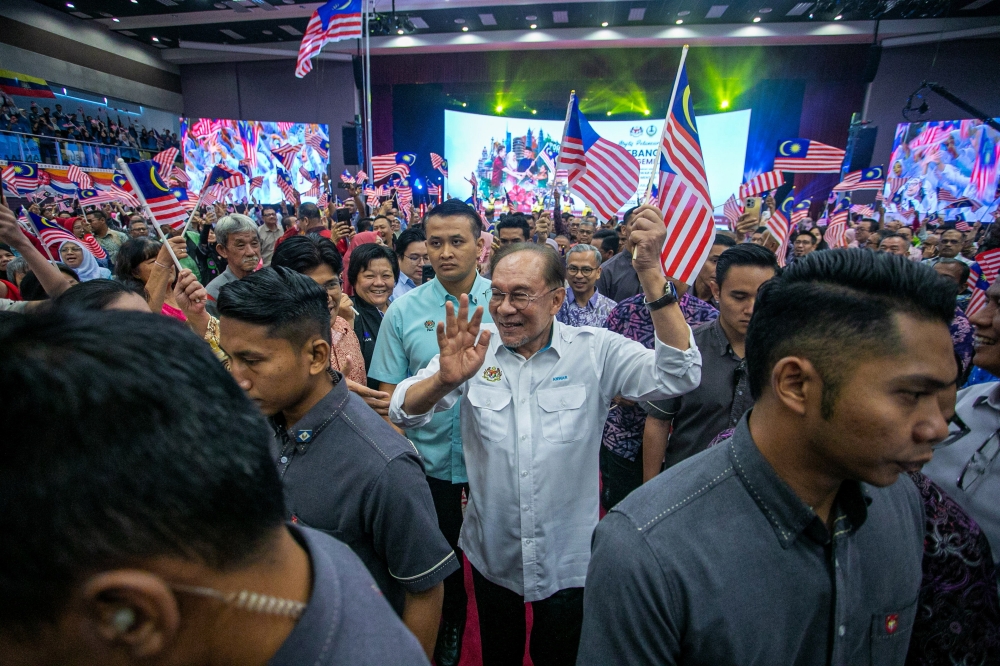
Prime Minister Datuk Seri Anwar Ibrahim has drawn a careful distinction between permissible political activity and conduct that breaches professional standards, warning his ministers and senior government figures that their right to campaign must be exercised responsibly. Speaking in Ipoh on July 19, the Prime Minister sought to clarify acceptable conduct for those holding public office, emphasizing that involvement in party politics need not conflict with proper governance, provided officials remain mindful of their duties and the law.
The guidance reflects an ongoing tension within Malaysia's political system, where elected representatives must balance their roles as public servants with their responsibilities to their political parties and constituents. Anwar's intervention suggests growing concern that some government officials may be blurring the boundaries between legitimate political engagement and the misuse of state apparatus for partisan advantage. This is a persistent challenge in developing democracies across Southeast Asia, where institutional safeguards against the weaponization of government resources remain under constant pressure.
Government ministers hold unique positions of influence and access to public resources, making the distinction between campaigning and abuse of office particularly important. The Prime Minister appears to recognize that outright prohibition of political activity would be impractical and arguably undemocratic, yet unregulated use of ministerial platforms and government machinery for electoral purposes undermines public trust and administrative integrity. His statement therefore attempts to establish clear expectations without imposing blanket restrictions that would effectively silence public representatives.
The timing of Anwar's remarks carries significance within Malaysia's current political landscape. With the nation's electoral calendar remaining active and multiple state-level competitions anticipated in coming years, questions about the proper conduct of government officials during campaign periods have become increasingly prominent. The instruction to government leaders demonstrates the Prime Minister's attempt to preempt controversies that might arise from overzealous campaign activities by officials wielding state authority.
Central to the Prime Minister's message is the principle that holding government office carries inherent responsibilities that cannot be suspended during election periods. Officials must ensure that government resources, facilities, and personnel are not repurposed for party political ends. The provision of public funds, vehicles, and administrative infrastructure exclusively for campaign activities represents a fundamental breach of trust between the state and its citizens. Similarly, coercion of civil servants to participate in party activities, or pressure on government beneficiaries to support particular candidates, constitutes abuse of the official position.
Anwar's directive also implicitly acknowledges the distinction between permissible political speech and improper conduct. Ministers retain the right to express political views and advocate for their parties' policies, which is essential in a functioning democracy. However, this right must be exercised in a manner that does not exploit official status or confuse government communications with party propaganda. Public funds should not be deployed to amplify political messages, and government platforms should not become vehicles for partisan campaigning.
For Malaysian readers, this clarification carries implications beyond immediate political considerations. The rule of law and institutional integrity form the foundation upon which democratic systems depend. When officials face unclear boundaries regarding proper conduct, ambiguity creates opportunities for corruption and abuse. Conversely, when expectations are transparent and consistently enforced, public confidence in government strengthens. Anwar's statement therefore serves broader governance interests, not merely partisan ones.
The emphasis on avoiding crossing unspecified lines suggests that the Prime Minister expects his ministers to exercise judgment and restraint based on established principles rather than detailed regulations. This approach places considerable responsibility on individual officials to recognize improper conduct and self-correct. It also implies that enforcement mechanisms exist to address violations, though the statement does not elaborate on consequences or monitoring mechanisms. The effectiveness of such guidance ultimately depends on institutional culture and political will to hold officials accountable.
Regionally, Malaysia's approach reflects broader Southeast Asian concerns about maintaining democratic norms amid intense political competition. Countries across the region have grappled with similar challenges, where rapid political contestation and resource inequality between governing and opposition parties risk tilting electoral playing fields. Establishing and maintaining boundaries between legitimate political activity and abuse of state power represents an ongoing institutional struggle that transcends Malaysia.
The Prime Minister's message also signals something about his own understanding of governance. By explicitly reminding ministers that they can campaign while respecting boundaries, Anwar positions himself as an advocate for both democratic participation and institutional restraint. This balancing act attempts to address concerns that government power might be weaponized without appearing to suppress legitimate political expression by senior officials. Whether this approach will prove sufficient depends on how consistently it is applied and whether public perception aligns with stated principles.
Moving forward, the test of Anwar's directive lies in implementation. Government agencies would benefit from clearer guidance on distinguishing between permitted and prohibited activities. Training programs that educate officials about boundaries, coupled with transparent enforcement of rules, would strengthen compliance. Additionally, independent oversight mechanisms that can investigate complaints about misuse of official positions for campaign purposes would lend credibility to the stated commitment to balanced conduct.

