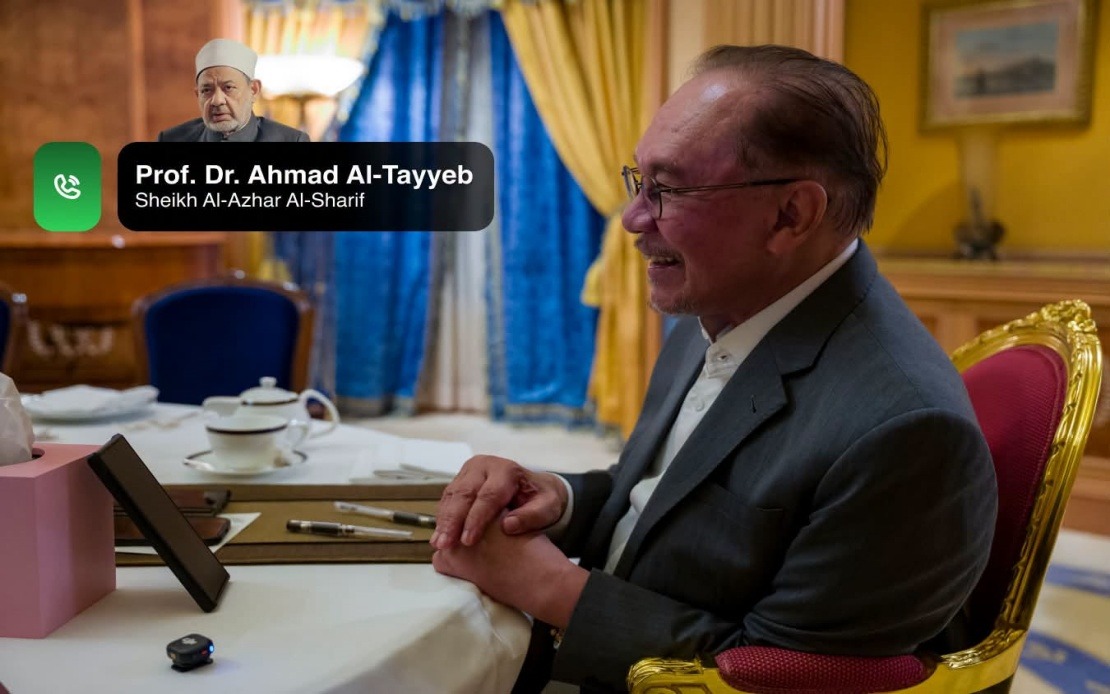
Prime Minister Datuk Seri Anwar Ibrahim has held substantive discussions with Sheikh al-Azhar al-Sharif Prof Dr Ahmad al-Tayyeb regarding the advancement of Islamic education and da'wah initiatives across Malaysia and the broader Muslim community. The two leaders connected by telephone, with the Grand Imam of Al-Azhar—one of Sunni Islam's most authoritative scholarly institutions—initiating contact to extend his concern for Anwar's wellbeing following recent surgery.
Anwar publicly acknowledged receiving al-Tayyeb's prayers and well-wishes during his post-operative recovery period, characterising both the surgical procedure and his rehabilitation as successful endeavours. Beyond personal health matters, the conversation pivoted to substantive policy discussions centring on how Islamic scholarship and religious outreach programmes might be strengthened to deepen believers' comprehension of Islamic teachings and contribute meaningfully to societal welfare. The Prime Minister framed this exchange as particularly significant, positioning the Grand Imam's counsel as fundamental guidance for maintaining intellectual rigour within Islamic scholarly traditions whilst simultaneously extending their tangible benefits across society.
Anwar specifically referenced Sheikh al-Tayyeb's previous visit to Malaysia, describing the occasion as having made a lasting and profound impression upon Malaysia's Muslim population. This historical connection underscores the bilateral relationship's established nature and suggests that engagement between Malaysian leadership and Al-Azhar's institutional hierarchy extends beyond episodic contact. The Prime Minister expressed optimism about future meetings, proposing that additional face-to-face encounters in either Cairo or Kuala Lumpur would provide valuable opportunities to advance collaborative da'wah and knowledge-sharing initiatives aimed at benefiting communities across both nations and the Islamic world more broadly.
Parallel to his engagement with Sheikh al-Tayyeb, Anwar also engaged in a separate conversation with Mohamed Abdelsalam, Secretary-General of the Council of Muslim Elders—an influential advisory body within Islamic governance frameworks. Abdelsalam similarly reached out to inquire about the Prime Minister's health status and convey supportive sentiments. This exchange demonstrates the multi-layered diplomatic and scholarly connections Malaysia maintains within prominent Islamic institutional networks, reflecting the country's positioning as a significant player in contemporary Muslim-majority governance and intellectual discourse.
During his conversation with Abdelsalam, Anwar reciprocated concern by asking after the health of Abdelsalam's wife, who was undergoing hospitalisation at the time of their exchange. This personal dimension illustrates how relationships within the highest echelons of Islamic leadership often interweave formal diplomatic protocol with genuine human concern—a characteristic frequently emphasised within Islamic teaching frameworks. The Prime Minister's inquiry and prayers for recovery reflected both courtesy and the spiritual dimensions that inform interactions among senior Muslim leaders.
A significant theme emerging from both conversations centred on al-Tayyeb's expressed desire to return to Malaysia for an extended visit. This prospective engagement carries implications for Malaysia's international Islamic leadership profile and its capacity to attract high-profile scholarly figures to contribute to the nation's religious intellectual ecosystem. Such visits typically involve public lectures, institutional partnerships, and collaborative academic projects that enhance Malaysia's visibility within global Islamic educational circles.
Anwar highlighted the strategic importance of strengthening Malaysia's formal relationship with Al-Azhar itself, an institution that holds unparalleled influence over Islamic jurisprudence and theological interpretation across the Sunni world. The Premier articulated a particular commitment to nurturing what he characterised as straightforward, accessible, and authoritative Islam—a formulation suggesting preference for Islamic understanding that eschews extremism, remains intellectually rigorous, and resonates authentically with contemporary believers across diverse cultural contexts. This framing aligns with Malaysia's broader positioning as a model for progressive Islamic governance that maintains theological orthodoxy whilst accommodating modern pluralistic societies.
Anwar publicly expressed heartfelt gratitude toward both Sheikh al-Tayyeb and Mohamed Abdelsalam, emphasising the friendship, institutional backing, and confidence they have consistently demonstrated. Such explicit acknowledgment serves diplomatic purposes beyond mere courtesy, signalling to Malaysia's Muslim-majority population that their leadership enjoys the respect and support of revered international Islamic figures—a form of soft power that bolsters domestic legitimacy for the Prime Minister's administration.
The Prime Minister also acknowledged his wife Datuk Seri Dr Wan Azizah Wan Ismail's contribution throughout his political journey, particularly regarding her resilience, dedication, and sacrifice. This recognition contextualises Anwar's personal and professional challenges within a family framework and aligns with broader Islamic emphasis on spousal partnership and mutual support within leadership contexts. Her characterisation as an exemplary figure for Muslim women carries symbolic significance within Malaysia's contemporary political discourse.
Anwar concluded his public statements by expressing confidence that these various collaborative endeavours and international partnerships would continue strengthening, ultimately serving the interests of Malaysia's population and contributing to universal wellbeing. This commitment reflects the Prime Minister's aspiration to position Islamic learning and practice as inherently constructive forces within national development frameworks rather than domains separate from or antagonistic toward secular governance concerns. The consolidation of ties with Al-Azhar and Islamic intellectual leadership globally represents an investment in Malaysia's long-term soft power and its influence within broader Muslim-majority regions, particularly as conversations around reformist versus traditionalist Islamic interpretation continue evolving across Southeast Asia and beyond.

