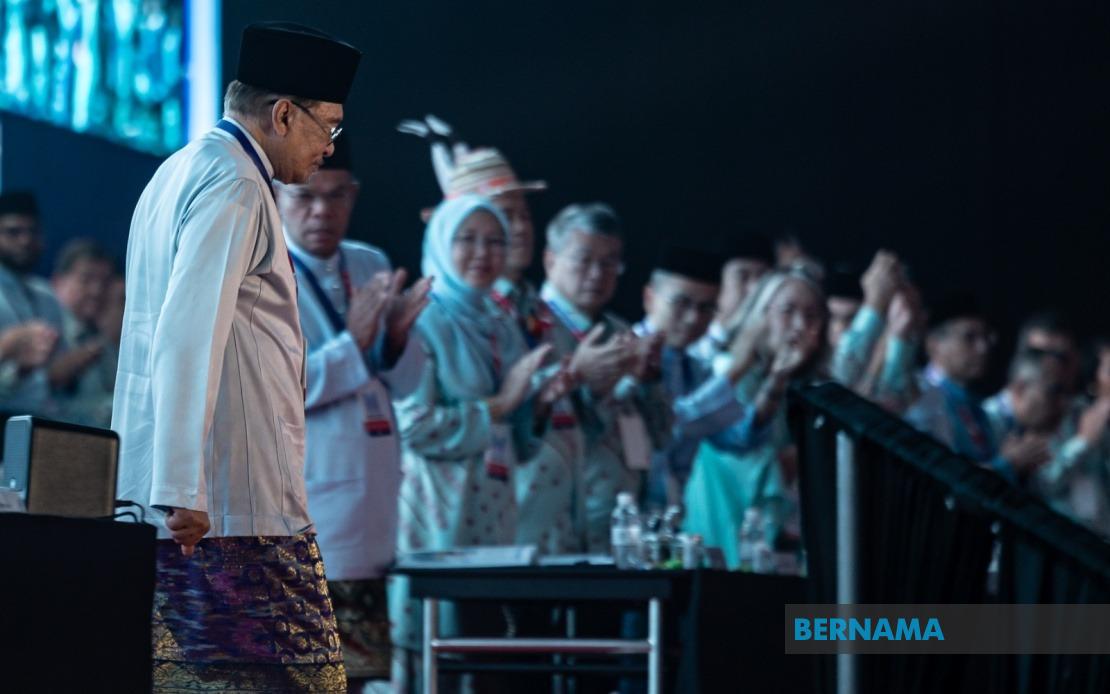
Prime Minister Datuk Seri Anwar Ibrahim has mounted a spirited defence of his government's reform agenda, insisting that three years of demonstrable progress should not be overshadowed by demands for faster change. Speaking at the 2026 PKR National Congress in Melaka on August 15, the PKR president sought to reframe the debate around his administration's trajectory, arguing that the substantive legislative and institutional changes already implemented represent a significant departure from decades of stagnation under previous governments.
Anwar's remarks reflect growing pressure from within his coalition and civil society for more aggressive action on governance reforms, institutional accountability, and anti-corruption measures. The Prime Minister's framing represents a carefully calibrated political strategy: acknowledging legitimate demands for change while simultaneously establishing a narrative that credits his administration with breaking a 60-year pattern of inertia. His invocation of the pre-2022 era serves as a historical baseline against which contemporary progress can be measured more favourably, even if absolute reform ambitions remain unfulfilled.
The legislative achievements Anwar enumerated carry genuine institutional significance for Malaysia's governance architecture. Amendments to the Audit Act 1957 expand parliamentary oversight mechanisms, while the Public Finance and Fiscal Responsibility Act 2023 imposes new budgetary discipline and transparency requirements on government spending. The Parliamentary Service Act modernises legislative operations, and the Consumer Credit Act addresses long-standing consumer protection gaps. The establishment of a Special Task Force on Agency Reform signals renewed attention to bureaucratic efficiency, while worker protection legislation for gig economy participants responds to structural employment shifts largely ignored in previous administrations.
Yet Anwar's acknowledgement that implementation remains incomplete reveals the persistent tension within Malaysia's Unity Government model. The coalition architecture, formed after the 2022 general election with support from UMNO-led Barisan Nasional and Sarawak-based parties alongside Anwar's Pakatan Harapan, inherently constrains radical institutional change. Reform initiatives must navigate the competing interests and ideological positions of coalition partners, creating inevitable friction between PH's transformative ambitions and the preferences of more conservative coalition members. This structural reality means that reforms either emerge diluted or proceed in carefully sequenced phases that maximise political palatability.
The Prime Minister's defence of gradualism carries particular weight given Malaysia's complex federal structure and entrenched institutional interests. Rapid, wholesale institutional overhaul risks destabilising established power bases across state governments, statutory bodies, and the civil service. Anwar's emphasis on foundations and staged implementation reflects not merely tactical caution but recognition that sustainable reform requires sufficient institutional buy-in to prevent rollback. The distinction between excuse and necessity proves crucial here: governments pursuing fundamental change in plural societies inevitably confront trade-offs between speed and durability.
For Malaysian readers, Anwar's message carries multiple resonances. Supporters of systemic reform may view his stance as excessive pragmatism that sacrifices transformative potential on the altar of coalition management. Critics from within PH who championed more aggressive governance overhaul during the 2018-2022 Pakatan governments may question whether the unity arrangement has fundamentally constrained the reform capacity his administration claimed to possess. Conversely, centrist observers and business interests may appreciate the emphasis on measured, institutionally grounded change that avoids disruptive shock to established systems.
The implications extend beyond domestic Malaysian politics into the broader Southeast Asian context. Malaysia's governance trajectory influences regional perceptions of whether meaningful democratic reform remains possible in established Southeast Asian systems or whether institutional sclerosis proves self-perpetuating. The success or failure of Anwar's phased reform model will inform debates across the region regarding optimal strategies for governance modernisation within politically constrained environments. Thailand, the Philippines, and Indonesia all grapple with analogous questions about reform feasibility within pluralistic political systems.
Anwar's candid admission that not all government actions have been flawless provides essential nuance to his defence. Rather than claiming perfection, the Prime Minister positions his administration within a learning framework, acknowledging missteps while maintaining the broader reform direction. This rhetorical stance contains intelligence: it provides political space to correct course or pause specific initiatives without abandoning the overarching reform narrative. The emphasis on learning also implicitly invites coalition partners and critics to view reform as an iterative process rather than a binary achievement-or-failure proposition.
The explicit reference to PH's position as the principal coalition party merits examination. This framing subtly reasserts PKR-led dominance within the government structure while explaining why coalition accommodation remains necessary. Anwar communicates that PH retains agency within the partnership but exercises it responsibly through negotiation rather than unilateral action. This positioning maintains PH's reform credentials while managing coalition tensions—a delicate balance requiring constant recalibration.
Looking forward, the substantive test of Anwar's reform agenda will involve execution quality and institutional embedding. Legislation enacted means little without effective implementation, resource allocation, and cultural change within implementing agencies. The Special Task Force on Agency Reform, for instance, must demonstrate tangible improvements in bureaucratic responsiveness and efficiency to validate claims of systemic transformation. Consumer protection and gig worker legislation require regulatory frameworks capable of genuine enforcement against established business interests. The parliamentary and fiscal reforms demand shifts in behaviour among elected representatives and finance officials accustomed to different norms.
Anwar's implicit challenge to reform advocates—accept achieved progress while continuing to demand further change—represents a mature political position that acknowledges ambition while respecting constraints. Yet it simultaneously places the burden on his administration to demonstrate that the phased approach yields cumulative, recognisable improvements rather than serving as perpetual justification for incompleteness. Malaysian stakeholders watching this reform trajectory will assess whether the administration's caution reflects strategic necessity or masks insufficient political will for deeper transformation.

