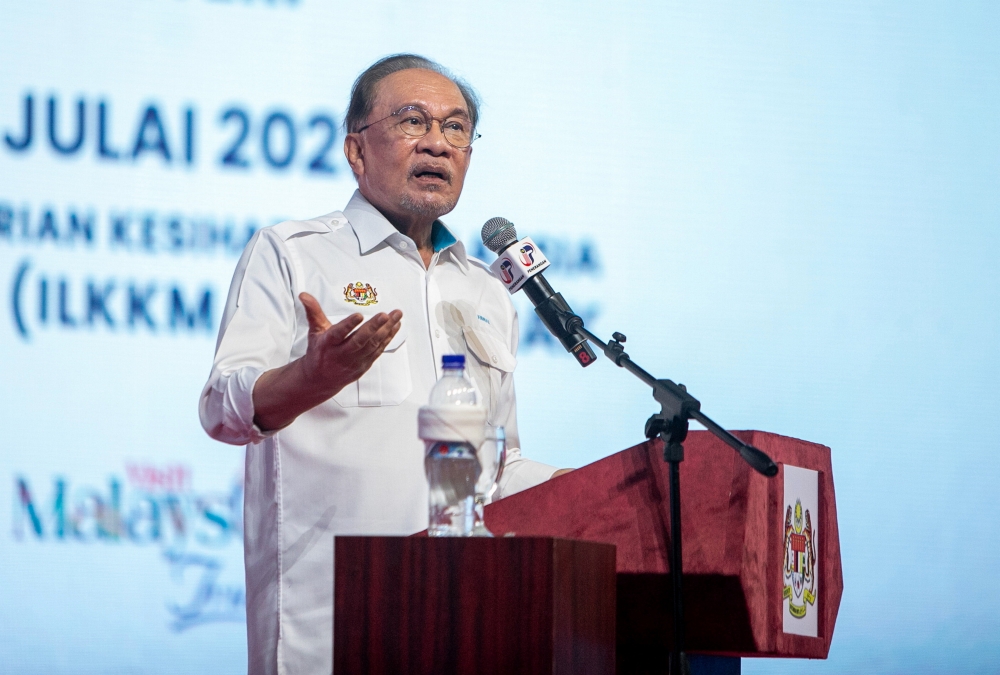
Prime Minister Datuk Seri Anwar Ibrahim has mounted a forceful defence of Malaysia's fuel pricing framework, positioning the government's subsidy model as a prudent fiscal choice that shields ordinary Malaysians from volatile international markets while avoiding the fiscal pitfalls of excessive borrowing. Speaking in Kajang, Anwar articulated the core tension facing policymakers: maintaining affordable fuel for households and businesses without surrendering to the temptation of deficit spending that would burden future generations.
The premier's remarks reflect mounting political scrutiny over the sustainability of Malaysia's fuel subsidy regime, which has become increasingly costly as global oil prices fluctuate and domestic consumption grows. Rather than treating the current system as temporary or problematic, Anwar reframed it as a deliberate policy choice that recognises the interconnected nature of inflation, social stability, and fiscal responsibility. His intervention suggests the government views fuel pricing not merely as an economic issue but as a cornerstone of its social contract with voters.
Anwar's argument rests on a fundamental question: who ultimately bears the cost? By maintaining price controls, the government accepts that burden through its budget allocations rather than transferring it to consumers' fuel tanks. This approach contrasts sharply with the alternative of allowing fuel prices to rise to market rates, which would increase household expenses, transportation costs, and inflation across the economy. While acknowledging the fiscal pressure on state finances, Anwar positioned the subsidy as preferable to the hidden costs of debt accumulation.
The timing of Anwar's defence matters considerably. Malaysia's public debt remains elevated relative to gross domestic product, and successive governments have grappled with balancing social spending against fiscal consolidation targets. By vocally supporting fuel subsidies, Anwar signals to his political base—particularly lower and middle-income voters who depend on affordable transport—that their welfare remains central to cabinet priorities. This messaging is especially important given Malaysia's pattern of subsidy-dependent politics, where fuel prices have historically triggered social unrest.
Under examination, however, Anwar's position contains an implicit acknowledgment of the policy's challenges. The question of "who will pay for it" cannot be indefinitely deferred. Fuel subsidies reduce government revenue available for education, healthcare, infrastructure, and debt servicing. They also create distortions: artificially low fuel prices can encourage inefficient consumption, smuggling to neighbouring countries, and industrial reliance on cheap energy that discourages productivity improvements. These second-order effects accumulate over time, potentially creating larger fiscal problems than a controlled price adjustment would generate.
The Prime Minister's framing also reflects regional dynamics. Across Southeast Asia, governments have taken divergent approaches to fuel pricing. Some, like Indonesia and Vietnam, have attempted gradual subsidy reforms to improve fiscal positions; others maintain controls to shield political constituencies. Malaysia's persistence with comprehensive subsidies places it increasingly at odds with the fiscal orthodoxy favoured by international financial institutions and increasingly by its own economic technocrats. Anwar's vigorous defence suggests the government believes the political cost of reform still exceeds the fiscal cost of continuation.
From a sectoral perspective, Malaysia's fuel policy has profound implications for competitiveness and economic structure. Cheap domestic fuel benefits labour-intensive industries and keeps inflation-sensitive sectors like manufacturing and logistics competitive. Yet it also subsidises inefficiency and discourages technological adoption that could improve productivity. Neighbouring countries that have reformed fuel pricing have often channelled savings into targeted cash transfers and investment in transportation and energy infrastructure—approaches that might better serve Malaysia's long-term development needs.
The subsidy's distributional impact merits scrutiny as well. While framed as protecting ordinary Malaysians, fuel subsidies disproportionately benefit car owners and commercial operators over public transport users and non-motorised populations. In urban areas particularly, this raises equity questions about whether the current system truly serves those most in need. A reformed system with direct cash transfers might achieve the government's social goals more efficiently while freeing resources for other priorities.
Anwar's insistence that alternatives mean "piling on debt" presents a false dichotomy. Governments could pursue subsidy reform paired with targeted support mechanisms, efficiency improvements in state enterprises, or gradual adjustments that spread costs across economic agents rather than concentrating them in government finances. Several neighbouring economies have demonstrated that managed transitions away from comprehensive subsidies, combined with compensatory measures, need not trigger economic crisis or social turmoil.
Nevertheless, Anwar's political calculation reflects Malaysian realities. The government faces competing pressures: a base expecting continued subsidies, fiscal constraints limiting flexibility, and international observers questioning sustainability. By defending the status quo firmly, Anwar maintains coalition cohesion while deferring difficult choices. This approach provides short-term political breathing room but leaves unresolved the medium-term question of how Malaysia finances public services and debt repayment as global economic conditions evolve.
Looking forward, the sustainability question will not disappear simply because leadership defends existing policy. As fuel import bills fluctuate with oil markets and Malaysia's fiscal space tightens, policymakers will eventually confront choices Anwar defers today. Whether reform comes through planned transition or crisis-driven adjustment will largely depend on whether the government begins now laying groundwork for public acceptance of structural change, or whether it continues privileging short-term messaging over long-term adjustment.

