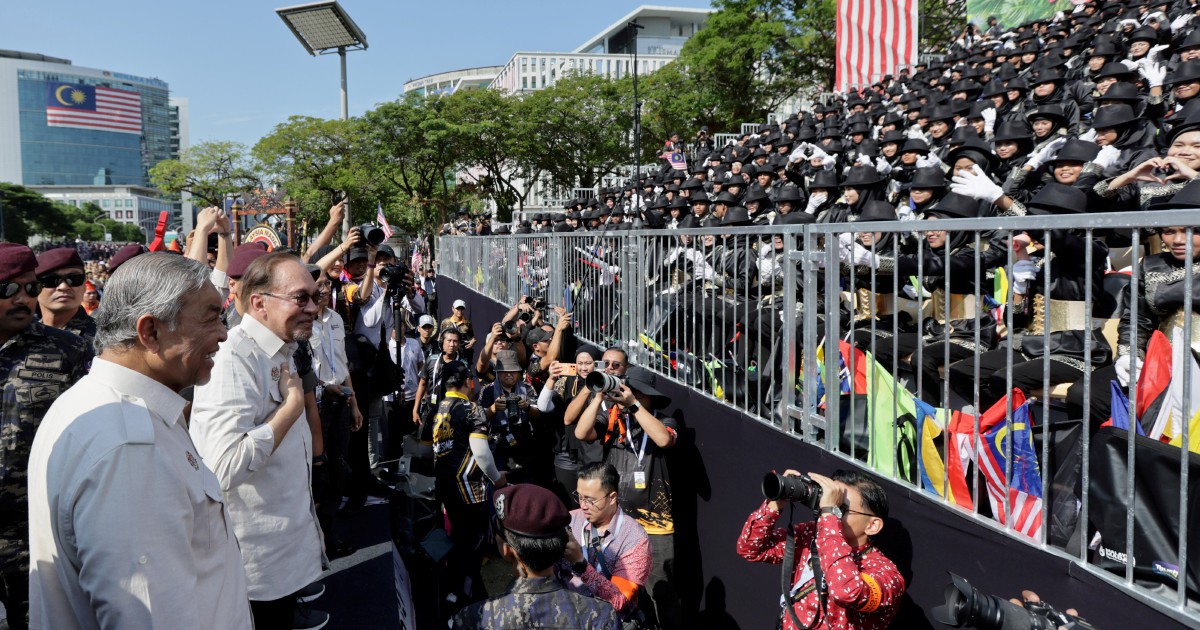
Prime Minister Datuk Seri Anwar Ibrahim demonstrated accessibility and warmth towards ordinary Malaysians during an unscheduled walkabout at Dataran Putrajaya today, breaking from formal protocol to spend considerable time engaging directly with parade attendees and well-wishers. Following the conclusion of the main National Day parade proceedings, the premier chose to move through the crowd rather than depart immediately, initiating conversations and physical embraces with numerous children he encountered along the route.
The impromptu public interaction underscores a deliberate approach to political engagement that characterises much of Anwar's tenure since assuming office. Rather than maintain the distance typical of high office, the Prime Minister repeatedly paused his progression through the gathered crowds to acknowledge individual citizens, demonstrating a commitment to direct democratic connection that resonates with voters accustomed to more formal and distant leadership styles.
Such moments carry particular significance in Malaysia's political landscape, where public perception of leadership accessibility influences electoral dynamics and public trust. Anwar's willingness to engage spontaneously with ordinary families, particularly children, reinforces messaging around his administration's people-centric governance philosophy. The visual symbolism of a sitting prime minister kneeling or bending to embrace young citizens during national celebrations communicates approachability and validates citizens' sense of belonging within the national narrative.
The National Day parade at Dataran Putrajaya represents one of Malaysia's most significant annual civic events, drawing together citizens from diverse backgrounds to commemorate national independence. The prime minister's participation in post-parade festivities extends the celebratory atmosphere beyond formal programme elements, transforming the occasion into genuine community engagement rather than a purely ceremonial exercise. This approach mirrors efforts across Southeast Asian democracies to humanise political leadership through authentic public interaction.
From a strategic communication perspective, such unscripted moments often carry greater credibility with citizens than prepared remarks or formal addresses. The spontaneity of Anwar's interactions—stopping unprompted to greet specific individuals—suggests genuine interest rather than calculated political performance. Media documentation of these exchanges through visual footage amplifies their reach beyond those physically present at Dataran Putrajaya, extending the human connection narrative across national and social media platforms.
Children feature prominently in such interactions because encounters between political leaders and young citizens carry symbolic weight within democratic societies. These moments communicate messages about investment in future generations and national cohesion to broader audiences observing the interactions. Parents and extended family members who witness their children embraced by the prime minister become emotionally invested stakeholders in national governance narratives, strengthening affective bonds between leadership and electorate.
The setting of Dataran Putrajaya, Malaysia's administrative capital, adds another layer to these interactions. The location itself represents institutional power and state authority, yet Anwar's decision to step beyond ceremonial barriers and engage personally with the crowd reconfigures the symbolic geography of power. Rather than remaining isolated within formal protocols, the prime minister integrated himself into the festive atmosphere, temporarily dissolving hierarchical boundaries that typically define prime ministerial public appearances.
Such engagement patterns reflect broader trends in democratic politics where leaders increasingly recognise the political and social value of authentic connection. In the Malaysian context, where regional variations, ethnic diversity, and socioeconomic disparities can create distance between government and constituencies, direct personal interaction serves valuable reconciliatory functions. Anwar's approach suggests an understanding that governance effectiveness depends partly on emotional resonance and perceived trustworthiness rather than purely institutional authority.
The National Day celebrations themselves provide optimal occasions for such political theatre because patriotic sentiment creates favorable conditions for leadership visibility and positive public reception. Citizens attending national commemorative events arrive psychologically primed for expressions of national unity and collective pride, making them more receptive to political messaging embedded within celebratory contexts. Anwar's embrace of this opportunity demonstrates sophisticated understanding of how symbolic occasions can reinforce political positioning.
For Malaysian observers accustomed to more reserved or hierarchical approaches to political leadership, such displays of warmth and accessibility mark a notable shift in prime ministerial comportment. Whether viewed as genuine reflection of Anwar's personal disposition or strategic deployment of humanising political tactics, these interactions shape public perception of his administration's character and governing philosophy. Subsequent amplification through broadcast media and social networks extends their influence far beyond the immediate Dataran Putrajaya audience.
The recurring nature of these unscheduled public engagements throughout Anwar's tenure suggests consistency rather than isolated occurrence, reinforcing perceptions of leadership style and governmental approach. Citizens who observe such interactions develop impressions about prime ministerial availability and receptiveness to public concerns, which subsequently influences their voting preferences and assessments of government legitimacy. These seemingly informal moments thus acquire significant political consequence.
As Malaysia continues navigating complex questions regarding economic development, social cohesion, and political polarisation, leadership expressions of unity and personal connection carry amplified meaning. Anwar's post-parade interactions at Dataran Putrajaya contribute incrementally to broader political narratives around his administration's vision for inclusive, connected governance that transcends traditional barriers between state apparatus and ordinary citizens.

